Camping offers something that can be surprisingly difficult to find in everyday life: a chance to get away from constant screens, wireless connections, chargers, notifications, and electronic devices. Yet modern camping trips can still involve smartphones, smartwatches, Bluetooth speakers, portable power stations, tablets, GPS devices, and even campground Wi-Fi. Low EMF camping is a practical approach to simplifying this electronic environment while still keeping the technology that makes your trip safer and more enjoyable.
The idea isn’t that you need to eliminate every electromagnetic field around your campsite. That would neither be realistic nor necessary. Instead, you can look at the sources you control, decide which electronics you actually need, create reasonable distance from them, and switch off wireless functions when they aren’t being used.
In many cases, this doesn’t require buying specialized equipment. Some of the most practical changes involve nothing more than choosing where you pitch your tent, changing a few phone settings, and leaving unnecessary electronics at home.
What Does Low EMF Camping Actually Mean?
Electromagnetic fields aren’t a single type of exposure. The term EMF encompasses different portions of the electromagnetic spectrum, and the sources around a campsite can vary considerably depending on where you’re staying and what equipment you’re using.
Radiofrequency, or RF, energy is associated with wireless communications such as cellular signals, Wi-Fi, and Bluetooth. A smartphone, cellular-enabled smartwatch, portable hotspot, or Bluetooth speaker can therefore be an RF source.
Electric and magnetic fields are associated with electricity and electrical equipment. At a primitive tent site without electricity, there may be relatively few man-made electrical sources nearby. At an RV campground, however, electrical hookups, internal RV wiring, appliances, chargers, inverters, and other equipment can create a much different environment.
This is one reason there isn’t a single definition of a “low-EMF campsite.” A remote tent site and a fully equipped RV resort are very different situations.
A more useful way to think about the subject is to identify the electronic and electrical sources that are actually around you and decide whether they need to be there.
Choose Your Campsite With EMF in Mind
One advantage of camping is that you often have more control over your immediate surroundings than you do at home. If several campsites are available, location can be worth considering before you unpack all of your equipment.
A primitive campsite away from developed facilities may have fewer electrical and wireless sources nearby. A campsite beside a campground office, Wi-Fi access point, electrical distribution equipment, or a row of RV hookups may have more technology around it.
That doesn’t automatically make one campsite “safe” and another “unsafe.” It simply means the electronic environment can be different.
Distance is also important. The strength of electromagnetic fields generally decreases as you move farther from a source, although the exact relationship depends on the source and field type. Rather than worrying about creating a completely EMF-free campsite, think about whether you can create practical separation from sources you don’t need to be close to.
For example, if you have a choice between pitching your tent immediately beside electrical equipment or farther away, choosing the more distant location is a simple step that doesn’t interfere with the camping experience.
Cellular coverage is another consideration. Remote doesn’t necessarily mean there are no cellular signals. Towers can provide coverage over large areas, and many campgrounds advertise cellular service or Wi-Fi as an amenity.
For most campers, there is no need to choose a campsite solely based on EMF. Simply make the electronic environment one factor you consider along with safety, shade, terrain, proximity to bathrooms, privacy, and convenience.
Put Your Smartphone Into “Camping Mode”
Your phone may be one of the most useful pieces of equipment you bring camping. It can provide maps, weather information, emergency communication, a flashlight, a camera, and entertainment.
There is therefore little reason to leave it home simply because you’re trying to reduce unnecessary wireless use.
Instead, prepare the phone before your trip.
Download offline maps for the area where you’ll be camping. Save campground reservations and directions locally or take screenshots. Download music, podcasts, audiobooks, or movies beforehand rather than relying on streaming. You can also save important phone numbers and emergency information in advance.
Once you reach your campsite, consider turning off wireless functions that aren’t needed.
If you’re not using Bluetooth, turn it off. If there isn’t a Wi-Fi network you intend to use, Wi-Fi can be disabled. When you don’t need cellular communication, airplane mode can shut down several wireless transmitting functions at once, although the exact behavior can vary by phone and settings.
This is an especially easy habit to adopt overnight.
If you need your phone as an alarm clock, you can generally still use the alarm while the device is in airplane mode. Place the phone away from your head rather than sleeping with it underneath your pillow or directly beside your sleeping bag.
These small adjustments are at the heart of low EMF camping because they allow you to keep useful technology without having every wireless feature operating continuously.
Treat Your Tent Like a Low-Tech Bedroom
At home, many people have routers, televisions, chargers, smart speakers, tablets, phones, and other electronics in or near the bedroom.
Camping provides an opportunity to create something very different.
Your tent can remain primarily a place for sleeping rather than becoming a miniature version of your bedroom at home.
You don’t necessarily need to ban electronics from the tent. There may be good reasons to keep your phone accessible, particularly if you are camping somewhere remote. Instead, focus on positioning and necessity.
Avoid placing a charging phone immediately beside your head if it could easily be several feet away. Don’t stack tablets, power banks, smartwatches, Bluetooth speakers, and phones next to your sleeping bag simply because that’s the most convenient location.
If you have electronics that aren’t needed overnight, switch them off.
You can also designate one section of your campsite as the place where electronics and charging equipment are kept. Depending on weather, wildlife, security, and the type of equipment involved, that might be a vehicle, RV storage area, covered table, or another protected location.
The goal isn’t to make your sleeping area perfectly free of electromagnetic fields. It’s simply to avoid surrounding yourself with unnecessary electronics when you’re trying to sleep.
Decide Which Electronics Are Actually Worth Bringing
Camping gear has become increasingly technological. There are Bluetooth lanterns, app-controlled coolers, GPS watches, wireless speakers, smart lighting systems, tablets, cellular hotspots, portable televisions, and numerous other connected products designed for outdoor use.
Some can be useful. Others may simply reproduce the same connected environment you were hoping to escape.
Before packing, ask yourself whether each electronic device will meaningfully improve your trip.
A dedicated flashlight doesn’t require Wi-Fi. A paperback doesn’t need a charger. A standard wristwatch doesn’t require Bluetooth. A deck of cards never needs a software update.
This doesn’t mean that traditional equipment is always better. A GPS device can be extremely valuable for backcountry travel. A phone can provide emergency communication. A weather radio can deliver important information. Rechargeable lights can be more practical than carrying disposable batteries.
The point is to be selective rather than automatically bringing every device you normally use at home.
If you’re taking a three-day camping trip and don’t expect to work, perhaps the laptop can stay home. If you’re camping with friends or family, maybe you don’t need everyone streaming entertainment individually.
Reducing electronics can simplify your campsite while also reducing the number of batteries, chargers, cables, and power sources you have to manage.
Think About Power Banks, Solar Generators, and Inverters
Portable electricity has changed camping significantly.
A small USB battery can keep a phone charged for several days. Larger portable power stations can operate lights, refrigerators, laptops, fans, medical equipment, and even some appliances. Solar panels can replenish those batteries during extended trips.
These products can be extremely useful, but they also introduce additional electrical equipment into the campsite.
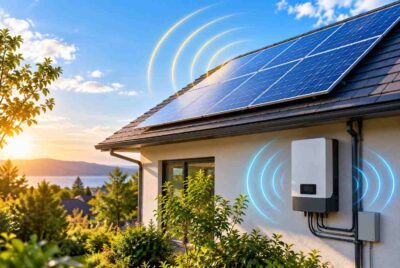
Portable power stations may contain batteries, charging electronics, AC inverters, and other electrical components. Solar setups can include panels, wiring, charge controllers, batteries, and inverters. RV systems can be considerably more complex.
You don’t necessarily need to avoid this equipment. Instead, think about where you place it.
If a portable power station can sit several feet away from where you sleep rather than immediately beside your pillow, there is little reason not to create that additional distance. Similarly, charging stations can be positioned away from sleeping and seating areas when practical.
Keep safety considerations first. Power equipment should always be used according to the manufacturer’s instructions, protected appropriately from weather, and positioned where it won’t create a tripping, fire, ventilation, or water hazard.
It is also important not to lump solar panels, batteries, and inverters together as if they’re identical EMF sources. Different components operate differently, and field strength can depend on the equipment, load, wiring, distance, and operating conditions.
If you use substantial electrical equipment while camping and want to know what’s happening around it, measurement is more useful than guessing.
Consider Measuring Your Campsite
An EMF meter is one of the few products that fits naturally into this subject because it can help answer a practical question: where are the measurable fields actually coming from?
Rather than assuming that a particular location or device is producing high levels, you can take measurements.
For example, you could compare readings near a portable power station with readings several feet away. You could check different locations inside an RV, around an electrical hookup, near charging equipment, or in several potential locations for your tent.
A meter can also help distinguish between different sources. However, it is important to understand what your meter measures. Some meters measure RF radiation, while others measure electric and magnetic fields. Combination meters may measure multiple types.
If you’re interested in purchasing a meter, Safe Living Technologies EMF Meters can be viewed through the company’s official meter collection here:
An EMF meter isn’t essential camping equipment. If your primary strategy is simply using fewer electronics and creating distance from the devices you do bring, you may have no need for one.
For someone who enjoys measuring and comparing the environment, however, a meter can provide more useful information than relying on assumptions about which equipment produces the strongest fields.
Tent Camping and RV Camping Can Be Very Different
The term “camping” covers everything from sleeping under a tarp in the wilderness to staying in a luxury motorhome equipped with televisions, air conditioning, Wi-Fi, satellite equipment, and a full electrical system.
For that reason, reducing unnecessary electronic exposure looks different depending on how you camp.
Tent Camping
A basic tent campsite can be remarkably simple from an electronics perspective.
If there is no electrical hookup and you bring only a phone, flashlight, and small power bank, there may be relatively few electrical devices around your sleeping area.
Your main considerations are likely to be your own wireless devices and whatever infrastructure exists around the campground.
This makes tent camping particularly well suited to a lower-tech approach.
RV Camping
An RV is essentially a small mobile home, so there can be far more equipment to consider.
Depending on the RV, you may have shore power, extensive electrical wiring, an inverter, batteries, solar equipment, a television, microwave, refrigerator, Wi-Fi equipment, cellular boosters, smart devices, and multiple chargers.
You may also be parked relatively close to neighboring RVs containing their own electronics.
That doesn’t mean RV camping can’t be part of a low EMF camping approach. It simply requires looking at more potential sources.
One useful strategy is to identify where major electrical equipment is located relative to the bed and seating areas. Batteries, inverters, electrical panels, routers, and cellular equipment don’t necessarily need to be positioned close to places where you spend long periods if your RV layout gives you other options.
Wireless features can also be disabled when they aren’t being used.
Again, measurement can be helpful because every RV layout is different.
Pay Attention to the Campground, Not Just Your Equipment
It’s easy to focus entirely on what you’ve packed and forget that a developed campground has its own infrastructure.
Many modern campgrounds provide Wi-Fi, electrical hookups, laundry facilities, vending machines, offices, bathhouses, lighting, security systems, and other electrical equipment.
RV parks can have electrical pedestals at nearly every site.
Some campers also use cellular boosters and personal Wi-Fi hotspots.
You can’t control everything your neighbors use, nor is there much benefit in spending your vacation worrying about every electronic device in the campground.
Instead, concentrate on the things you can reasonably control.
If you have multiple sites to choose from, look at what’s immediately around each one. If you aren’t going to use campground Wi-Fi, you don’t necessarily need the campsite closest to the access point. If electrical equipment is located at one edge of a site, you may be able to position your tent or seating area elsewhere.
Small placement decisions can often accomplish more than complicated solutions.
Create a Simple Low-EMF Camping Checklist
Planning before you leave home makes it much easier to keep your campsite simple. Instead of arriving with a vehicle full of connected devices and deciding what to do with them afterward, determine which technology you’ll actually need before packing. The following checklist can serve as a starting point rather than a rigid set of rules.
- Download maps before leaving home. Offline maps reduce your dependence on a cellular connection and can also be useful when camping in areas with poor reception.
- Save important information offline. Keep reservation details, campground maps, emergency information, addresses, and other important documents accessible without requiring Wi-Fi or cellular data.
- Turn off wireless features you aren’t using. Wi-Fi, Bluetooth, and cellular connectivity don’t necessarily need to operate continuously throughout the trip.
- Use airplane mode when appropriate. If you don’t need to receive calls or messages for a period of time, airplane mode provides an easy way to disable several wireless functions. Make sure doing so is appropriate for your safety and communication needs.
- Keep your phone away from your head while sleeping. If you’re using the phone as an alarm, place it farther from your pillow rather than directly beside your head.
- Leave unnecessary electronics at home. Every device you don’t bring is one less device to charge, store, protect, and think about.
- Position charging equipment thoughtfully. Power banks, charging stations, inverters, and portable power stations generally don’t need to sit immediately beside sleeping or relaxation areas.
- Consider the surrounding campground infrastructure. Wi-Fi equipment, electrical pedestals, and other installations can influence where you choose to position your tent or spend your time.
- Measure when you want specific answers. If you’re concerned about a particular device or location, an appropriate EMF meter can provide information specific to your campsite.
- Keep the subject in perspective. Camping should still be enjoyable. The objective is to make simple, practical choices rather than spend your entire trip searching for electromagnetic fields.
You don’t have to follow every suggestion on every trip. Someone camping deep in the backcountry will have different priorities than a family spending a week at a full-service RV resort.
Do You Need EMF Protection Products While Camping?
Probably not in many situations.
That’s worth saying because reducing unnecessary electronic exposure doesn’t automatically require purchasing shielding products.
Consider the simplest options first.
Can you turn the device off?
Can you disable the wireless connection?
Can you move it farther away?
Can you leave it home?
Can you choose a different location for your tent or sleeping area?
If the answer to one of those questions is yes, you may already have a practical solution.
Products can make sense when they address a specific need. An EMF meter, for example, has an obvious purpose if you want to measure fields around your campsite. Other products should be evaluated according to what they actually do and whether they solve a problem you genuinely have.
Be particularly cautious about products marketed with sweeping promises to “eliminate,” “neutralize,” or completely protect you from all EMF. Different types of electromagnetic fields behave differently, and product claims should be evaluated carefully.
For many campers, the best low-EMF setup may also be the cheapest one: fewer devices, fewer connections, and more distance.
Affiliate Advertisement

Can You Have an EMF-Free Camping Trip?
“EMF-free” isn’t a particularly useful goal.
Electromagnetic fields occur naturally. The Earth has a magnetic field, visible light is part of the electromagnetic spectrum, and electromagnetic energy exists throughout our environment.
Man-made signals can also travel substantial distances. A remote campsite may still receive cellular, radio, television, satellite, or other signals.
A better objective is reducing unnecessary exposure from sources you can control.
That distinction changes the entire approach.
Instead of trying to make your tent an impenetrable bubble, you can simply stop sleeping next to an actively connected phone when you don’t need to. Instead of worrying about every distant cellular tower, you can decide whether you need your Bluetooth speaker operating all afternoon.
Practical changes are easier to maintain because they don’t interfere with the reason you went camping in the first place.
Don’t Sacrifice Safety to Reduce EMF
Any discussion of minimizing electronics while camping should include an important qualification: safety comes first.
There are situations where cellular communication, GPS equipment, emergency beacons, weather radios, navigation devices, or other electronics can be extremely important.
If you’re hiking into remote terrain, don’t disable or leave behind essential safety equipment simply to reduce electronic exposure.
Tell someone where you’re going. Bring appropriate navigation equipment. Monitor severe weather when necessary. Keep sufficient battery capacity for emergency communications. Follow campground and wilderness safety recommendations.
If you need your phone turned on because you’re expecting an emergency call or because it’s your primary means of communication, keep it on.
Reducing unnecessary technology is very different from removing useful safety equipment.
The Unexpected Benefit: A Simpler Camping Trip
There is another reason to experiment with a lower-tech campsite that has nothing to do with EMF measurements.
Camping can be an opportunity to disconnect.
When the Bluetooth speaker stays home, you may hear birds instead. When the tablet isn’t sitting on the picnic table, you may spend more time talking with the people around you. When your phone is in airplane mode, there are fewer notifications competing with the reason you traveled into the woods in the first place.
There are practical benefits, too.
Fewer electronics mean fewer charging cables, fewer batteries to monitor, fewer expensive devices that can be damaged by rain, and less equipment to pack.
You may also find that you need a smaller portable power supply because you aren’t charging half a dozen devices every day.
Sometimes the easiest way to reduce technology is simply to discover that you didn’t need as much of it as you thought.
Conclusion
Camping already provides one of the easiest opportunities to step away from the heavily connected environment of everyday life. You don’t need to turn the experience into an exercise in avoiding every possible electromagnetic field, and you certainly don’t need to fill your backpack with specialized products.
A practical low EMF camping strategy can be much simpler. Bring the electronics that serve a genuine purpose. Turn off wireless functions when you aren’t using them. Create distance between electrical equipment and sleeping areas when practical. Consider the infrastructure around your campsite, and use measurement if you want to understand a particular source more clearly.
Most importantly, keep the subject in perspective. The goal isn’t to spend your vacation thinking about technology and EMF every minute.
It’s almost the opposite.
With fewer devices operating around you, camping can become what many people wanted it to be in the first place: a chance to spend less time connected to electronics and more time connected to the outdoors.
Before You Go…
Get Weekly EMF Protection Tips
Enjoy this article? Join the EMFLuLu newsletter for simple weekly tips to reduce everyday EMF exposure from phones, WiFi routers, laptops, and smart home devices.
Try Our Free EMF Calculators
Curious how much EMF exposure you may experience each day?
These simple tools can help you estimate your exposure and identify possible problem areas in your home.
Try these free calculators:
Like this article? Pin it on Pinterest!

More to Explore