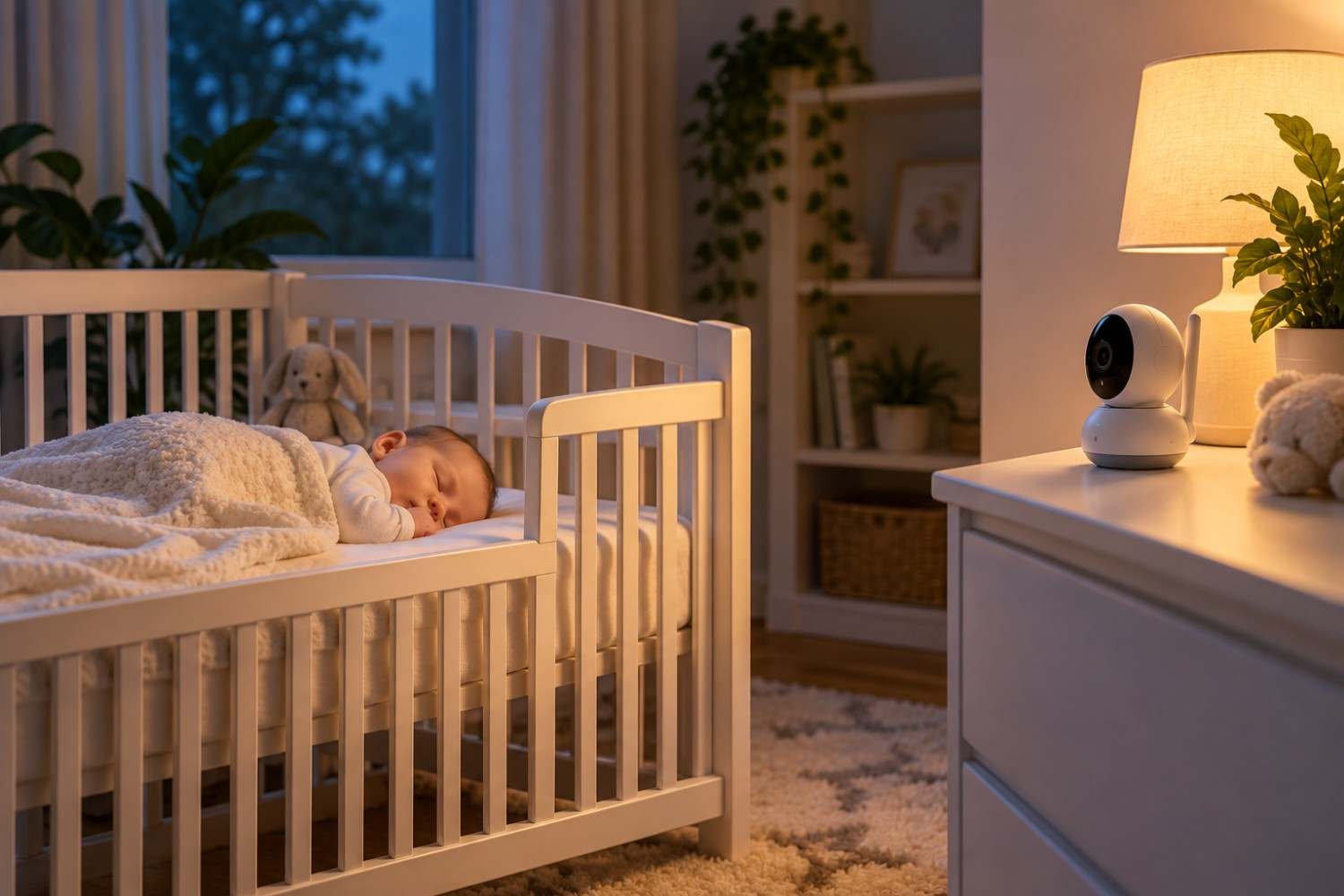
Baby monitors provide peace of mind for parents, allowing them to check on their sleeping baby without constantly entering the nursery. Whether you use a traditional audio monitor, a digital video monitor, or a WiFi-connected camera, these devices make it easier to hear and see what is happening in your child’s room. However, as wireless technology becomes more common in nurseries, some parents are beginning to wonder about baby monitor EMF and whether placing a monitor too close to a crib could increase their child’s exposure to electromagnetic fields.
Baby monitors use different technologies to transmit sound and video, and many wireless models produce radiofrequency (RF) electromagnetic energy during operation. While RF energy is a normal part of modern wireless communication, parents may reasonably want to understand how these devices work and whether their placement makes a difference.
The good news is that creating a practical nursery setup does not require eliminating every electronic device or purchasing expensive protective equipment. Understanding the differences between monitor types, maintaining a reasonable distance from the crib, and following basic safety recommendations can help parents make informed decisions.
In this article, we’ll explain what electromagnetic fields baby monitors produce, how distance affects exposure, where to position a monitor, and what parents should know about the scientific research. We’ll also discuss common placement mistakes and simple ways to reduce unnecessary exposure without sacrificing the convenience of monitoring your baby.
What Is Baby Monitor EMF and How Does It Work?
Electromagnetic fields are produced by electrical equipment and wireless communication systems. They are present around many devices used in everyday life, including smartphones, WiFi routers, televisions, household wiring, and baby monitors.
The type of electromagnetic field produced by a baby monitor depends on its design and how it communicates with the receiving device.
Most modern wireless baby monitors transmit information using radiofrequency signals. These signals carry sound, video, or both from a transmitter in the nursery to a receiver elsewhere in the home. Some monitors connect directly to a dedicated parent unit, while others use a home’s WiFi network to send video to a smartphone or tablet.
Radiofrequency energy is classified as non-ionizing radiation. Unlike ionizing radiation, such as X-rays, RF energy does not have enough energy per photon to remove tightly bound electrons from atoms or directly damage DNA through ionization.
This distinction is important because the word “radiation” can sound alarming even though it describes several very different physical phenomena.
Radiofrequency EMF vs. Low-Frequency Electromagnetic Fields
Baby monitors can produce more than one type of electromagnetic field.
Wireless transmission generally involves radiofrequency energy, which allows the monitor to communicate with another device. The strength of the signal and the amount of exposure at a particular location depend on factors such as transmission power, antenna characteristics, operating mode, and distance.
The electrical components inside a monitor and its power supply may also produce lower-frequency electric and magnetic fields associated with electricity.
These are different types of exposure, and they should not be treated as interchangeable.
For example, a wireless monitor might continue transmitting RF signals even when its video display is turned off. Meanwhile, a monitor connected to an electrical outlet may produce low-frequency fields around its power adapter and wiring.
Understanding these differences helps explain why monitor placement and device settings can influence exposure.
How Far Should a Baby Monitor Be From a Crib?
One of the most common questions parents ask is how far a baby monitor should be positioned from their sleeping child.
The first consideration should always be physical safety, particularly the risk posed by electrical cords.
The U.S. Consumer Product Safety Commission (CPSC) advises parents to keep baby monitor cords and all monitor parts at least three feet away from children. This recommendation is intended to prevent strangulation and other physical hazards.
Importantly, three feet is a cord-safety recommendation, not a scientifically established safe distance for electromagnetic exposure.
From an EMF perspective, increasing the distance between a wireless transmitter and a person generally reduces exposure. However, the relationship depends on the monitor’s antenna, transmission characteristics, and surrounding environment.
There is no universally established distance at which every baby monitor becomes completely free of RF exposure.
For parents who want to minimize unnecessary exposure, positioning the monitor farther away than the minimum physical safety distance can be a reasonable precaution, provided the camera or microphone still functions effectively.
For example, a monitor placed on a stable shelf across the nursery may provide a clear view of the crib while keeping the transmitting device and its power cord away from the baby’s sleeping area.
The goal is not to find a magical distance that guarantees zero exposure. Instead, it is to create a sensible balance between monitoring performance, physical safety, and unnecessary proximity to electronic equipment.
Placing a Baby Monitor on a Dresser
A dresser can be a convenient location for a baby monitor, especially when it provides a clear view of the crib.
However, parents should consider the distance between the dresser and the sleeping area, whether the monitor can be knocked over, and whether its cord could become accessible as the child grows.
A monitor placed on a dresser should be positioned securely, away from the edge, with its cord routed safely and completely out of the child’s reach.
If the dresser is directly beside the crib, a different location may be preferable.
Wall-Mounting a Baby Monitor
Wall mounting is another option, particularly for video monitors that need an elevated view of the crib.
A properly installed wall mount may allow parents to position the camera farther from the sleeping area while maintaining a useful viewing angle.
However, mounting a camera high on the wall does not automatically make it safe.
Power cords must still be secured and kept inaccessible, and the mounting hardware must be appropriate for the device and wall surface.
Parents should follow the manufacturer’s installation instructions rather than improvising with tape, loose hooks, or unstable mounting accessories.
Should a Baby Monitor Be Attached to the Crib?
Attaching a monitor directly to a crib may seem convenient because it provides a close view of the baby. However, this arrangement can introduce unnecessary safety concerns.
A device attached to the crib may become accessible to a growing child, and any attached cable could create a strangulation hazard.
Even battery-powered devices without external cords should not be placed inside the crib or attached in a way that allows the child to grab or dislodge them.
A separate, securely positioned location away from the crib is generally a better choice.
Do WiFi and Non-WiFi Baby Monitors Produce Different EMF Levels?
Not all baby monitors communicate in the same way, and understanding these differences can help parents choose a device that fits their needs.
Some monitors use WiFi to connect to a home network, while others use dedicated radio connections between the nursery unit and a parent receiver. Traditional audio monitors may use still other wireless technologies.
All wireless models can produce radiofrequency emissions, but the amount and pattern of transmission vary considerably.
The following comparison highlights the main differences between common monitor types.
| Monitor Type | How It Works | EMF Considerations |
| WiFi video monitor | Connects through a wireless network | RF emissions depend on transmission activity, power, and design |
| Non-WiFi digital video monitor | Uses a dedicated wireless connection | Still produces RF energy even without WiFi |
| Audio-only wireless monitor | Transmits sound to a receiver | RF activity varies by model and operating mode |
| Wired monitoring system | Uses a physical cable for communication | Avoids RF transmission for that connection, although other electrical fields may remain |
Are Non-WiFi Baby Monitors Lower in EMF?
It is tempting to assume that a monitor without WiFi automatically produces less electromagnetic exposure.
However, that is not necessarily true.
A non-WiFi digital monitor still needs to transmit information wirelessly between the nursery and parent units. Depending on its design, it may transmit frequently or continuously.
Similarly, a WiFi monitor may adjust its transmission activity based on movement, sound, video streaming, and other operating conditions.
A monitor’s wireless technology alone does not tell you how much RF exposure it produces.
Parents interested in comparing devices should look at manufacturer specifications, transmission modes, and credible testing information rather than relying solely on labels such as “low radiation” or “WiFi-free.”
Do Audio-Only Monitors Produce Less EMF?
Audio-only monitors transmit less information than video monitors, but that does not automatically mean they produce less RF exposure.
An audio monitor with voice activation may transmit only when it detects sound, while another model might maintain an active connection throughout the night.
Video monitors may also use power-saving or voice-activated modes that change how frequently they transmit.
For parents who do not need video monitoring, an audio-only monitor may still be a practical choice because it offers simpler functionality and may have fewer unnecessary features.
The most useful comparison is between specific devices and their operating modes rather than broad product categories.
Is Baby Monitor EMF Harmful to Infants?
Parents naturally want to minimize avoidable risks in their baby’s environment. However, discussions about electromagnetic exposure should distinguish established scientific findings from uncertainties and personal precautionary choices.
Wireless baby monitors emit non-ionizing RF energy. At sufficiently high exposure levels, radiofrequency energy can produce heating effects in biological tissue.
Safety standards for RF-emitting devices are designed to limit exposure and protect against established adverse effects.
Current scientific evidence has not established that ordinary exposure from compliant baby monitors causes health problems in infants. However, research specifically examining long-term exposure from baby monitors in infants is limited.
This means it would be inaccurate to claim that baby monitors have been proven harmful. It would also be inappropriate to suggest that every possible long-term effect has been studied conclusively.
For families who prefer to take a precautionary approach, increasing distance and avoiding unnecessary wireless transmission are practical options that generally do not interfere with normal monitoring.
Are Babies More Sensitive to Electromagnetic Fields?
Infants and young children differ from adults in body size, anatomy, and development. These differences are among the reasons researchers continue to examine how electromagnetic exposure interacts with the human body.
However, biological differences do not automatically establish that everyday baby monitor exposure causes injury or developmental problems.
The scientific evidence does not currently support claims that typical baby monitor exposure causes childhood cancer, developmental disorders, or other specific diseases.
Parents should be cautious about websites or product advertisements that present these outcomes as established facts without reliable supporting evidence.
It is also important to recognize that more immediate nursery hazards, such as accessible electrical cords, unstable equipment, and unsafe sleep environments, have clear and well-documented consequences.
Addressing those hazards should remain the first priority.
What Do Public Health Agencies Say?
Organizations such as the U.S. Food and Drug Administration (FDA), Federal Communications Commission (FCC), and World Health Organization (WHO) provide information about radiofrequency exposure and wireless technology.
Their guidance generally distinguishes between established effects from sufficiently high RF exposure and questions about possible effects from lower-level exposure.
Parents can consult these organizations for broader information about wireless radiation, safety standards, and the state of scientific research.
For nursery safety, the CPSC and the American Academy of Pediatrics provide particularly important guidance about monitor cords and safe infant sleeping environments.
A balanced approach combines established physical safety recommendations with reasonable personal choices about electronic device placement.
Seven Practical Ways to Reduce Baby Monitor EMF Exposure
If you are concerned about baby monitor EMF, there are several straightforward ways to reduce unnecessary exposure without giving up the convenience of a monitor.
Most of these adjustments involve where equipment is positioned, how it operates, and whether certain features are needed. They do not require specialized accessories or expensive protective products.
The following seven strategies can help parents create a practical monitoring arrangement while keeping physical safety at the center of their decisions.
1. Increase the Distance Between the Monitor and Crib
Distance is one of the simplest factors parents can control.
When practical, position the transmitting monitor farther from the crib while maintaining a clear view or reliable audio connection.
A stable shelf or wall-mounted position across the nursery may work well.
Increasing distance generally reduces RF exposure from the transmitter, although the exact reduction depends on the equipment and room conditions.
Always maintain at least the CPSC-recommended three-foot separation for monitor parts and cords, and keep them completely inaccessible to the child.
2. Keep Power Cords Completely Out of Reach
Cord safety deserves special attention because monitor cords have been involved in infant strangulation incidents.
A cord can become dangerous if it hangs near the crib, runs along a reachable wall, or becomes accessible as a child grows.
Parents should route cords away from the sleeping area and secure them according to the manufacturer’s instructions.
A cord that appears inaccessible to a newborn may become reachable once the child begins sitting, standing, or climbing.
Periodically reassessing the setup is an important part of maintaining nursery safety.
3. Consider Voice-Activated or ECO Modes
Some baby monitors include voice-activated transmission, sometimes called VOX mode, or an energy-saving ECO mode.
Depending on the model, these features may reduce transmission activity when the nursery is quiet.
However, the term “ECO mode” does not have one universal technical meaning. Some devices reduce wireless activity, while others primarily dim the screen or conserve battery power.
Check the manufacturer’s documentation to understand exactly what the feature does.
If reduced transmission is important to you, look for clear explanations of whether the nursery unit stops transmitting, transmits intermittently, or maintains a continuous connection.
Also confirm that important sounds will still be detected reliably.
4. Choose Only the Monitoring Features You Need
Modern baby monitors can include high-definition video, motion detection, cloud recording, temperature monitoring, smartphone notifications, and two-way audio.
These features may be useful, but not every family needs all of them.
If your primary goal is simply to hear when your baby wakes, an audio-only monitor may be sufficient.
If you prefer to check your baby’s position visually, a video monitor may be more appropriate.
Choosing a device based on your actual monitoring needs can help avoid unnecessary complexity, although fewer features do not automatically guarantee lower RF emissions.
5. Reduce Unnecessary Wireless Devices Near the Crib
Baby monitors are not the only wireless devices that may be present in a nursery.
Parents sometimes keep smartphones, tablets, wireless speakers, and other connected equipment nearby.
If these devices are not needed close to the crib, consider placing them elsewhere.
This can simplify the nursery, reduce clutter, and potentially reduce nearby RF sources.
There is no need to remove every electronic device from the home. The goal is simply to avoid keeping unnecessary transmitting equipment immediately beside a sleeping child.
6. Turn Off Monitoring Equipment When It Is Not Needed
Some families use their baby monitors throughout the day and night, even when an adult is already in the nursery.
If monitoring is unnecessary, turning off the device can eliminate its active wireless transmission during that period.
However, parents should not turn off monitoring equipment when they rely on it to hear or observe their child from another room.
Monitoring reliability and the child’s needs should take priority over attempts to minimize exposure.
7. Follow the Manufacturer’s Instructions
Every monitor has its own installation requirements, wireless operating characteristics, and safety precautions.
Some manufacturers specify minimum separation distances for RF compliance, while others provide detailed recommendations about mounting, ventilation, power adapters, and cord placement.
Read the instructions before installing the monitor and check whether the manufacturer provides updated safety notices or recalls.
A properly installed monitor is more likely to function as intended and less likely to introduce preventable physical hazards.
Affiliate Advertisement

Common Baby Monitor Placement Mistakes to Avoid
Even a high-quality baby monitor can create problems if it is installed incorrectly.
Parents often focus on obtaining the best camera angle, but the safest location is not necessarily the one closest to the baby.
Before deciding where to position your monitor, consider several common mistakes that are worth avoiding.
Placing the monitor inside the crib: Electronic equipment should not be placed in the baby’s sleep space. The crib should remain free of unnecessary objects, consistent with safe sleep recommendations.
Leaving cords hanging near the crib: Loose cords can create serious strangulation hazards, even when the monitor itself appears to be positioned safely.
Using an unstable mounting arrangement: Cameras balanced on narrow shelves or attached with unsuitable hardware may fall into the crib or onto nearby furniture.
Positioning the monitor directly above the baby: A device mounted directly over the crib may introduce a falling-object hazard if the installation fails. A safer location should be chosen according to the manufacturer’s mounting instructions.
Assuming a wireless monitor is completely free of physical hazards: Even wireless models may require power cords, adapters, batteries, or mounting equipment.
A well-planned nursery should prioritize safe sleep, secure equipment, and reliable monitoring before concerns about electromagnetic exposure.
Should You Measure EMF Levels in Your Baby’s Nursery?
Some parents consider using an EMF meter to compare electromagnetic field levels around their baby’s crib.
An appropriate meter may provide useful information about certain types of electromagnetic fields, but its capabilities depend heavily on the device.
For example, a meter designed to measure low-frequency magnetic fields may not detect the radiofrequency signals produced by a wireless baby monitor.
Similarly, a basic RF meter may not accurately capture brief transmission bursts or measure every frequency used by modern wireless devices.
Measurements can also change depending on where the meter is positioned, nearby reflective surfaces, other transmitting devices, and the monitor’s operating mode.
For parents who are curious, measurements taken at different locations may help illustrate how readings vary with placement.
However, consumer EMF meters should not be treated as medical diagnostic tools. A reading alone cannot establish whether an infant’s environment is safe or unsafe.
You also do not need to purchase an EMF meter to follow basic nursery precautions.
Keeping equipment and cords away from the crib, following installation instructions, and choosing practical device settings are useful steps regardless of whether measurements are available.
Frequently Asked Questions About Baby Monitor EMF
Parents often have additional questions after choosing a monitor or deciding where to install one. The following answers address several common concerns about placement, wireless transmission, and everyday use.
Can a Baby Monitor Be Placed Six Feet From a Crib?
Yes. A baby monitor can often be placed six feet from a crib, provided it maintains a reliable connection and an appropriate camera angle or microphone range.
Six feet is not a scientifically established EMF safety threshold, but increasing distance from a wireless transmitter generally reduces exposure.
The monitor should also be securely positioned, with all cords inaccessible to the child.
Do Non-WiFi Baby Monitors Emit Radiation?
Yes. Most non-WiFi wireless baby monitors use radiofrequency signals to communicate with their dedicated receivers.
Not using WiFi does not mean a device produces no electromagnetic emissions.
The type and amount of RF energy depend on the specific monitor and its operating characteristics.
Does Turning Off the Video Screen Stop EMF Transmission?
Not necessarily.
Many baby monitors continue transmitting information even when the parent unit’s screen is dark.
Some models have special modes that reduce transmission activity, but others maintain a continuous wireless connection.
Check the manufacturer’s instructions to determine how your monitor operates when its display is off.
Should Parents Use an EMF Meter to Check a Nursery?
An EMF meter is optional, not a requirement for creating a safe nursery.
A suitable instrument can help compare certain field levels in different locations, but inexpensive meters may have significant limitations.
Parents should not interpret a single reading as proof of a health risk or as a guarantee of safety.
Is It Better to Use a Wired Baby Monitor?
A wired connection can eliminate the need for RF transmission over that particular communication link, but it does not necessarily eliminate all electromagnetic fields.
Wired equipment also introduces cables that must be managed carefully.
For most families, physical safety, monitoring reliability, and ease of installation are more important considerations than attempting to eliminate every source of electromagnetic energy.
Conclusion: Creating a Safer, More Practical Nursery Setup
Baby monitors are valuable tools that help parents stay connected to their children, but choosing the right location is an important part of using them responsibly.
When considering baby monitor EMF, remember that increasing distance from a wireless transmitter generally reduces exposure, while current scientific evidence has not established that ordinary exposure from compliant baby monitors causes harm to infants.
The most important precautions are straightforward: keep monitor parts and cords at least three feet away and completely out of reach, use secure mounting arrangements, and position equipment where it provides reliable monitoring without creating physical hazards.
Parents who want to take additional precautions can consider greater separation, suitable power-saving modes, and limiting unnecessary wireless devices near the sleeping area.
Ultimately, a safer nursery does not depend on eliminating technology or purchasing expensive protective accessories. It depends on understanding how your equipment works, following established safety guidance, and making practical decisions that support your baby’s comfort and well-being.
Before You Go…
Get Weekly EMF Protection Tips
Enjoy this article? Join the EMFLuLu newsletter for simple weekly tips to reduce everyday EMF exposure from phones, WiFi routers, laptops, and smart home devices.
Try Our Free EMF Calculators
Curious how much EMF exposure you may experience each day?
These simple tools can help you estimate your exposure and identify possible problem areas in your home.
Try these free calculators:
Like this article? Pin it on Pinterest!


More to Explore