Sleep is one of the most important parts of a healthy lifestyle. It is during sleep that your body repairs tissues, consolidates memories, regulates hormones, and prepares for the day ahead. While most people focus on comfortable mattresses, blackout curtains, or room temperature, many overlook the number of electronic devices that remain active throughout the night. Smartphones, tablets, Wi-Fi routers, smartwatches, Bluetooth accessories, and other connected technology have become permanent fixtures in many bedrooms.
An EMF sleep checklist can help you evaluate your bedroom and evening routine to identify simple changes that may reduce unnecessary exposure to electromagnetic fields (EMFs). The goal is not to create fear or suggest that every electronic device must be eliminated. Instead, it is about becoming more intentional with technology and making practical adjustments that fit your lifestyle.
The encouraging news is that many of the most effective changes cost little or nothing. Small habits, such as moving a charging phone farther from your bed or switching a device to airplane mode, can be easy additions to your nightly routine. As those habits become second nature, you may discover other opportunities to create a more relaxing and organized sleep environment.
Why Your Bedroom Is the Best Place to Start Reducing EMF Exposure
If you’re interested in reducing unnecessary EMF exposure, your bedroom is one of the easiest places to begin. Unlike your workplace, your commute, or public spaces where you have limited control over your surroundings, your bedroom is entirely within your control. Every improvement you make can be repeated every single night.
Think about how many hours you spend asleep each year. For most adults, that adds up to nearly one-third of life. Because sleep occupies such a significant portion of each day, even modest improvements to your nighttime environment become habits that continue to provide benefits over time.
Another advantage is that bedrooms tend to have fewer electronics than other areas of the home. While living rooms often contain televisions, gaming systems, streaming devices, and multiple smart home products, your bedroom may only have a handful of devices that need attention. That makes it easier to identify unnecessary electronics and simplify the space.
Many people also find that reducing clutter from technology naturally encourages better sleep habits. Removing distractions can make it easier to read a book before bed, practice relaxation exercises, or simply fall asleep without checking notifications one last time.
It is important to remember that an EMF-conscious bedroom is not about perfection. If you rely on your smartphone as an alarm clock or need certain devices nearby for practical reasons, that’s perfectly reasonable. The objective is simply to reduce unnecessary exposure where it is convenient to do so.
The Ultimate EMF Sleep Checklist
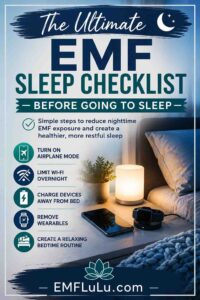
The checklist below is designed to be practical rather than overwhelming. You do not need to complete every item on your first night. Instead, consider choosing one or two changes each week until they become part of your normal routine. Over time, these small improvements can help create a bedroom that feels calmer, less cluttered, and more focused on rest.
Remember that every household is different. Some suggestions may be easy to implement immediately, while others may require compromise with family members or depend on your home’s layout. The important thing is to make informed choices that fit your needs.
Turn Airplane Mode On Before Bed
One of the simplest items on any nighttime checklist is switching your smartphone to airplane mode before going to sleep. Most modern phones continuously communicate with nearby cellular towers, Wi-Fi networks, and Bluetooth devices throughout the day. Airplane mode temporarily disables many of these wireless communication features with a single tap.
If you primarily use your phone as an alarm clock, airplane mode often allows the alarm to continue functioning normally while limiting wireless activity. You can test your specific phone during the day to verify that alarms still work as expected before relying on it overnight.
Many people also discover an unexpected benefit after making this change. Without incoming notifications, emails, text messages, or social media alerts arriving throughout the night, there is less temptation to check the phone during bedtime or immediately after waking.
If you prefer keeping your phone nearby, placing it in airplane mode can be one easy step toward creating a quieter sleeping environment.
If you’re looking for additional protection during the day while carrying your phone, DefenderShield EMF Radiation Protection Phone Cases are designed to help reduce exposure from the side of the phone facing your body while maintaining normal device functionality.
It’s important to remember that protective accessories work best alongside good habits such as maintaining distance and using airplane mode whenever practical.
Charge Devices Away from Your Bed
Many of us have developed the habit of plugging our phones into the charger on a nightstand only inches from our pillow. While this arrangement is certainly convenient, it isn’t always necessary.
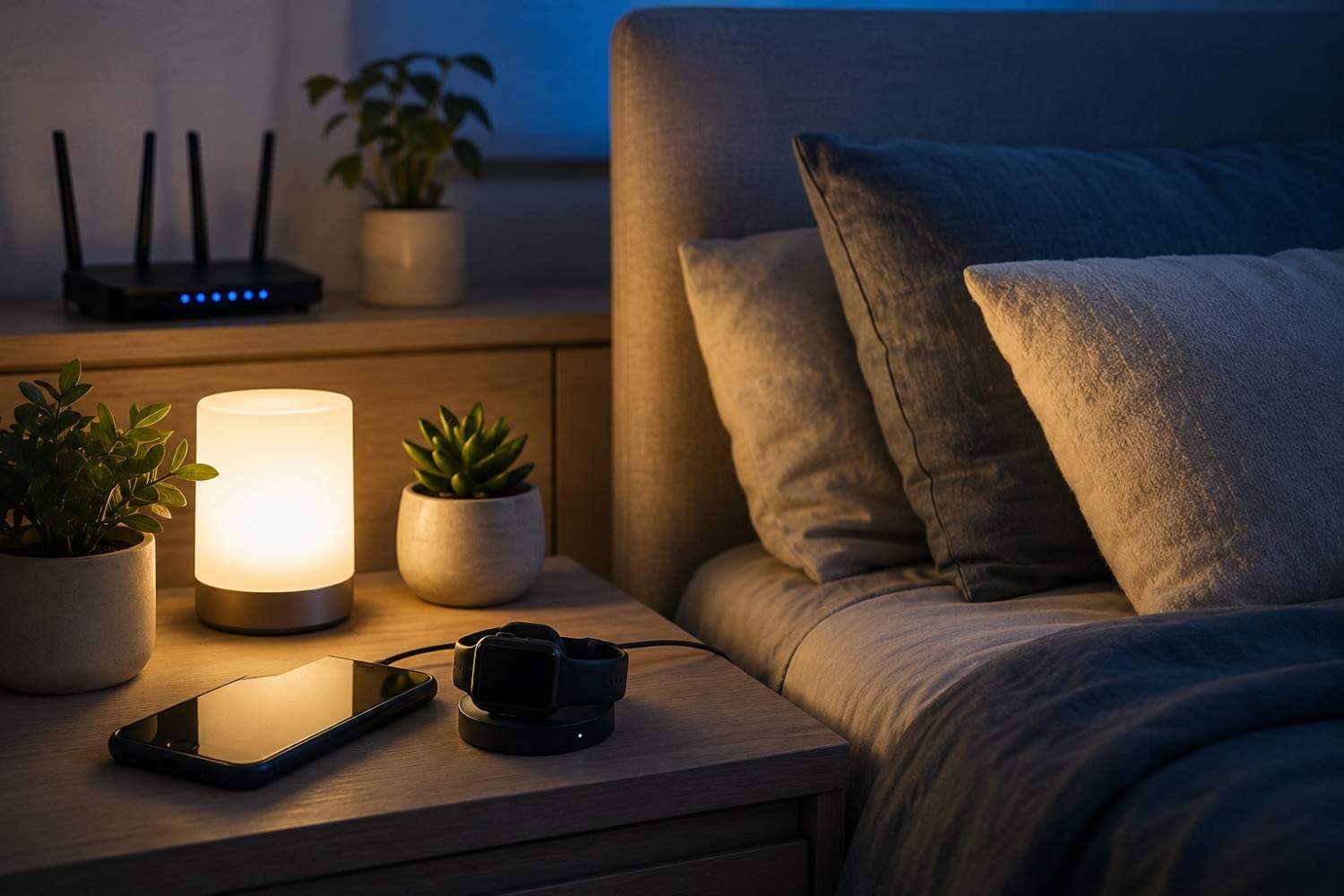
If possible, consider charging your phone on a dresser across the room instead of beside your bed. This simple adjustment increases the distance between you and the device during the night while also making it less likely that you’ll reach for your phone if you wake up.
The same idea applies to tablets, smartwatches, wireless earbuds, portable batteries, and laptops. If they don’t need to remain within arm’s reach overnight, relocating them to another part of the bedroom—or even another room—can help reduce clutter while encouraging healthier bedtime habits.
Moving chargers away from the bed has another practical advantage. Many people report spending less time scrolling through social media after the lights are out simply because their phone is no longer within easy reach.
If relocating your charging station requires a longer cable, choose a high-quality charging cable from a reputable manufacturer that meets your device’s specifications. Organizing cables neatly also reduces trip hazards and helps keep your bedroom looking tidy.
Turn Off Wi-Fi If Practical
For some households, turning off the Wi-Fi router before bed is a simple adjustment that fits naturally into the evening routine. For others, it may not be practical because of overnight security cameras, smart home devices, internet-connected appliances, or family members who work unusual hours.
If your household can comfortably disconnect Wi-Fi overnight, you may choose to switch off the router manually before going to bed and turn it back on in the morning. Some routers also allow scheduled shutoff times through their settings, while others can be connected to a programmable timer.
Using a timer means you don’t have to remember to turn the router off every evening. Once programmed, the schedule happens automatically.
One popular option is the BN-LINK Digital Programmable Timer (link to Amazon.com), which can automate devices that do not require power throughout the night.
Whether or not you decide to power down your router, it is generally a good idea to avoid placing it directly beside a bedroom wall where someone sleeps if there are other practical locations available within your home.
This section of the EMF sleep checklist is one that each family will approach differently. Convenience, household needs, and technology requirements all play a role in deciding what works best.
Remove Unnecessary Electronics from the Bedroom
One of the easiest improvements you can make requires no purchases at all. Simply look around your bedroom and ask yourself which electronic devices truly need to be there.
Over time, many bedrooms gradually accumulate old tablets, unused phones, Bluetooth speakers, gaming controllers, smart home hubs, portable chargers, extra charging cables, and electronic accessories that no longer serve a purpose. While each individual item may seem insignificant, together they contribute to unnecessary clutter and distractions.
Start by removing devices that you rarely use. If an old tablet hasn’t been touched in months, consider storing it in another room. If a Bluetooth speaker is only used occasionally, place it in your living room instead of your nightstand. Wireless earbuds can often be charged in a home office or kitchen rather than beside your bed.
As you simplify the room, you may notice that the space begins to feel more peaceful. Many people appreciate the cleaner appearance just as much as the reduced number of electronics.
This process also creates a good opportunity to organize charging cables, recycle outdated electronics responsibly, and eliminate items that simply collect dust.
The goal isn’t to create an empty bedroom. Instead, it’s about making your sleep environment primarily a place for rest rather than a storage area for technology.
Keep Smartwatches and Fitness Trackers Off While Sleeping
Wearable technology has become incredibly popular over the past decade. Smartwatches and fitness trackers can monitor heart rate, estimate sleep stages, count steps, and deliver notifications throughout the day. While these features are convenient, many people simply continue wearing the devices overnight out of habit.
If tracking your sleep is important to you, wearing a smartwatch at night may be worthwhile. However, if you only use it during the day, consider charging it overnight instead of wearing it while you sleep.
Many smartwatches communicate using Bluetooth and, depending on the model and settings, may also use Wi-Fi or cellular connections. If you choose to wear one while sleeping, explore the available settings. Some devices offer sleep modes or allow wireless features to be disabled during certain hours.
Charging your watch overnight on a dresser or desk instead of your bedside table is another simple adjustment that fits naturally into an evening routine. It also ensures the battery is ready for the following day.
The goal is not necessarily to stop using wearable technology but to think about when and where it is most useful. If it provides little benefit while you’re asleep, giving it a place to charge outside your immediate sleeping area may be worth considering.
Create More Distance Between Yourself and Electronics
One of the simplest concepts to understand when thinking about EMFs is distance. In many situations, increasing the distance between yourself and an electronic device can reduce your exposure.
Fortunately, this often requires nothing more than rearranging your room.
Take a moment to look around your bedroom. Is your phone sitting on the pillow beside you? Is a tablet resting on the nightstand only inches from your head? Is a wireless speaker directly behind your bed?
Moving these items even a few feet farther away is often easy and doesn’t interfere with your daily routine. A dresser across the room, a nearby shelf, or even a charging station outside the bedroom can all be practical alternatives.
Distance also encourages healthier bedtime habits. When your phone isn’t within arm’s reach, you’re less likely to check emails, browse social media, or watch videos after you’ve already decided it’s time to sleep.
This portion of your EMF sleep checklist doesn’t require buying new equipment or changing your lifestyle dramatically. It simply encourages you to be intentional about where electronics are placed during the hours you’re resting.
Avoid Sleeping with a Laptop Nearby
Laptops often become temporary fixtures in the bedroom. Maybe you answered a few emails before bed, watched a movie, or finished some work. Once you’re tired, it’s easy to close the lid and leave the computer on the nightstand until morning.
Instead, make it part of your nightly routine to return your laptop to a desk, home office, or another room when you’re finished using it.
Besides reducing bedroom clutter, this habit helps create a stronger mental separation between work and sleep. Many sleep experts recommend reserving the bedroom primarily for sleeping and relaxation whenever possible.
If your laptop must remain in the bedroom, avoid placing it on the bed or directly beside your pillow overnight. A desk or dresser several feet away is generally a more practical location.
Making this small change also reduces the chance of accidentally knocking the laptop onto the floor or damaging charging cables while sleeping.
Consider Wired Connections Whenever Practical
Wireless technology offers incredible convenience, but there are situations where a wired connection may work just as well—or even better.
For example, if your desktop computer never moves, using an Ethernet cable instead of Wi-Fi may provide a faster and more reliable internet connection. Likewise, wired headphones can be an excellent option for listening to relaxing music or guided meditation before bed without relying on Bluetooth.
You don’t have to eliminate wireless technology entirely. Instead, look for opportunities where wired alternatives naturally fit your routine.
A simple Ethernet cable is inexpensive, easy to install in many homes, and can provide a dependable internet connection for stationary devices.
One option to consider is a Cat6 Ethernet Cable (link to Amazon.com), available in various lengths to accommodate different room layouts.
Small adjustments like these often improve organization while reducing dependence on wireless connections where they aren’t necessary.
Check Where Extension Cords and Power Strips Are Located
Extension cords and power strips make it easy to power multiple devices, especially in bedrooms with limited electrical outlets. However, it’s worth taking a few minutes to evaluate where those cords are positioned.
Avoid routing extension cords underneath your mattress, pillow, or bedding. Besides being a general safety concern, this arrangement can trap heat and make inspecting cords more difficult.
Instead, keep cords visible and positioned where they won’t become tripping hazards. Cable organizers or simple Velcro cable ties can help keep everything neat without creating a tangled mess behind furniture.
If you discover old power strips with damaged cords or loose outlets, replacing them is a smart safety upgrade regardless of your interest in EMFs.
Keeping electrical equipment organized contributes to a cleaner, safer bedroom while making future maintenance much easier.
Create a Relaxing Bedtime Routine
An EMF-conscious bedroom isn’t only about electronics. Your nightly habits also play an important role in preparing your mind and body for sleep.
Many people have developed routines centered around screens. Watching television, scrolling through social media, reading emails, or answering messages often continues until the moment they try to fall asleep.
Replacing even part of that screen time with calming activities may help create a more peaceful transition into bedtime.
Some ideas include:
- Reading a printed book
- Journaling
- Gentle stretching
- Deep breathing exercises
- Meditation
- Prayer
- Listening to relaxing music
- Preparing for the following day
You don’t need an elaborate evening ritual. Even spending fifteen or twenty minutes away from screens before bed can help create a calmer atmosphere and encourage consistency.
Many readers find that this becomes one of the most valuable parts of their nighttime routine because it promotes relaxation regardless of their thoughts about EMF exposure.
Keep Your Bedroom Focused on Sleep
Bedrooms have slowly evolved into entertainment centers, offices, classrooms, and media rooms. While modern lifestyles sometimes make this unavoidable, creating boundaries can still be helpful.
Ask yourself whether every activity that currently happens in your bedroom truly needs to happen there.
Could you answer emails in your home office instead?
Could you watch television in the living room?
Could you finish work before entering the bedroom?
The fewer activities your brain associates with your bed, the easier it may become to view the bedroom primarily as a place to relax and sleep.
This mindset shift often leads to additional improvements naturally. People who stop working in bed frequently spend less time on their phones before sleeping. Those who move gaming systems into another room often find it easier to maintain a consistent bedtime.
Your bedroom doesn’t have to be perfect. It simply needs to support the primary purpose of helping you rest.
Affiliate Advertisement

Develop a Consistent Nightly Routine
One reason checklists are so effective is that they reduce the need to remember every small task individually. Pilots, surgeons, and engineers all rely on checklists because consistency helps prevent mistakes.
The same principle can apply to your bedtime routine.
Instead of wondering each night whether you’ve remembered everything, consider creating your own short routine that becomes automatic.
A typical evening might include:
- Plug in devices at a charging station away from the bed.
- Place your phone in airplane mode.
- Remove your smartwatch and place it on its charger.
- Make sure unnecessary electronics are turned off.
- Spend a few minutes reading instead of scrolling on your phone.
- Turn out the lights at approximately the same time each evening.
Over time, these actions require very little thought because they become habits rather than individual decisions.
A well-designed routine is often more sustainable than making large changes all at once. Small improvements repeated every night throughout the year can have a meaningful impact on how organized and relaxing your bedroom feels.
Common Bedroom EMF Mistakes
After learning about ways to simplify your nighttime routine, it helps to recognize some of the most common habits that people overlook. Many of these are easy to correct once you become aware of them. The goal isn’t to create a perfect bedroom overnight, but rather to identify opportunities for improvement.
Some of the most common bedroom habits include:
- Sleeping with a phone underneath the pillow or directly beside your head.
- Charging multiple electronic devices on the nightstand.
- Wearing a smartwatch all night when sleep tracking isn’t needed.
- Leaving Bluetooth enabled on devices that aren’t being used.
- Keeping an old tablet or laptop on the bed after using it.
- Placing a Wi-Fi router on the opposite side of a bedroom wall when another location in the home would work just as well.
- Falling asleep while streaming videos or scrolling through social media.
- Allowing charging cables and electronics to accumulate around the bed.
None of these habits automatically make your bedroom unsafe. Instead, they are reminders that technology has gradually become part of nearly every aspect of our lives. By evaluating these everyday routines, you may find several simple adjustments that help create a cleaner, more relaxing sleep environment.
Remember that meaningful improvements usually come from consistency rather than making dramatic changes all at once.
Do You Need Expensive EMF Products?
One of the biggest misconceptions surrounding EMF reduction is the idea that improving your bedroom requires purchasing numerous specialty products. In reality, many of the most effective changes discussed in this article cost nothing at all.
Moving your phone across the room, placing it in airplane mode, charging electronics away from your bed, reducing clutter, and establishing healthier bedtime habits can all be done without spending money.
That said, some people appreciate products that complement these habits. If you spend significant time using electronic devices during the day or simply want additional tools to help evaluate your environment, there are reputable products available.
For example, many people choose to use DefenderShield EMF Radiation Protection Phone Cases while carrying their phones throughout the day. These cases are designed to help reduce exposure from the side of the phone facing your body while allowing the phone to function normally.
Others may decide to measure their environment using an EMF meter rather than relying on assumptions.
The important point is that products should support good habits—not replace them. Creating distance from electronics, organizing your bedroom, and developing a consistent bedtime routine remain the foundation of an EMF-conscious sleep environment.
When an EMF Meter Can Be Helpful
Many readers eventually become curious about the amount of EMF present in different areas of their home. Rather than guessing, an EMF meter allows you to take actual measurements and better understand your surroundings.
An EMF meter can help you identify areas where wireless devices, electrical wiring, appliances, or other electronics produce stronger readings. It can also help you evaluate whether moving a device or rearranging furniture changes the measurements.
Keep in mind that purchasing an EMF meter isn’t necessary for everyone. Many of the practical suggestions in this article can be implemented successfully without one.
However, if you’re interested in learning more about your home environment, a quality meter can provide useful information.
One respected option is the Safe Living Technologies Safe and Sound Pro II RF Meter, which is designed to measure radiofrequency signals from many common wireless sources.
The value of an EMF meter lies in helping you make informed decisions based on measurements rather than assumptions. For homeowners who enjoy learning about their environment, it can be an educational investment.
Building Healthy Habits Matters More Than Perfection
When people first begin learning about EMFs, it’s easy to feel as though every electronic device represents another problem to solve. Fortunately, that isn’t a productive way to approach the topic.
Instead, focus on progress.
If tonight you decide to move your phone across the room, you’ve made progress.
If next week you organize your charging station or remove unnecessary electronics from your bedroom, you’ve made additional progress.
Several weeks later, you may decide to establish a consistent bedtime routine, relocate your Wi-Fi router, or begin charging wearable devices outside your bedroom.
Small improvements accumulate over time. More importantly, they tend to become lasting habits because they don’t require major lifestyle changes.
An organized bedroom often leads to better sleep habits regardless of your interest in EMFs. Less clutter, fewer distractions, and more intentional use of technology can all contribute to a more relaxing environment.
Frequently Asked Questions
Before wrapping up, let’s answer a few common questions that readers often have after reviewing an EMF-conscious bedtime routine.
Should I turn my phone completely off every night?
Turning your phone off is certainly an option if you don’t need it overnight. However, many people prefer using airplane mode because it allows the phone to continue functioning as an alarm clock while disabling many wireless communication features.
Is airplane mode enough?
Airplane mode is one practical step that many people choose to include in their nighttime routine. It reduces wireless communication on most smartphones, making it an easy habit to adopt before bed.
Should I unplug my Wi-Fi router every night?
That depends on your household. If your family doesn’t require internet access overnight and you don’t rely on internet-connected security devices or smart home equipment, shutting off the router may be a practical option. If your home depends on overnight connectivity, leaving it on may be the better choice.
Can I still use my phone as an alarm clock?
Absolutely. Many phones continue to sound alarms while in airplane mode. It’s a good idea to test this feature during the day so you know exactly how your device behaves.
Do I need an EMF meter?
Not necessarily. Many of the recommendations in this article don’t require any specialized equipment. An EMF meter is simply a tool that can provide additional information if you’re interested in measuring your home environment.
Are EMF products required to reduce exposure?
No. Good habits such as increasing distance from electronics, limiting unnecessary wireless use, and organizing your bedroom are often the first and most practical steps. Products may complement those habits, but they shouldn’t replace them.
Conclusion
Creating a bedroom that supports healthy sleep doesn’t have to involve complicated routines or expensive equipment. In many cases, the biggest improvements come from simple decisions that gradually become part of your nightly habits. Charging your phone away from the bed, using airplane mode when practical, reducing unnecessary electronics, and creating a calming bedtime routine are all straightforward changes that can help simplify your environment.
An EMF sleep checklist isn’t about eliminating every electronic device from your home or striving for perfection. Instead, it serves as a practical guide for making thoughtful choices about the technology you use each evening. By focusing on habits that are easy to maintain, you can build a bedtime routine that feels both realistic and sustainable.
Start with one or two items from this checklist tonight, then add another change as your routine develops. Over time, those small steps can lead to a bedroom that feels more organized, less distracting, and better suited for a restful night’s sleep.
Before You Go…
Get Weekly EMF Protection Tips
Enjoy this article? Join the EMFLuLu newsletter for simple weekly tips to reduce everyday EMF exposure from phones, WiFi routers, laptops, and smart home devices.
Try Our Free EMF Calculators
Curious how much EMF exposure you may experience each day?
These simple tools can help you estimate your exposure and identify possible problem areas in your home.
Try these free calculators:
Like this article? Pin it on Pinterest!

More to Explore