Wireless charging has made powering an iPhone remarkably convenient. Instead of searching for a cable or repeatedly plugging a connector into your phone, you can place a compatible device against a magnetic charger and let it charge. Apple’s MagSafe system makes this process even easier by using magnets to help align the phone with the charging coil. But if you are trying to reduce electromagnetic field exposure in your home, you may be wondering about MagSafe EMF and whether magnetic wireless charging creates an additional source of exposure.
The short answer is that MagSafe does use electromagnetic fields as part of the charging process. That does not automatically mean MagSafe is dangerous or that you need to stop using it. Wireless power transfer simply cannot occur without electromagnetic fields. Understanding what those fields are, how MagSafe differs from wired charging, and how distance and charging habits affect your exposure can help you decide how you want to use the technology.
This guide takes a practical look at MagSafe charging without assuming that every source of EMF is something to fear. If reducing unnecessary EMF exposure is important to you, there are several simple changes you can make without giving up your iPhone or wireless charging entirely.
What Is MagSafe Charging?
MagSafe is Apple’s magnetic charging and accessory system. Although the MagSafe name was originally associated with magnetic power connectors on Mac computers, Apple later brought the name to the iPhone for a different type of technology.
With compatible iPhones, magnets arranged around the wireless charging components help a MagSafe charger snap into the correct position on the back of the phone. This makes wireless charging easier because positioning matters when transferring power through induction.
Traditional wireless charging pads can sometimes be finicky. Place your phone too far to one side and it may charge inefficiently or fail to charge altogether. MagSafe helps solve this problem by physically aligning the phone and charger.
It is important, however, to distinguish the magnets from the actual charging mechanism.
The magnets do not simply “push” electricity into the phone. Their main role is positioning and attachment. The power itself is transferred through electromagnetic induction between coils in the charger and phone.
This distinction becomes especially important when discussing EMF because there are different types of fields involved.
How Does MagSafe Wireless Charging Work?
To understand why a MagSafe charger produces electromagnetic fields, it helps to understand how wireless charging works.
A standard wired charger transfers electrical energy through conductive material. Electricity travels through the cable and into the phone’s charging circuitry.
Wireless charging removes that physical electrical connection between the charger and phone.
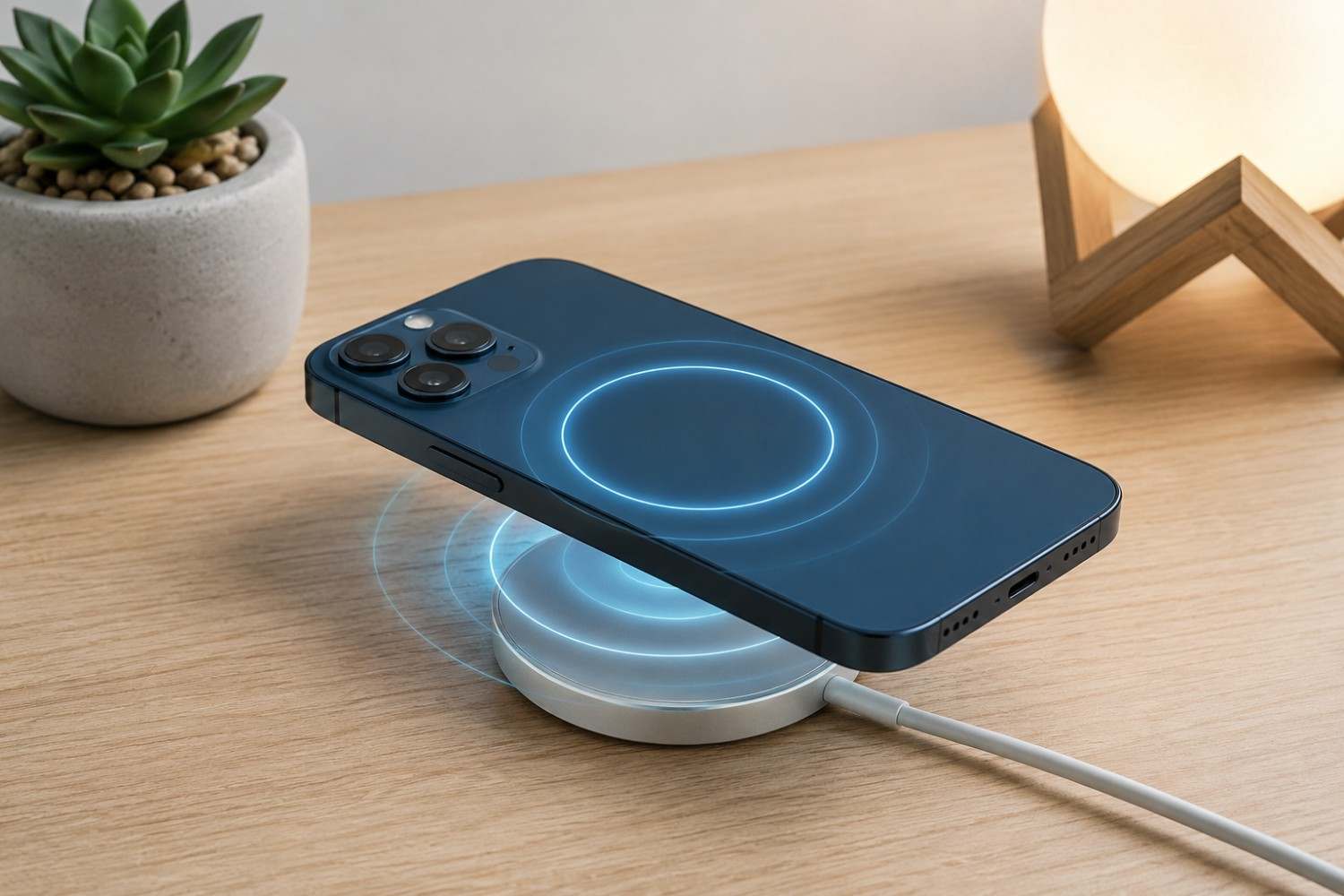
Inside the wireless charger is a transmitting coil. When alternating electrical current passes through this coil, it creates a changing magnetic field. A receiving coil inside the phone interacts with this field, allowing energy to be transferred across the small space separating the two devices.
The phone then converts that transferred energy into electricity that can be used to charge its battery.
This process is known as inductive charging.
MagSafe adds magnetic alignment to this basic concept. The magnets help keep the charging coils properly positioned relative to each other.
Think of it as two different jobs happening at once. The permanent magnets help hold and align the devices, while the electromagnetic charging system transfers the energy.
Does a MagSafe Charger Produce EMF?
Yes. A MagSafe charger produces electromagnetic fields while transferring power to a compatible device. That is an inherent part of inductive wireless charging.
However, saying that a device “produces EMF” doesn’t provide enough information by itself. EMF is a broad term covering many different types and frequencies of electromagnetic energy.
Your home already contains numerous EMF sources. Electrical wiring and appliances can produce electric and magnetic fields. Wi-Fi routers, Bluetooth devices, cell phones, smart speakers, and other wireless electronics use radiofrequency signals.
A MagSafe charging setup can involve several sources simultaneously.
The wireless power transfer process generates a changing electromagnetic field between the charger and receiving coil. The MagSafe system also contains permanent magnets that create static magnetic fields. Meanwhile, the iPhone itself may be communicating through cellular networks, Wi-Fi, Bluetooth, and other wireless services.
This is one reason discussions about MagSafe EMF should distinguish between the charging system and the phone’s wireless communications. If you measure electromagnetic activity around a phone while it is charging, not everything you detect necessarily originates from the MagSafe charger.
MagSafe EMF vs. Regular Qi Wireless Charging
MagSafe and traditional Qi wireless charging share the same basic concept: power is transferred wirelessly through electromagnetic induction.
With an ordinary wireless charging pad, you place the phone over the charging area and attempt to align its internal receiving coil with the transmitter in the charging pad.
MagSafe improves this process by using magnets to help establish alignment automatically.
That can make charging much more convenient. Instead of moving the phone around until you find the correct position, the magnetic connection helps guide it into place.
Magnetic alignment has also become more important outside Apple’s original MagSafe ecosystem. The Qi2 wireless charging standard incorporates a magnetic power profile inspired by the concept of magnetic alignment.
From an EMF perspective, however, the fundamental point remains the same: wireless charging relies on electromagnetic fields to transfer energy.
MagSafe isn’t transferring electricity “through magnets” in the way the phrase magnetic charging might suggest. The magnets assist with positioning, while induction performs the power transfer.
MagSafe Charging vs. Wired Charging
If your primary goal is minimizing EMF associated specifically with wireless power transfer, wired charging offers a straightforward alternative.
A wired charger doesn’t need to create an inductive coupling between two coils to transfer energy across an air gap. Instead, electricity travels through the charging cable into the phone.
That doesn’t mean a wired charger or its associated electronics create absolutely zero electromagnetic fields. Electrical devices and current-carrying conductors can produce electric and magnetic fields. The key difference is that wired charging does not require the same intentional wireless power-transfer field between a charging pad and phone.
There is also no reason that your choice needs to be all-or-nothing.
You might use a wired charger at your bedside or desk, where convenience isn’t especially important, and keep MagSafe available in your kitchen, office, car, or another location where quickly attaching and removing the phone is useful.
For someone taking a precautionary approach to EMF, this can be a reasonable compromise. You aren’t abandoning technology simply because it generates an electromagnetic field. Instead, you are deciding when the convenience is worthwhile.
Does Distance From a MagSafe Charger Matter?
Distance is one of the simplest concepts to understand when trying to reduce exposure to many localized EMF sources.
Field strength generally decreases as you move farther away from a source. The exact relationship varies depending on the type of field, source geometry, frequency, and other factors, so it is not appropriate to give readers one universal formula or “safe distance” that applies to every charger.
Fortunately, you don’t necessarily need one.
If your phone is charging on a table several feet away, you aren’t interacting with the charger in the same way you would if you were holding the phone and charger against your body.
This makes distance an easy precaution.
Rather than keeping an actively charging phone directly beside your hand for hours while working, you could move it to another part of your desk. Rather than keeping a charging phone next to your pillow overnight, you could place it farther away.
Small changes in placement can reduce unnecessary proximity without interfering with the usefulness of the device.
Should You Keep a MagSafe Charger Beside Your Bed?
The bedroom is worth special consideration because of how much time we spend there.
A charger placed on a nightstand may remain within a few feet of your head for seven or eight hours every night. Your phone may also maintain cellular, Wi-Fi, and Bluetooth connections during that time.
If reducing nighttime EMF is one of your goals, your charging setup is therefore worth evaluating.
You don’t necessarily need an elaborate bedroom overhaul. A few simple changes can reduce unnecessary exposure while still allowing you to wake up with a fully charged phone.
Before deciding what works best in your bedroom, consider how you actually use your phone at night. If it primarily sits untouched until morning, there may be little reason it needs to remain directly beside your pillow.
Some practical options include:
- Move the charging location farther from the bed rather than keeping it on the nightstand.
- Charge your phone earlier in the evening and disconnect it before going to sleep.
- Use a wired charger when wireless charging isn’t necessary.
- Use airplane mode overnight when you don’t need cellular or wireless connectivity.
- Disable Wi-Fi or Bluetooth when those connections aren’t needed.
- Avoid sleeping with a phone or active wireless charger immediately beside your head.
These are simple behavioral changes rather than expensive solutions. You can choose whichever ones fit your lifestyle.
What About the Magnets in MagSafe?
The word “magnetic” can create some confusion when people first investigate MagSafe.
MagSafe contains permanent magnets. These produce static magnetic fields. That is different from the changing electromagnetic field used during inductive wireless power transfer.
Static magnetic fields also differ from radiofrequency electromagnetic fields used for cellular, Wi-Fi, and Bluetooth communication.
This distinction matters because EMF isn’t one single thing.
People sometimes see an EMF meter react near a device and assume every reading represents the same type of radiation. In reality, different meters measure different portions of the electromagnetic spectrum.
The magnets themselves also create another consideration that isn’t really an EMF-reduction issue: implanted medical devices.
Apple and medical-device manufacturers provide guidance regarding the use of products containing magnets around pacemakers, defibrillators, and other implanted devices. Anyone with an implanted medical device should follow guidance from their physician and device manufacturer rather than relying on general internet advice about separation distances.
Does Your iPhone Produce EMF While Using MagSafe?
This is an important point because your MagSafe charger isn’t the only potential source around the charging area.
Your iPhone is a wireless communications device.
Even while sitting untouched on a charger, it may maintain a connection with a cellular tower, communicate with your Wi-Fi router, maintain Bluetooth connections, receive notifications, synchronize data, perform cloud backups, and communicate with accessories.
The activity isn’t necessarily constant at the same level, either. Wireless transmissions can vary depending on what the phone is doing and the quality of its connection.
Imagine placing an EMF meter next to your phone while it is charging and seeing the reading change. It might be tempting to attribute everything to the charger.
But the phone could simultaneously be transmitting data over Wi-Fi or communicating through cellular service.
This is why meaningful measurements require some thought about what you are actually trying to measure.
Can You Measure MagSafe EMF Yourself?
If you’re interested in your personal environment rather than relying exclusively on general information, measurements can be useful.
The challenge is selecting appropriate measurement equipment.
An EMF meter may measure magnetic fields, electric fields, radiofrequency radiation, or some combination of these. No single number necessarily represents every type of electromagnetic field around a MagSafe charging setup.
You also need to consider background levels in the room.
A nearby Wi-Fi router, laptop, electrical cable, Bluetooth device, smart home product, or another source could affect measurements.
A simple experiment can make your observations more useful. Rather than taking one reading and trying to interpret it in isolation, compare several conditions.
For example:
- Measure the area with the charger unplugged to establish a background reading.
- Plug the MagSafe charger in without placing the phone on it and measure again.
- Place the phone on the charger and measure during active charging.
- Take measurements at several distances.
- Repeat your measurements after disabling unnecessary wireless communications on the phone if you are attempting to separate charging-related fields from RF transmissions.
Comparisons like these can tell you much more than a single measurement.
Safe Living Technologies sells professional EMF measurement equipment, including meters designed to evaluate different types of electromagnetic fields. If you decide to purchase a meter, make sure you understand what frequencies and field types the particular instrument measures before assuming it can evaluate every aspect of your MagSafe setup.
Affiliate Advertisement

Practical Ways to Reduce EMF Exposure While Using MagSafe
One of the most useful things about reducing unnecessary technology-related exposure is that many precautions don’t cost anything.
You don’t necessarily need shielding products, special cases, or a completely redesigned home. Changing how and where you use electronics can often be the simplest starting point.
If you want to reduce your MagSafe EMF exposure while continuing to enjoy the convenience of wireless charging, consider these habits:
- Give the charger some space. You don’t need to sit immediately beside your phone while it charges. Place it farther away when practical.
- Avoid using the phone extensively while it is charging wirelessly. If the phone can sit on the charger by itself, you naturally increase the distance between your body and the charging system.
- Reconsider bedside placement. If your charger is six inches from your pillow every night, moving it farther away is a simple change.
- Use wired charging when convenient. If you’re going to leave your phone charging on a desk for an hour anyway, plugging it in may be just as easy.
- Turn off wireless connections you aren’t using. Airplane mode, Wi-Fi, Bluetooth, and cellular settings give you some control over the phone’s wireless communications.
- Unplug unused charging equipment. If you don’t need a charger powered continuously, unplugging it is an easy habit that can also reduce standby energy use.
- Don’t obsess over eliminating every electromagnetic field. Modern homes contain many sources of EMF. Focusing on easy, meaningful changes is more practical than attempting to create a completely EMF-free environment.
These steps also have an advantage over many commercial “EMF protection” solutions: they address the source or your proximity to it directly.
Do You Need an EMF Protection Product for MagSafe?
Probably not as your first step.
When addressing an EMF source, I prefer starting with straightforward changes involving distance, placement, and usage.
If you’re concerned about your MagSafe charger being close to your bed, moving it across the room costs nothing. If you don’t need wireless charging at your desk, using the charging cable you already own may solve the issue.
Buying an accessory should not replace basic exposure-reduction practices.
There is also an inherent challenge with trying to shield a wireless charging system. MagSafe needs electromagnetic coupling between the charger and phone to transfer power. Placing shielding directly between the charging coils could interfere with the function you are trying to preserve.
That is why I wouldn’t recommend buying an “EMF blocking” product simply because you own a MagSafe charger.
For this particular issue, distance and charging habits make more sense as the starting point.
MagSafe EMF: Putting the Exposure in Perspective
It is easy for discussions about electromagnetic fields to become overly simplistic.
One side may suggest that because a technology produces EMF, it should be avoided completely. Another may argue that because a product complies with applicable standards, there is no reason anyone should ever think about reducing exposure.
There is a practical middle ground.
You can understand that MagSafe uses electromagnetic fields while also recognizing how useful the technology can be.
MagSafe provides excellent alignment, easy one-handed attachment, convenient charging, and less dependence on repeatedly inserting a connector into your phone. For many people, those benefits are worthwhile.
At the same time, someone who prefers a precautionary approach can decide that wireless charging isn’t necessary eight hours a night beside the bed.
Technology doesn’t always have to be classified as either “safe” or “dangerous” before you make sensible choices about how you use it.
Frequently Asked Questions About MagSafe and EMF
There are several questions that commonly arise when wireless charging and EMF are discussed. The answers below provide a quick reference while reinforcing some of the distinctions covered throughout this article.
Does MagSafe emit EMF?
Yes. MagSafe wireless charging relies on electromagnetic induction to transfer power between the charger and phone. A changing electromagnetic field is therefore an intentional part of how the charging system works.
Is MagSafe radioactive?
No. MagSafe is not radioactive.
Wireless charging involves non-ionizing electromagnetic fields. This is fundamentally different from ionizing radiation such as X-rays and gamma rays.
Using the word “radiation” without explaining what kind can unnecessarily confuse discussions about consumer electronics.
Is MagSafe safer than a regular wireless charger?
There isn’t a simple answer based solely on the MagSafe name.
MagSafe and conventional Qi chargers both rely on inductive power transfer. MagSafe’s magnetic alignment can help keep the transmitting and receiving coils correctly positioned.
Actual exposure around a particular charging setup can depend on the charger, operating conditions, distance, phone, alignment, and what you are measuring.
Is wired charging lower EMF than MagSafe?
Wired charging eliminates the need for inductive wireless power transfer between the charger and phone, making it a sensible choice for someone specifically trying to reduce exposure associated with wireless charging.
That doesn’t mean a powered wired charger creates no electromagnetic fields whatsoever. Electrical devices and cables can still produce fields. The charging method is simply different.
Should I unplug my MagSafe charger when I’m not using it?
You can.
If you don’t need a charger operating or drawing standby power, unplugging it is a simple habit. Whether this makes a meaningful difference to your overall EMF environment will depend on your setup and other sources nearby.
How far should I stay from a MagSafe charger?
There isn’t one universal distance that can accurately be called “safe” for every charger and every situation.
Instead of focusing on a magic number, use distance practically. Don’t keep an active charger pressed against your body when it doesn’t need to be there, and consider moving charging equipment farther from locations where you spend long periods.
If you want to know what is happening in your specific environment, appropriate measurement equipment can provide more useful information than a generic distance recommendation.
Can I use MagSafe in my bedroom?
Yes.
If reducing nighttime EMF exposure is important to you, however, consider where the charger and phone are located. Moving them farther from your bed, charging earlier in the evening, or using wired charging are simple alternatives.
Conclusion: Do You Need to Stop Using MagSafe?
MagSafe is a clever and convenient charging technology. The magnetic attachment helps properly align the phone and charger, while electromagnetic induction allows energy to move wirelessly between the charging coil and the receiving coil inside the phone.
Because electromagnetic fields are part of that process, it is reasonable for someone interested in reducing EMF exposure to think about how frequently and where they use wireless charging.
That doesn’t mean you need to throw away your MagSafe charger.
Simple habits such as increasing distance, avoiding prolonged close contact while the phone is charging, moving charging equipment away from your bed, unplugging chargers when they aren’t needed, and choosing wired charging when it’s equally convenient can reduce unnecessary exposure without dramatically changing your relationship with technology.
Ultimately, understanding MagSafe EMF is less about becoming afraid of wireless charging and more about making informed choices. Learn how the technology works, reduce unnecessary exposure where doing so is easy, and use MagSafe when its convenience genuinely makes your life easier.
Before You Go…
Get Weekly EMF Protection Tips
Enjoy this article? Join the EMFLuLu newsletter for simple weekly tips to reduce everyday EMF exposure from phones, WiFi routers, laptops, and smart home devices.
Try Our Free EMF Calculators
Curious how much EMF exposure you may experience each day?
These simple tools can help you estimate your exposure and identify possible problem areas in your home.
Try these free calculators:
Like this article? Pin it on Pinterest!

More to Explore