Electric recliners can make relaxing at the end of the day incredibly convenient. Instead of pulling a lever or pushing back with your body, you can press a button and let an electric motor adjust the chair for you. Some newer models go much further, adding powered headrests, USB charging ports, wireless charging, massage, heat, and even Bluetooth features. With electrical components located underneath or inside a chair where you may spend hours at a time, it is reasonable to wonder about electric recliner EMF and whether a powered chair produces electromagnetic fields close to your body.
The short answer is yes: electrical equipment in a powered recliner can produce electromagnetic fields. However, that answer needs some important context. EMF is a broad term, and simply detecting an electromagnetic field does not mean that a product is dangerous. The type of field, its strength, the distance between you and the source, how long the equipment operates, and the particular design of the chair all matter.
This article looks at where EMF can come from in an electric recliner, what changes when the chair is moving or stationary, how you can measure your own chair, and some practical ways to reduce unnecessary exposure without giving up a piece of furniture you enjoy or depend on.
How Does an Electric Recliner Work?
A traditional recliner uses a mechanical system that allows the footrest and backrest to move without electricity. A power recliner accomplishes similar movements using an electric motor or linear actuator. Pressing a button sends power to the appropriate mechanism, which moves the chair into the desired position.
The exact design varies considerably. A relatively simple power recliner might contain a power supply, wiring, controls, and one motor. More sophisticated chairs can have several motors that independently control the footrest, backrest, lumbar support, and headrest.
The power supply is another important component. Many recliners do not simply send household AC power directly to the motor. Instead, a transformer or power supply converts electricity from the wall outlet into the voltage and current required by the chair.
Manufacturers can also build additional electronics into the chair. USB charging ports are increasingly common, and some models provide wireless charging surfaces for smartphones. Heated seats, massage functions, LED lighting, memory settings, and wireless controls can add even more electrical components.
That means there is no single EMF profile that applies to every powered recliner. Two chairs that look nearly identical from across the room could contain very different electronics.
Do Electric Recliners Produce EMF?
Electrical and electronic equipment can produce electromagnetic fields, so a powered recliner can have measurable fields around some of its components.
For most basic electric recliners, the primary areas of interest are extremely low-frequency electric and magnetic fields associated with electrical power, wiring, transformers, and motors. These are different from the radiofrequency, or RF, energy associated with devices such as Wi-Fi routers, cell phones, and Bluetooth transmitters.
This distinction is important.
An electric recliner does not automatically become an RF-transmitting device simply because it plugs into an electrical outlet. A basic recliner with a wired hand control and electric motor may not need Wi-Fi or Bluetooth at all.
However, a more sophisticated chair could include wireless features. Bluetooth controls, wireless charging, or other wireless technology may change the types of electromagnetic fields associated with the chair.
Therefore, when considering electric recliner EMF, it makes more sense to examine the individual electrical components than to treat the entire chair as one EMF source.
Where Can EMF Come From in an Electric Recliner?
A power recliner may contain several possible sources of electromagnetic fields, and their locations can vary by manufacturer and model. Understanding these components can help you determine which parts of your particular chair are worth investigating.
Here are some of the most common areas to consider.
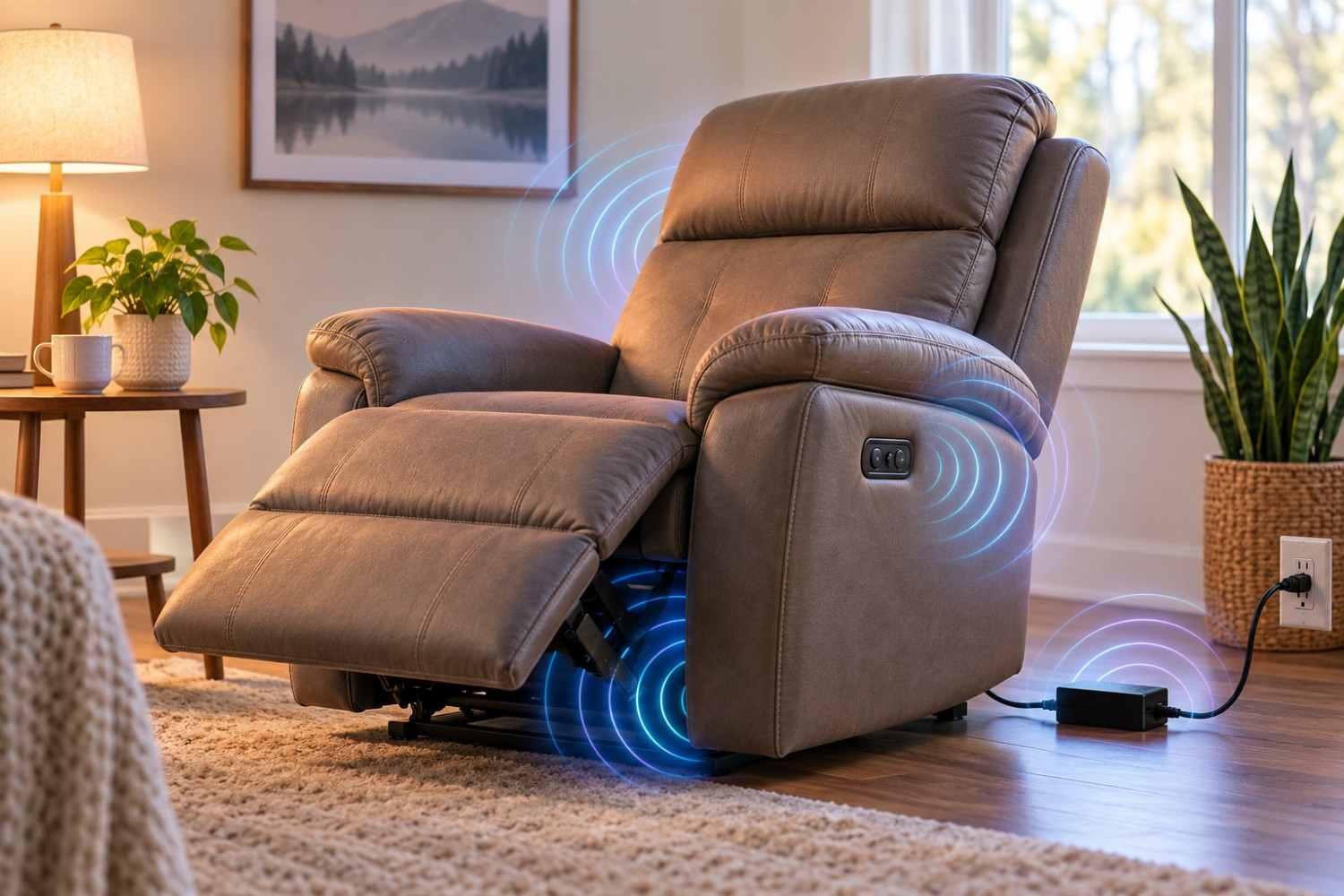
Electric Motor or Linear Actuator
The motor or actuator is what physically moves the chair. Depending on the design, one or several may be mounted beneath the seat or toward the rear of the recliner.
When you press the control button, electrical current powers the motor and the chair begins moving. Because motors use electricity and create magnetic fields while operating, this is an obvious location to examine if you are measuring a powered recliner.
There is an important practical consideration, however: the motor usually operates for only a short period.
You might sit in a recliner for two hours while watching a movie but run the motor for only several seconds when reclining and another several seconds when returning upright. A measurement taken directly beside an operating motor therefore does not necessarily represent your exposure during the entire two hours.
Transformer or Power Supply
The power supply is another component worth identifying.
Depending on the chair, you might find a transformer along the power cord, on the floor behind the recliner, or attached elsewhere in the electrical system. Its job is generally to convert incoming household electricity into power suitable for the chair’s electronics and motors.
Because transformers can generate magnetic fields, location matters. A power supply sitting on the floor several feet from your body presents a different exposure situation than a powered component immediately underneath the seat.
If you own a recliner and want to investigate its EMF, finding the transformer is a useful first step.
Electrical Wiring
Wiring connects the recliner’s electrical components. Wires may run underneath the seat, through the back, along the frame, or between different motors and controls.
Current flowing through wiring produces a magnetic field, while energized wiring may also contribute to electric fields.
Once again, this doesn’t establish that the field represents a health hazard. It simply explains why an electrically powered chair may produce measurable EMF even though much of its electrical system is hidden underneath upholstery.
USB Charging Ports
Many modern recliners have USB ports built into the armrest or control panel. This allows you to charge a smartphone or tablet without reaching for a wall outlet.
It is certainly convenient, but it also introduces charging electronics into an area very close to where you sit.
If your goal is to minimize unnecessary electrical sources immediately beside your body, there is no requirement to use the recliner’s USB port simply because it is available. You can leave it unused and charge your phone elsewhere.
Wireless Charging
Some premium power recliners now include wireless charging pads.
Wireless charging is different from plugging a phone into a USB cable. Compatible wireless chargers commonly use magnetic induction to transfer energy between coils in the charging pad and device.
The charging area is generally designed for very short-range energy transfer, which is why the phone must be placed directly on or extremely close to the charging surface.
If you are concerned about unnecessary EMF exposure, this is an easy feature to skip. A recliner does not need its wireless charging function to recline.
Heating and Massage
Some powered chairs include heating elements or massage systems.
These functions require additional electrical equipment. Depending on the design, that equipment may be located in the seat or backrest, placing it closer to the user’s body than the power supply sitting on the floor.
Someone investigating a multifunction recliner should therefore test these features separately rather than assuming the chair will produce identical readings regardless of which functions are active.
Bluetooth and Other Wireless Features
A recliner equipped with Bluetooth or another wireless communication system introduces a separate consideration because these technologies can use RF signals.
Check your owner’s manual or the manufacturer’s specifications rather than assuming your chair has wireless connectivity.
A remote control also isn’t automatically wireless. Some recliners use wired hand controls connected directly to the chair.
Does a Power Recliner Produce EMF When It Isn’t Moving?
This may be more important than what happens during the few seconds when you adjust the chair.
A person might sit in an electric recliner for several hours every evening while operating its motor for less than a minute. It therefore makes sense to distinguish between the chair operating and simply being plugged in.
When the motor is actively moving the chair, electricity is being supplied to the actuator. The resulting electromagnetic fields around the motor and related wiring may be different from those present when the motor is idle.
When the chair stops moving but remains plugged in, the motor may no longer be operating, but that does not necessarily mean every electrical component is completely de-energized. The power supply and certain electronics may remain connected to electricity.
The answer also depends on the chair’s features. A chair with illuminated controls, charging electronics, wireless connectivity, or standby electronics may behave differently from a simple power recliner.
An unplugged chair presents another situation. Disconnecting it from the wall removes its connection to household electrical power, although battery-backed or independently powered components could still operate.
For that reason, measuring your actual chair under different operating conditions provides much more useful information than assuming all recliners behave identically.
Why Distance From the Electrical Components Matters
One of the basic principles worth understanding when evaluating electric recliner EMF is that your distance from the source matters.
This can sometimes cause confusion when people see EMF measurements online.
Suppose someone places a meter directly against a recliner motor and records a relatively high reading. That demonstrates what the field is like at that measurement location. It does not necessarily demonstrate what the field strength is where someone’s head, chest, or legs are positioned while sitting normally.
Measurements should therefore be taken where exposure actually occurs.
You might measure directly beside the motor to identify it as a source and then move the meter to the seat cushion, backrest, armrest, head position, and other areas where your body would normally be located.
You may find that readings change significantly over relatively short distances.
This is also why locating the recliner’s power supply can be useful. If the transformer is on the floor immediately underneath where you rest your feet, its relationship to your body is different from a transformer positioned several feet behind the chair.
How Can You Measure EMF Around an Electric Recliner?
One advantage of investigating a powered recliner is that you can perform comparisons relatively easily. Instead of relying on a reading from someone else’s chair, you can examine the exact recliner in your home.
You need to make sure the meter you’re using measures the type of field you want to investigate. EMF meters differ in what they detect. Some measure low-frequency electric and magnetic fields, some measure RF radiation, and some provide multiple measurement capabilities.
For readers who want a multi-field meter, one example is the Safe and Sound Pro II RF Meter from Safe Living Technologies for RF measurements, although it should not be confused with a dedicated low-frequency magnetic/electric-field meter.
For an electric recliner specifically, make sure you have appropriate measurement capability for low-frequency electric and magnetic fields if those are what you are investigating. An RF-only meter will not give you the complete picture of a conventional motorized chair.
Once you have suitable equipment, the goal isn’t simply to hunt for the highest number you can produce. A more informative approach is to make consistent measurements under different conditions.
For example, you can compare the following situations:
- Measure the area with the recliner unplugged to establish a baseline.
- Plug the recliner in without moving it and measure again.
- Measure while the chair is actively reclining.
- Repeat while returning the chair to its upright position.
- Check near the motor or actuators.
- Check near the transformer or power supply.
- Measure at the seat, backrest, armrests, and approximate head position.
- If the chair has heating or massage, activate each feature separately and compare the readings.
- If it has USB or wireless charging, compare readings when the charging feature is being used.
- If wireless connectivity is present, use an appropriate RF meter to investigate that separately.
This type of testing gives you far more context than a single measurement taken directly against the motor.
It is also worth checking the room before blaming the recliner for every reading. Electrical wiring in the wall, extension cords, lamps, wireless routers, phones, and other nearby equipment can affect what your meter detects.
Affiliate Advertisement

Simple Ways to Reduce Unnecessary EMF Around a Power Recliner
If you discover measurable fields around your recliner and would prefer to reduce unnecessary exposure, there are several straightforward steps to consider. These don’t require assuming that the chair is dangerous or purchasing an assortment of shielding products.
The following ideas are primarily about eliminating electrical functions you don’t need and increasing distance where practical.
Find the Power Supply
First, determine where the chair’s transformer or power supply is located.
If it is movable and the manufacturer’s instructions permit it, avoid placing the power supply unnecessarily close to your body. Don’t modify the chair’s electrical system, stretch cables, or position equipment in a way that could create a tripping, overheating, or electrical hazard.
Skip Features You Don’t Need
A chair might include ten features even though you purchased it primarily because you wanted powered reclining.
If you don’t need wireless charging, don’t use it. If you rarely use the heated seat or massage function, leave those functions off.
This is one of the easiest approaches to reducing unnecessary electrical activity without giving up the chair itself.
Charge Your Phone Somewhere Else
A built-in USB or wireless charger is convenient, but it isn’t essential to reclining.
If minimizing nearby electronics is important to you, charge your phone at a separate location instead of keeping a charging device beside your body while sitting for long periods.
Check for Wireless Connectivity
Look through the manufacturer’s specifications or owner’s manual to see whether your recliner contains Bluetooth, Wi-Fi, or other wireless features.
Don’t assume it does simply because the chair is electric.
If optional wireless functions can be disabled without affecting normal operation, you can decide whether the convenience is worthwhile to you.
Consider Unplugging When Appropriate
Some people may choose to unplug a basic power recliner when they know they will not need to adjust it.
However, this recommendation comes with an important qualification.
A powered lift chair can be an accessibility or mobility device. Someone may rely on its motor to get safely into a standing position. In that situation, having the chair ready to operate is far more important than reducing a potentially small EMF exposure.
Follow the manufacturer’s safety instructions, and don’t disconnect a chair if doing so could interfere with your ability to use it safely.
What About Power Lift Chairs?
Power lift chairs deserve special consideration because they aren’t simply luxury furniture for everyone who uses them.
A lift recliner can raise and tilt the seat forward, helping someone transition from sitting to standing. This can be particularly useful for people with limited mobility.
Electrically, a lift chair has many of the same considerations as a conventional power recliner. It contains a motorized mechanism, power supply, controls, and wiring, and it may have additional convenience features.
The difference is the importance of the powered function to the person using it.
If someone relies on a lift chair for mobility, I would not recommend routinely unplugging it merely as an EMF-reduction measure. A better approach is to identify the sources, measure the chair if desired, avoid optional electrical features that aren’t needed, and follow the manufacturer’s safety instructions.
Practical safety should always take priority.
Is a Manual Recliner a Lower-EMF Alternative?
If your main goal is eliminating electrical equipment from your chair, a traditional manual recliner is the simplest alternative.
A basic mechanical recliner doesn’t require a motor, power supply, electrical wiring, USB port, or electronic control system to change positions. As a result, it eliminates the chair-based electrical sources associated with those components.
That doesn’t mean everyone should replace an electric recliner with a manual one.
Powered chairs can be much easier to adjust. They can provide finer positioning, powered headrests and lumbar adjustments, and significant accessibility benefits. A lift chair may make an enormous practical difference to someone who has difficulty standing.
If you don’t need those features and are already shopping for a recliner, a manual model is an easy way to avoid adding another powered device to your sitting area. If you already own and enjoy an electric recliner, however, its electrical components alone aren’t a reason to throw it away.
Should You Be Worried About EMF From an Electric Recliner?
This is where it is particularly important to separate the ability to detect EMF from evidence that an exposure is harmful.
Electromagnetic fields exist around many electrical and electronic devices. Detecting a field with an EMF meter does not by itself demonstrate a health hazard.
When assessing a powered recliner, it is more useful to ask specific questions. What type of field are you measuring? How strong is it where your body actually sits? Does the reading change when the motor stops? Where is the transformer? Does the chair contain wireless transmitters? Are you using charging, heating, or massage functions?
These questions provide useful information.
A dramatic meter reading taken directly against an operating motor may attract attention, but without information about distance, field type, measurement method, and normal usage, it doesn’t tell you very much about someone’s everyday exposure.
It is also difficult to generalize from one chair to another. A simple single-motor recliner and a premium chair with several motors, heating, massage, wireless charging, USB ports, and Bluetooth are fundamentally different electrical products.
If you’re particularly concerned, measure the chair you actually use.
The Bottom Line
Electric recliners contain powered components, so it should not be surprising that electromagnetic fields can be present around parts of the chair. Motors, transformers, electrical wiring, charging systems, and optional electronic features can all contribute.
However, that doesn’t mean every powered recliner creates the same exposure or that detecting EMF establishes a health risk.
The most useful way to think about electric recliner EMF is to consider the actual sources, field types, distance, operating conditions, and amount of time you spend near active components. Someone who wants to take a precautionary approach can locate the transformer, avoid unnecessary charging or wireless features, increase distance from powered components when practical, and measure their particular chair if they want more information.
For people who don’t need powered furniture and want the simplest option, a manual recliner removes the motor and related electrical components entirely. For everyone else, particularly people who depend on power lift chairs for mobility, there is no reason to sacrifice safety or independence based simply on the fact that a chair produces measurable electromagnetic fields.
Understanding what your chair contains and how you actually use it is far more helpful than assuming that anything powered is automatically dangerous.
Before You Go…
Get Weekly EMF Protection Tips
Enjoy this article? Join the EMFLuLu newsletter for simple weekly tips to reduce everyday EMF exposure from phones, WiFi routers, laptops, and smart home devices.
Try Our Free EMF Calculators
Curious how much EMF exposure you may experience each day?
These simple tools can help you estimate your exposure and identify possible problem areas in your home.
Try these free calculators:
Like this article? Pin it on Pinterest!

More to Explore