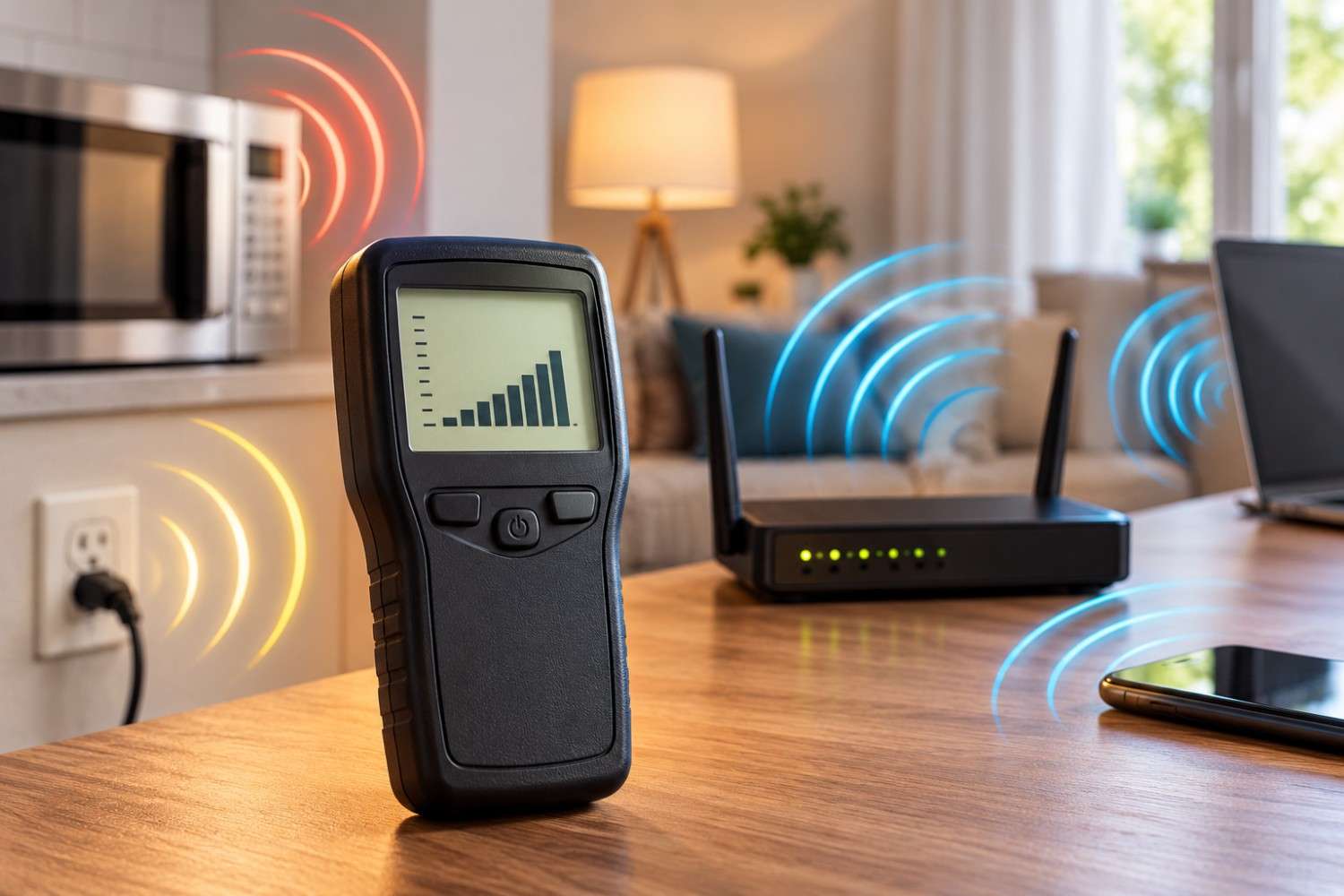
Buying an EMF meter can feel like finally gaining the ability to see something that has always been invisible around you. Then you turn the meter on, walk around your house, and encounter numbers, abbreviations, changing readings, and occasional spikes that may leave you with more questions than answers. Learning how to read an EMF meter is not simply a matter of deciding whether a number is high or low. You first need to understand what type of electromagnetic field you are measuring, which unit the meter is displaying, how distance affects the measurement, and why readings can change from one moment to the next.
Fortunately, you do not need to become an electrical engineer to make useful measurements around your home. Once you understand a few basic principles, an EMF meter can become a practical tool for identifying sources, comparing locations, and seeing how simple changes such as increasing your distance from a device affect the readings.
This guide explains the numbers in plain English so that you can use an EMF meter with more confidence and, just as importantly, understand what the meter cannot tell you.
What Does an EMF Meter Actually Measure?
The term “EMF” can make it sound as though an EMF meter measures one specific thing. In reality, electromagnetic fields cover different frequencies and types of fields.
Consumer EMF meters vary considerably. Some measure only one type of field, while multi-function meters may measure AC magnetic fields, AC electric fields, and radiofrequency, or RF, electromagnetic fields.
Understanding which one you are measuring is the first step toward understanding the number on the display.
Magnetic Fields
AC magnetic fields are associated with alternating electrical current. Around a home, they may be detected near electrical wiring, breaker panels, transformers, appliances, motors, and other equipment that uses electricity.
Magnetic fields are commonly displayed in milligauss (mG) or microtesla (µT).
A useful conversion to remember is:
1 µT = 10 mG
If one meter displays 0.2 µT and another displays 2 mG, those measurements represent the same magnetic flux density expressed in different units.
Magnetic fields generally become weaker as distance from the source increases, although exactly how quickly that happens depends on the source and its configuration.
Electric Fields
Electric fields are produced by voltage and are commonly measured in volts per meter, abbreviated V/m.
You may detect electric fields around electrical wiring, power cords, lamps, appliances, power strips, and other energized equipment.
An important distinction is that voltage can be present even when relatively little current is flowing. For that reason, electric-field and magnetic-field measurements around the same device can look very different.
Radiofrequency Fields
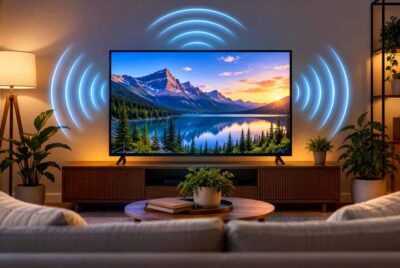
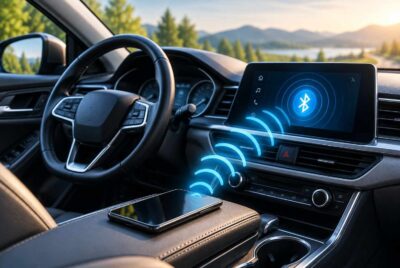
Radiofrequency electromagnetic fields are associated with wireless communications and other RF sources. Around a modern home, potential sources include Wi-Fi routers, smartphones, Bluetooth devices, wireless security cameras, smart-home equipment, and other wireless transmitters.
RF meters may display measurements using units such as:
µW/m² — microwatts per square meter
mW/m² — milliwatts per square meter
Some instruments can also express RF field strength in V/m.
This is where reading the display carefully becomes especially important. A value of 100 µW/m² is not the same as 100 mW/m². Before comparing a reading you obtained with a number you found online, make sure the units are the same.
How to Read an EMF Meter Without Getting Overwhelmed
When learning how to read an EMF meter, it helps to resist the temptation to immediately classify every number as “good” or “bad.” Instead, start by asking what the number actually represents.
Before interpreting a measurement, determine the type of field being measured, the unit being displayed, where the measurement was taken, the distance between the meter and the suspected source, and whether you are looking at a current, average, maximum, or peak reading.
This approach turns the meter into a tool for comparison rather than a device that simply flashes numbers at you.
For example, suppose you walk up to your Wi-Fi router and get a noticeably stronger RF reading. Instead of stopping there, move several feet away and measure again. Then take a reading at the chair or desk where you normally spend time.
You now have much more useful information than you would get from a single measurement directly beside the router.
Understanding Magnetic Field Readings: mG and µT
If your meter is set to magnetic-field mode, you will probably see either milligauss or microtesla.
One of the easiest mistakes for beginners to make is comparing numbers without noticing that different units are being used.
For example:
1 mG = 0.1 µT
5 mG = 0.5 µT
10 mG = 1 µT
Once you know this relationship, converting between the two is fairly straightforward.
Around a house, try taking magnetic-field measurements near devices containing motors or transformers. You can also check areas where you spend significant amounts of time, such as your bed, couch, desk, and favorite chair.
What may be particularly informative is not the measurement directly against an appliance but how quickly the reading changes as you move away.
Imagine that a meter displays a noticeably stronger magnetic field while held inches from an appliance. Take another measurement one foot away, then three feet away, and perhaps six feet away.
You may see the reading decrease considerably.
The World Health Organization notes that electric and magnetic fields are strongest close to their sources and diminish with distance. This makes distance an important part of interpreting a measurement rather than simply recording the highest number you can find.
Understanding Electric Field Readings: V/m
Electric-field measurements are commonly displayed as volts per meter, or V/m.
This measurement can be confusing because beginners sometimes expect electric-field and magnetic-field measurements to rise and fall together. They do not necessarily do so.
Electric fields are associated with voltage, while magnetic fields are associated with electrical current.
You might detect an electric field near an energized cord or wiring even when the connected equipment is not consuming much electricity.
When measuring electric fields, technique can matter. Your body, grounding conditions, nearby objects, and the design and orientation of the meter can influence measurements. Follow the manufacturer’s directions for the particular instrument you are using.
Rather than walking through the house looking only for the largest number, establish repeatable measurement conditions. Hold the meter according to its instructions and compare similar locations using the same technique.
That will make your results much more meaningful.
Understanding RF Readings
RF is often the most interesting measurement for beginners because so many devices in a modern home communicate wirelessly.
It can also be one of the most confusing.
Suppose you place an RF meter near your Wi-Fi router. Instead of showing one stable number, the display may jump up, fall down, and suddenly spike again.
That does not automatically mean anything is wrong with your meter.
Wireless devices transmit information in bursts and patterns that can change with activity. Your Wi-Fi environment while nobody is using the network may look different from the same environment while someone is streaming video, downloading a large file, or participating in a video call.
Phones can also behave differently depending on what they are doing.
That is why a single momentary RF number does not necessarily provide a complete picture of your environment.
Pay Attention to the Units
Before interpreting RF measurements, look closely at the units.
For example:
1 mW/m² = 1,000 µW/m²
Therefore, a meter displaying 0.5 mW/m² is displaying the equivalent of 500 µW/m².
This becomes particularly important when researching readings online. One website might discuss µW/m² while your meter displays mW/m². Without converting the units, the numbers can appear dramatically different even when they describe the same power density.
Peak Readings vs. Average or Current Readings
Another term you may encounter is “peak.”
The exact meaning and calculation of peak, maximum, average, and similar functions depend on the particular meter. Check your meter’s manual before assuming that two meters calculate these values in exactly the same way.
Peak readings can be useful when investigating RF because wireless signals may contain brief pulses that can be easy to miss while watching a rapidly changing display.
For example, the TriField TF2 (affiliate link) includes a Peak Hold feature intended to capture fast pulses. That gives the user another way to observe a changing RF environment rather than trying to watch every movement on the screen.
An average measurement answers a somewhat different question. Instead of focusing on a brief maximum, it can help describe what is occurring over a period of time, depending on how the instrument calculates and displays the value.
Neither number should automatically be considered the “correct” reading. They provide different information.
Why Distance Can Tell You More Than a Single Number
One of the most useful experiments you can perform with an EMF meter is also one of the simplest: change your distance from the source.
Suppose you are testing a Wi-Fi router.
Measure immediately beside it.
Move one foot away and measure again.
Move three feet away.
Then move six feet away.
Finally, take a measurement at the location where you normally sit or sleep.
You have now created a small experiment showing how the field at your actual location compares with the field close to the source.
The same idea can be applied to a refrigerator, television, laptop, power strip, electrical panel, smart-home device, or other suspected source.
This is one reason I prefer looking at EMF meters as investigative tools. Finding the highest number possible is easy. Understanding where that measurement occurs in relation to your normal activities is much more useful.
If moving a chair several feet changes a measurement substantially, you have learned something practical without buying anything or removing technology from your home.
What Is Considered a High EMF Reading?
This is probably the question almost everyone eventually asks, and unfortunately it does not have one universal numerical answer.
There isn’t a single EMF number that applies equally to magnetic fields, electric fields, RF fields, every frequency, and every exposure situation.
Official exposure limits vary according to factors such as frequency and field type. International organizations including the International Commission on Non-Ionizing Radiation Protection, or ICNIRP, publish exposure guidelines, and individual countries may establish their own standards.
It is also important to understand the difference between official exposure limits and much lower precautionary recommendations that you may encounter on EMF-oriented websites.
They are not interchangeable.
Some organizations and individuals recommend minimizing exposure well below established regulatory or international guideline levels as a precautionary approach. People are free to use more conservative personal targets, but those targets should not be presented as though they are official safety limits when they are not.
The World Health Organization has also emphasized an important point about exposure guidelines: a guideline value should not be interpreted as a precise dividing line where everything below it is automatically harmless and everything immediately above it becomes harmful.
This is another reason an EMF meter should not be treated as a medical diagnostic device.
It measures electromagnetic fields. It does not diagnose illness, determine the cause of symptoms, or tell you whether a particular reading is responsible for a health problem.
Try a Simple EMF Survey of Your Home
Once you understand how to read an EMF meter, a simple home survey can teach you much more than randomly walking around looking for high numbers. The goal is to create repeatable measurements that help you compare locations, sources, and distances.
You don’t need to measure every electrical object in the house. Start with places where you spend the most time and then investigate individual devices that interest you.
A simple survey could include the following steps:
- Establish a baseline. Start in an area away from obvious electrical and wireless devices and record the measurements for each mode your meter supports.
- Check your bedroom. Take measurements where your head and body are positioned while sleeping rather than only measuring devices around the room.
- Measure your home office. Check the actual location of your chair and then compare it with readings closer to your computer, monitors, power strips, router, and other equipment.
- Test your Wi-Fi router at several distances. Compare readings beside the router with readings one, three, and six feet away and at your normal sitting locations.
- Test your phone under different conditions. If your meter can measure the relevant RF frequencies, compare readings when the phone is relatively inactive with readings during wireless activity. Keep the meter itself positioned consistently.
- Check major appliances. Refrigerators, microwave ovens, televisions, laundry equipment, and other appliances can be interesting sources to investigate.
- Record your results. Instead of relying on memory, write down the measurement mode, units, distance, location, reading, and anything the device was doing at the time.
A simple record might look like this:
| Location | Field | Distance | Reading | Notes |
| Bedroom | RF | Pillow location | ___ | Normal nighttime setup |
| Router | RF | 1 foot | ___ | Wi-Fi active |
| Router | RF | 6 feet | ___ | Wi-Fi active |
| Desk | Electric | Sitting position | ___ | Computer on |
| Refrigerator | Magnetic | 1 foot | ___ | Compressor running |
Repeat measurements can be particularly helpful. If you get an unexpected result, don’t immediately draw a conclusion. Measure again and see whether you can reproduce it.
Seven Common EMF Meter Mistakes Beginners Make
Most beginner mistakes happen because people understandably want a quick answer from their meter. Taking a little extra time to understand what you are measuring can prevent confusing or misleading results. Here are seven mistakes worth watching for.
Ignoring the Measurement Mode
An RF measurement cannot be directly compared with a magnetic-field measurement. Always know which mode your meter is using before interpreting the number.
Ignoring the Units
A number without its unit has little meaning. Pay attention to whether you are looking at mG, µT, V/m, µW/m², mW/m², or another unit.
Measuring Only Inches From a Device
Close-range measurements can help identify a source, but they may not represent your normal exposure. Follow up with measurements at realistic distances.
Reacting to One Spike
Particularly with RF, readings can fluctuate. A brief spike is information, but it should be considered alongside repeated, peak, and longer-term observations as appropriate for your meter.
Forgetting About Your Own Electronics
If you’re measuring RF while carrying an actively transmitting phone or smartwatch, you may accidentally be measuring a device on your own body.
Comparing Results From Different Meters Without Checking Specifications
Meters differ in frequency range, sensitivity, response time, axes, measurement method, and units. Two instruments are not necessarily measuring exactly the same thing in exactly the same way.
Assuming the Meter Can Diagnose a Health Risk
An EMF meter measures fields. It cannot determine whether a headache, sleep problem, fatigue, or other symptom was caused by EMF exposure. Health concerns should be discussed with an appropriate healthcare professional.
Affiliate Advertisement

Do Beginners Need an Expensive EMF Meter?
Not necessarily.
The right meter depends on what you want to measure. Someone interested only in RF may prefer a dedicated RF meter, while a homeowner who wants to investigate several kinds of fields may find a multi-function meter easier and more economical.
For beginners, I would look for clearly labeled measurement modes, an easy-to-read display, useful documentation, and specifications that explain what frequencies and measurement ranges the instrument actually covers.
One option that fits the subject of this article particularly well is the TriField TF2 EMF Meter (affiliate link). It combines AC magnetic, AC electric, and RF measurements in one handheld meter. According to its specifications, its magnetic mode covers 40 Hz to 100 kHz, its electric mode covers 40 Hz to 100 kHz, and its RF mode covers 20 MHz to 6 GHz. It also includes a Peak Hold function.
The benefit for a beginner is that one instrument can be used to learn the differences between magnetic, electric, and RF measurements instead of requiring three separate devices.
However, don’t assume that buying a more expensive meter automatically produces more useful information. A sophisticated instrument isn’t particularly helpful if you don’t understand what it measures. Learning proper measurement technique is at least as important as choosing the meter.
What Should You Do When You Find a Stronger Reading?
Finding a stronger reading does not mean you need to panic, throw away a device, or immediately buy a shielding product.
Investigate first.
Try to determine the source. Move the meter closer and farther away. If practical and safe, turn the suspected device off and see whether the reading changes. Turn it back on and measure again.
You can also repeat the measurement at another time.
If the reading falls dramatically with distance, consider whether you actually spend much time close to that source. A strong measurement two inches from an appliance may have very different practical relevance from a measurement at the chair where you sit for eight hours each day.
This approach can also prevent unnecessary purchases.
Sometimes the easiest exposure-reduction measure is simply moving something. You might discover that relocating a router, moving a chair, changing where a wireless device sits, or increasing the distance between an electrical appliance and a bed changes your measurements.
Measure first. Identify the source. Experiment with practical changes. Then measure again.
Frequently Asked Questions About Reading an EMF Meter
Beginners often encounter the same questions after using a meter for the first time. The following answers provide a quick reference for some of the measurements and behaviors you are most likely to encounter.
What does mG mean on an EMF meter?
mG stands for milligauss, a unit commonly used to express magnetic flux density. Some meters use microtesla instead. One microtesla equals 10 milligauss.
What does V/m mean?
V/m means volts per meter and is a unit of electric-field strength. Some RF measurements can also be expressed in V/m, so always check which mode your instrument is using.
What does µW/m² mean?
µW/m² means microwatts per square meter. It is a unit of power density that can be used when measuring RF electromagnetic fields.
Why does my EMF meter keep jumping?
A changing reading isn’t necessarily a problem with the meter. Electromagnetic environments can change constantly, particularly when measuring RF from wireless devices that transmit intermittently.
Can an EMF meter detect Wi-Fi?
An RF meter can detect Wi-Fi if the Wi-Fi frequency falls within the meter’s specified frequency range. Check the specifications of your particular instrument.
Can an EMF meter detect Bluetooth?
The same principle applies to Bluetooth. The meter needs an RF measurement range that covers the frequencies being used.
Can an EMF meter measure 5G?
Some can measure at least portions of frequencies used by 5G networks, but “5G” encompasses different frequency ranges. A meter that detects one portion of 5G spectrum does not necessarily measure every possible 5G frequency. Check the meter’s specified frequency range rather than assuming that any RF meter measures all 5G signals.
How far away should I hold an EMF meter?
There is no single distance appropriate for every measurement. If you are locating a source, close measurements can be useful. If you want to understand the field where you normally sit or sleep, measure at that actual location. Testing at several distances often provides the most useful information.
Are inexpensive EMF meters accurate?
Price alone cannot tell you whether a meter is accurate. Look at the manufacturer’s specifications, measurement range, frequency response, sensitivity, accuracy claims, calibration information where available, and instructions. Very inexpensive meters may also combine measurements or use simplified indicators that provide less information.
Can an EMF meter tell me if an area is safe?
An EMF meter can tell you the electromagnetic-field measurement that the instrument is capable of detecting under the conditions in which you used it. It cannot provide a universal medical “safe” or “dangerous” diagnosis. Exposure guidelines also vary by frequency and type of field.
The Most Important Skill Is Learning to Compare
It is tempting to buy an EMF meter because you want a definitive answer about your house. In practice, one of the greatest benefits of owning a meter may be its ability to help you compare.
Bedroom versus living room.
One foot versus six feet.
Device on versus device off.
Router beside your desk versus router across the room.
Phone idle versus actively transmitting.
Those comparisons help turn abstract numbers into practical information.
You may discover that something you were worried about produces very little change at your normal distance. You might also discover an unexpected source you had never considered.
Either result is useful.
Your goal does not need to be creating an environment with zero electromagnetic fields. Electricity, wireless communications, appliances, natural sources, and modern infrastructure make electromagnetic fields part of everyday life.
A more realistic goal is understanding what is around you and making informed choices about your environment.
Conclusion: Understanding What Your EMF Meter Is Telling You
The numbers on an EMF meter become far less intimidating once you understand what they represent. Magnetic fields may be displayed in milligauss or microtesla, electric fields are commonly measured in volts per meter, and RF measurements may appear in units such as microwatts or milliwatts per square meter. The measurement mode, units, distance from the source, meter specifications, and whether you are looking at a momentary or peak measurement all provide important context.
Once you understand how to read an EMF meter, the goal becomes less about chasing individual numbers and more about recognizing patterns. Measure where you actually spend time. Compare different distances. Identify sources. Make a change when appropriate and measure again.
An EMF meter is ultimately a measurement tool, not a medical diagnostic device and not a crystal ball. Used thoughtfully, however, it can help make an invisible part of your environment much easier to understand.
Measure. Identify. Compare. Then decide whether a practical change makes sense.
Before You Go…
Get Weekly EMF Protection Tips
Enjoy this article? Join the EMFLuLu newsletter for simple weekly tips to reduce everyday EMF exposure from phones, WiFi routers, laptops, and smart home devices.
Try Our Free EMF Calculators
Curious how much EMF exposure you may experience each day?
These simple tools can help you estimate your exposure and identify possible problem areas in your home.
Try these free calculators:
Like this article? Pin it on Pinterest!
More to Explore