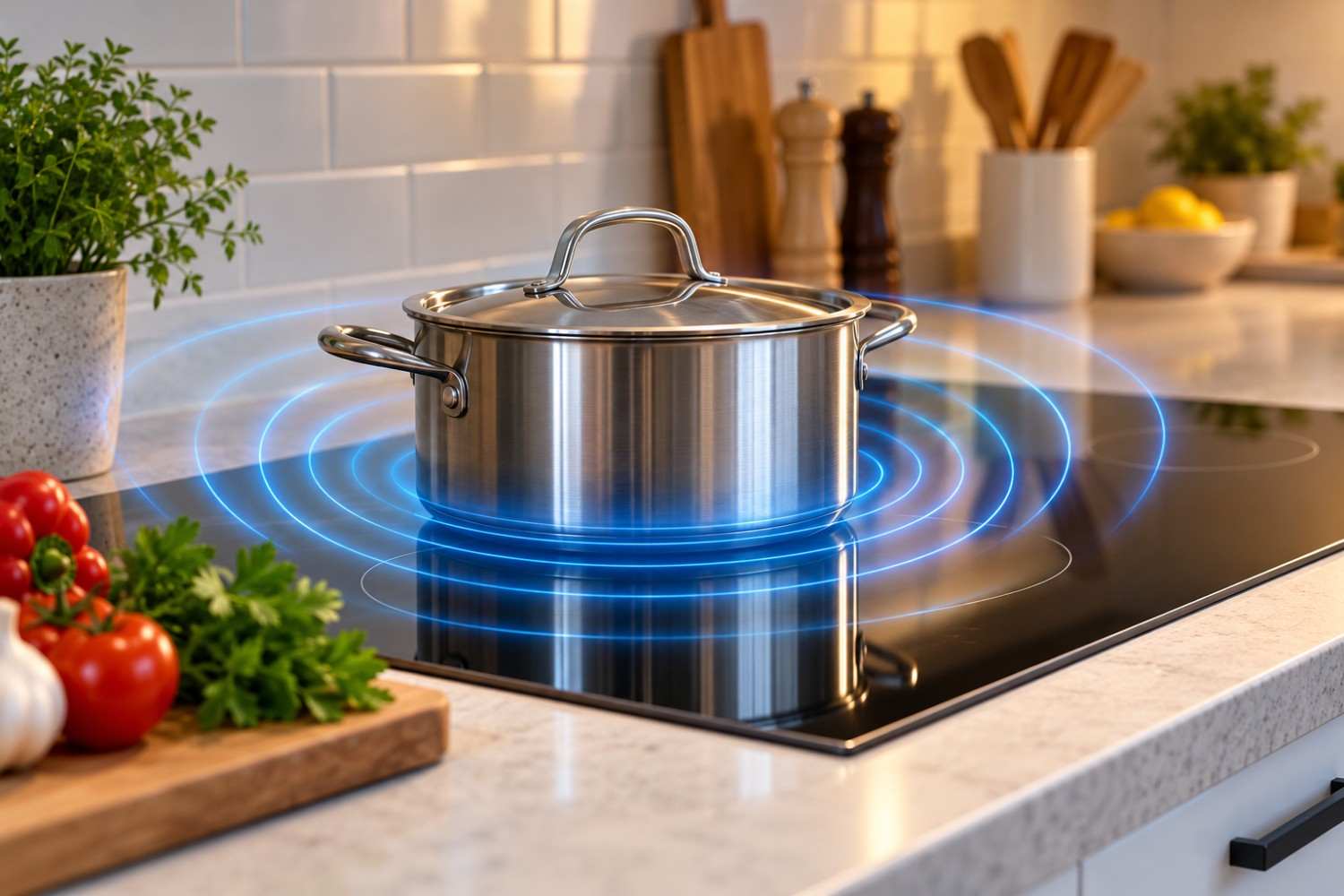
Induction cooktops have become increasingly popular because they heat quickly, offer precise temperature control, and can be more energy-efficient than traditional cooking methods. But unlike a conventional electric burner, induction cooking relies directly on electromagnetic fields to heat cookware. That naturally raises questions about induction cooktop EMF, including how much electromagnetic exposure these appliances produce, whether the fields reach the person cooking, and what can be done to reduce exposure.
The short answer is that induction cooktops do produce measurable electromagnetic fields. This is not simply an unwanted side effect of the appliance—it is fundamental to how induction cooking works. However, the amount of exposure a person receives depends on several factors, including distance from the cooktop, the power setting, the size and placement of the cookware, and the design of the appliance itself.
That makes induction cooking a more complicated subject than simply labeling it “safe” or “unsafe.” In this article, we will look at how induction cooktops work, what researchers have measured, why distance is so important, and some practical steps you can take if you would like to minimize unnecessary EMF exposure in your kitchen.
How Does an Induction Cooktop Work?
An induction cooktop may look similar to a smooth-top electric stove, but the method it uses to heat food is quite different.
Underneath the glass cooking surface is an electromagnetic coil. When the cooktop is operating, alternating electrical current passes through this coil and creates a rapidly changing magnetic field. When compatible cookware is placed over the cooking zone, that changing magnetic field induces electrical currents – known as eddy currents – in the metal cookware.
The electrical resistance of the cookware converts that energy into heat. In simple terms, instead of first heating an electric element and transferring that heat into the pan, induction technology causes the cookware itself to heat.
This is one reason induction cooking can respond so quickly when you change the temperature setting.
It also explains why not every pot and pan works on an induction cooktop. The cookware generally needs to contain a ferromagnetic material that interacts properly with the cooktop’s magnetic field. Cast iron and many types of magnetic stainless steel cookware work well, while some aluminum, copper, and glass cookware will not work unless they contain an induction-compatible base.
A simple test is to place a magnet against the bottom of a pot or pan. If the magnet sticks firmly, the cookware will often work with an induction cooktop, although checking the manufacturer’s instructions is still a good idea.
Do Induction Cooktops Produce EMF?
Yes. Induction cooktops intentionally generate electromagnetic fields as part of their normal operation.
The important point is understanding what kind of electromagnetic field is involved.
The electromagnetic spectrum includes many different types of energy. X-rays and gamma rays, for example, are forms of ionizing radiation with enough energy to remove electrons from atoms. Induction cooktops do not produce this type of ionizing radiation as their cooking mechanism.
Instead, induction cooktops typically operate using alternating magnetic fields in what researchers describe as the intermediate-frequency range. A 2022 study that measured more than 70 induction cookers in real homes reported fundamental frequencies generally between 20 and 30 kilohertz for the cookers measured.
This distinction matters because the word “radiation” by itself can make almost any appliance sound alarming. The more useful questions are what frequencies are being produced, how strong the fields are where a person is actually standing, how exposure changes with distance, and what the scientific evidence tells us about those exposures.
So while induction cooktop EMF is very real and measurable, the presence of an electromagnetic field by itself does not establish that normal use causes harm.
How Much EMF Does an Induction Cooktop Produce?
There is no single EMF measurement that accurately represents every induction cooktop.
Measurements can change considerably depending on the appliance and how it is being used. The distance between the measurement instrument and cooking zone is especially important. Power level, cookware size, burner size, cookware position, and the design of the cooktop can also affect measurements.
One useful real-world study published in 2022 measured intermediate-frequency magnetic fields from more than 70 household induction cookers. Researchers reported an average magnetic field of approximately 0.23 microtesla (μT) at a horizontal distance of 30 centimeters, measured at the height of the cooking table.
The researchers found that distance from the center of the cooking zone was an important factor when estimating exposure. Wattage and cookware diameter were also incorporated into their exposure models.
Other research has similarly demonstrated that induction-cooker exposure is highly dependent on where measurements are taken.
A 2017 study examining intermediate-frequency fields from household appliances found that induction cookers produced some of the highest measurements among the appliances evaluated at close range. However, none of the appliance emissions evaluated at 20 centimeters and beyond exceeded the exposure summation rules used by the researchers under the referenced ICNIRP guidelines and IEC standard.
More recent research has continued to show considerable differences among individual induction hobs. A 2025 exposure-assessment study reported variations greater than a factor of 20 depending on factors including power, coil size, and proximity to the coil. The researchers also raised questions about whether existing standardized testing procedures always capture the exposure of a person standing close to a cooktop.
The most useful takeaway is therefore not a single number. Where you stand and how the cooktop is being used can make a substantial difference in the electromagnetic field reaching your body.
Why Distance Matters With Induction Cooktop EMF
Distance is one of the simplest variables you can control when using an induction cooktop.
Magnetic fields from an induction cooking zone become weaker as you move farther away from their source. This means a measurement taken very close to an active cooking zone should not be assumed to represent your exposure several inches or a foot away.
This is particularly relevant in a kitchen because people sometimes stand with their abdomen almost against the edge of the counter while cooking. Someone may also lean over a burner while stirring a pot or checking food.
Current guidance from the Swiss Federal Office of Public Health recommends maintaining approximately 15 centimeters, or about 6 inches, between your body and an induction cooktop. It also recommends using the rear cooking zones when cooking at the highest power setting and using appropriately sized cookware.
You do not necessarily need to stand several feet away from your dinner while it cooks. Even modest changes in cooking position can increase your distance from the active electromagnetic coil.
This is one reason distance is such a practical EMF-reduction strategy. It doesn’t require purchasing another device or changing how your kitchen is wired.
Does the Cookware Make a Difference?
Cookware deserves more attention than it often receives when discussing induction cooktops.
An induction burner is designed to transfer energy efficiently into compatible cookware. When the pan is properly sized and centered over the active cooking zone, the system can operate more as intended.
The Swiss Federal Office of Public Health specifically recommends using cookware that is large enough to cover the marked cooking zone completely and placing the cookware in the center of that zone.
Using a small pot on a considerably larger induction zone may allow more of the magnetic field to extend beyond the base of the cookware.
That doesn’t mean you need to measure every pot in your kitchen before preparing dinner. A practical approach is simply to match the diameter of your cookware reasonably closely to the cooking zone and center it rather than placing it off to one side.
If you are buying new cookware, check that it is specifically labeled as induction-compatible and follow the recommendations supplied by your cooktop manufacturer.
What Does Research Say About Induction Cooktop Exposure?
Research on intermediate-frequency electromagnetic fields is not as extensive as research involving some other portions of the electromagnetic spectrum.
That uncertainty is worth acknowledging.
A systematic review published in Environmental Research evaluated 56 studies involving intermediate-frequency electric, magnetic, or electromagnetic fields. The researchers found considerable differences in study designs, frequencies, exposure levels, and biological endpoints. They concluded that the quality of evidence was inadequate to reach conclusions about adverse biological effects for most of the endpoints investigated.
That doesn’t mean adverse effects have been established, nor does it prove that no effects are possible. It means the available evidence has limitations and additional high-quality research would be useful.
Laboratory studies have also investigated induction-cooktop frequencies.
For example, a study exposing cells to a 23-kHz magnetic field reported no detectable effects on cell growth, DNA damage measures, mutation frequency, or several indicators of cellular stress under the experimental conditions used.
Another study examining a 23-kHz magnetic field at a substantially higher magnetic flux density than normal public reference levels similarly found no detectable genotoxicity or cellular stress responses under the conditions tested.
These experiments should not be interpreted as proving that every type of long-term exposure is harmless. Laboratory cell studies answer specific questions under specific experimental conditions.
Human exposure research also has limitations.
A study involving 1,565 mothers in Japan examined induction cooker use during pregnancy and several birth outcomes. Induction cooker use was not associated with low birth weight, being small for gestational age, or birth weight in that study. The researchers noted that the health effects of intermediate-frequency EMF exposure during pregnancy remained uncertain.
The broader picture, therefore, is more nuanced than either “induction cooktops are dangerous” or “there is absolutely nothing to think about.”
Induction cooktops generate measurable intermediate-frequency magnetic fields. Exposure generally changes substantially with distance and operating conditions. Existing research has not established a clear pattern of adverse health effects from ordinary household induction-cooker use, but research into intermediate-frequency exposure remains less developed than research into several other types of electromagnetic fields.
What About Exposure Guidelines?
Another point that can be confusing is the difference between an EMF reference level and evidence that an exposure is causing harm.
Exposure guidelines are designed to establish limits intended to protect people from established effects. Researchers and standards organizations can use measurements, modeling, and calculations of fields induced inside the body when assessing exposure.
A 2012 study of domestic and professional induction cooktops found that most of the cooktops tested complied with public exposure limits when measured at the standardized distance specified by the IEC procedure used in the study. However, the researchers reported that measurements and modeled exposures became more concerning at closer distances and questioned whether the standardized testing methodology adequately represented people standing very close to a cooktop.
A newer 2025 study also reported significant differences among induction hobs and raised concerns that certain standardized assessment procedures could underestimate exposure for someone standing directly beside the appliance.
There is an important distinction here: exceeding a reference level does not automatically mean that an adverse health effect will occur. Reference levels are part of a safety-assessment framework, and researchers may perform more detailed calculations to determine whether underlying restrictions within the body are exceeded.
For consumers, the practical lesson is much simpler: avoid unnecessary close contact with an active induction cooking zone.
Practical Ways to Reduce EMF Exposure From an Induction Cooktop
If you already own an induction cooktop, there is no need to assume that reducing exposure requires removing it from your kitchen. Many of the simplest exposure-reduction strategies involve changing how you use the appliance rather than buying anything.
The following steps are reasonable ways to reduce unnecessary exposure while still taking advantage of induction cooking:
- Create some distance while cooking. Avoid pressing your abdomen against the counter or cooktop edge. The Swiss public-health guidance recommends maintaining about 15 centimeters, or roughly 6 inches, of distance.
- Use the rear cooking zones when practical. This naturally places the active electromagnetic coil farther from your body, particularly when you’re using high power.
- Center cookware over the cooking zone. Proper alignment helps the cooktop and cookware interact as intended.
- Match cookware to the burner. Avoid using a very small pot on a much larger induction zone when a better-matched zone is available.
- Don’t stand directly over the cooktop unnecessarily. You may need to approach the stove to stir, flip, or check food, but you don’t have to remain extremely close during the entire cooking process.
- Use only the power you need. High-power or boost modes can be useful for quickly boiling water, but there is little reason to leave the cooktop at maximum output when a lower setting is sufficient for the food you’re preparing.
- Follow the manufacturer’s instructions. Cooktop designs vary, and the manufacturer’s recommendations for cookware size, positioning, and use should take priority for your particular appliance.
These aren’t complicated precautions. They follow a basic principle that applies to many EMF sources: when exposure can be reduced conveniently through sensible use and greater distance, there is little downside to doing so.
Can You Measure EMF From Your Own Induction Cooktop?
If you’re particularly interested in your own kitchen, measuring your cooktop can be more informative than relying on a number someone measured from a completely different appliance.
However, there is an important catch.
Not every EMF meter is suitable for measuring an induction cooktop.
Many inexpensive magnetic-field meters are designed primarily around the 50- or 60-Hz frequencies associated with household electricity. Induction cooktops commonly operate at much higher frequencies—often in the tens of kilohertz. A meter’s published frequency response therefore matters.
One option sold by Safe Living Technologies is the Gigahertz Solutions ME3830B EMF Meter, which the company states measures AC electric and magnetic fields with a frequency response extending from 16 Hz to 100 kHz. That range encompasses the roughly 20–30 kHz fundamental frequencies reported for many induction cookers in the 2022 household study.
If you use a meter, avoid taking a single measurement directly against the cooktop and treating that number as your personal exposure.
A more useful experiment is to measure at several distances. For example, you could measure close to the cooktop and then progressively farther away while keeping the cooktop, burner, cookware, and power setting the same.
You could also compare the front and rear cooking zones.
This gives you a much better picture of how the field changes throughout the space where you actually stand.
Keep in mind that consumer EMF meters also have limitations. Frequency response, maximum measurement range, orientation, calibration, and measurement technique can all influence the displayed number. A consumer meter should not be treated as a substitute for professional exposure assessment.
Affiliate Advertisement

What About Pacemakers and Other Implanted Medical Devices?
People with pacemakers, implanted cardioverter-defibrillators, or other electronic medical implants should treat induction cooking somewhat differently from someone who is simply interested in minimizing everyday EMF exposure.
Electromagnetic fields can potentially interfere with some implanted electronic medical devices under certain conditions. The appropriate distance and precautions depend on the specific medical device and cooktop.
For that reason, generic internet advice should not replace instructions from the medical-device manufacturer or a healthcare professional.
If you have an implanted electronic medical device, check the device manufacturer’s electromagnetic-interference guidance and ask your physician or device clinic whether there are specific restrictions for induction cooking.
This is one situation where a generalized recommendation such as “stand six inches away” should not automatically be assumed to be appropriate for every person and every implanted device.
Induction vs. Conventional Electric Cooking: What About EMF?
It is easy to assume that switching from induction to a conventional electric stove eliminates electromagnetic fields, but that isn’t entirely accurate.
Conventional electric appliances also generate electric and magnetic fields because electrical current flows through their heating elements and internal wiring. The frequencies and field characteristics, however, differ from those associated with induction cooking.
An induction cooktop deliberately produces a relatively strong alternating magnetic field at intermediate frequencies in order to transfer energy to the cookware. A traditional resistance heating element instead converts electrical energy into heat directly within the element.
From an EMF perspective, that makes the exposure patterns different.
But EMF is only one consideration when comparing cooking technologies. Energy efficiency, cooking speed, temperature control, burn risk, indoor air quality, ventilation, cost, cookware compatibility, and personal cooking preferences can all matter.
Gas cooking introduces its own set of considerations because combustion can produce indoor air pollutants. For that reason, choosing a cooking method based solely on electromagnetic fields ignores other factors that may be relevant to your household.
Frequently Asked Questions About Induction Cooktop EMF
There are several recurring questions about induction cooking and electromagnetic exposure. The answers below provide a quick reference while keeping in mind that individual cooktop models and operating conditions vary.
Do induction cooktops emit EMF?
Yes. Induction cooktops use alternating electromagnetic fields to induce electrical currents in compatible cookware. The magnetic field is an essential part of the heating process.
Is induction cooktop radiation ionizing?
No. The electromagnetic fields used by induction cooktops are non-ionizing. They do not operate using ionizing radiation such as X-rays or gamma rays.
How far should I stand from an induction cooktop?
The Swiss Federal Office of Public Health recommends maintaining approximately 15 centimeters, or about 6 inches, between your body and an induction cooktop. It also recommends using the rear cooking zones when cooking at maximum power.
If you have an implanted electronic medical device, follow the recommendations of your medical-device manufacturer and healthcare professional rather than relying on a general distance recommendation.
Does induction cooktop EMF decrease with distance?
Yes. Distance from the active cooking zone is an important determinant of exposure. Research measuring household induction cookers has found distance to be an important variable when estimating magnetic-field exposure.
This is why standing a little farther away can make a meaningful difference.
Does cookware affect electromagnetic exposure?
It can. Cookware diameter and positioning are among the variables researchers have examined when estimating exposure. Use induction-compatible cookware that appropriately matches the cooking zone and keep it centered whenever possible.
Is it dangerous to stand next to an induction stove?
Current evidence does not establish that normal household induction-cooktop use causes adverse health effects. However, induction cooktops can produce relatively strong magnetic fields at close distances, and research into the biological effects of intermediate-frequency fields remains limited.
Maintaining a reasonable distance while cooking is a simple precaution.
Do induction cooktops affect pacemakers?
Electromagnetic interference can potentially affect some implanted electronic medical devices. Anyone with a pacemaker or similar device should consult the implant manufacturer’s guidance and their healthcare professional regarding induction appliances.
Can any EMF meter measure an induction cooktop?
No. Check the meter’s frequency range before using it.
A meter designed primarily for 50/60-Hz household magnetic fields may not accurately measure an induction cooktop operating in the tens-of-kilohertz range. Look at the manufacturer’s published specifications rather than assuming that anything labeled an “EMF meter” will work.
Does an induction cooktop produce EMF when it is turned off?
The strong alternating magnetic field used for induction heating is associated with active operation. However, like many modern electronic appliances, an induction cooktop may contain powered electronics while connected to electricity even when it isn’t actively heating.
Those standby emissions should not be confused with the much more relevant magnetic field produced during active induction cooking.
Conclusion
Induction cooktops are unusual among household appliances because electromagnetic fields aren’t merely an incidental byproduct—they are central to how the appliance cooks food. An alternating magnetic field interacts with compatible cookware, causing the cookware itself to generate heat.
The amount of induction cooktop EMF reaching a person is not represented well by one universal number. Cooktop design, power setting, cookware diameter and positioning, and especially distance from the active cooking zone can all affect exposure.
Research confirms that induction cooktops produce measurable intermediate-frequency magnetic fields, particularly at close distances. At the same time, the available scientific evidence does not establish that ordinary household induction cooking causes adverse health effects, and research on the biological effects of intermediate-frequency exposure remains incomplete.
For someone who wants to take a precautionary approach, the practical steps are straightforward. Maintain some distance from the cooktop, use rear burners when practical, center appropriately sized cookware over the cooking zone, avoid leaning against the stove, and follow the manufacturer’s instructions.
You don’t have to fear your induction cooktop to make sensible choices about electromagnetic exposure. Understanding where the fields come from – and how quickly your exposure can change based on the way you cook – is a much more useful approach.
Before You Go…
Get Weekly EMF Protection Tips
Enjoy this article? Join the EMFLuLu newsletter for simple weekly tips to reduce everyday EMF exposure from phones, WiFi routers, laptops, and smart home devices.
Try Our Free EMF Calculators
Curious how much EMF exposure you may experience each day?
These simple tools can help you estimate your exposure and identify possible problem areas in your home.
Try these free calculators:
Like this article? Pin it on Pinterest!


More to Explore