Fast charging has changed the way many people use their phones. Instead of plugging a device in for several hours, newer chargers can restore a significant portion of a battery in a relatively short time. Higher-wattage USB-C adapters have also become common for tablets, laptops, and other portable electronics. But the ability to transfer more power raises an understandable question: does faster charging also mean stronger electromagnetic fields? When considering fast charger EMF, the answer is more complicated than simply assuming that more watts always equal more EMF. Charging power, electrical current, voltage, charger design, power-conversion circuitry, the cable, the connected device, and your distance from the equipment can all influence the electromagnetic environment around a charging setup.
Understanding these factors can help you make practical decisions without giving up the convenience of fast charging. It also helps separate the electromagnetic fields produced by electrical charging equipment from the radiofrequency signals a phone may produce through cellular, Wi-Fi, and Bluetooth connections.
What Exactly Is Fast Charging?
Fast charging is a broad term used to describe charging technologies capable of delivering more power to a compatible device than older, basic charging systems.
Electrical power is measured in watts. A simple way to understand the relationship is:
Voltage × Current = Power
For example, a charging system delivering 5 volts at 1 amp provides 5 watts of power. Modern charging systems can provide considerably more power by increasing voltage, current, or both.
USB-C has helped make higher-power charging increasingly common. USB Power Delivery, often called USB-PD, allows compatible chargers and devices to communicate with each other and determine an appropriate charging level. Other manufacturers and chipmakers have developed their own fast-charging technologies as well.
One important point is that the maximum wattage printed on a charger does not necessarily represent the amount of power continuously entering your phone.
If you connect a phone that accepts a maximum of 20 watts to a 65-watt USB-C charger, for example, the charger does not simply force 65 watts into the phone. Compatible devices and chargers negotiate the power level. Charging power can also change as the battery fills.
This is one reason comparing EMF solely according to the wattage printed on two charging adapters can be misleading.
Do Phone Chargers Produce EMF?
A phone charger is an electrical device, so electromagnetic fields can exist around its components and wiring while it operates.
It helps, however, to understand that “EMF” is a broad term rather than a single type of emission.
Electric fields are associated with voltage. Magnetic fields are associated with the movement of electrical current. A charger can therefore contribute to both types of fields.
Modern chargers also contain electronic circuitry that converts the alternating current, or AC, supplied by a household electrical outlet into the direct current, or DC, required by a phone or other battery-powered device. Modern switching power supplies perform this conversion efficiently using electronic components that rapidly switch electrical current.
Radiofrequency, or RF, electromagnetic fields are another consideration, but they should not automatically be attributed to the charging adapter.
A smartphone may simultaneously communicate with cellular towers, a Wi-Fi router, Bluetooth devices, and other wireless equipment while its battery is charging. Those transmissions come primarily from the phone’s wireless systems rather than from the fact that electricity is flowing through a USB charging cable.
This distinction becomes especially important when someone attempts to measure EMF around a charging phone. A meter reading near the phone may include activity associated with the phone itself, not simply the wall charger.
Does Fast Charging Produce More EMF?
It may seem reasonable to assume that if one charger transfers more power than another, it must automatically create proportionally stronger electromagnetic fields.
The actual relationship is not that simple.
Higher-power charging can involve greater electrical current, different voltages, and different power-conversion conditions. Electrical current is relevant to magnetic fields, so the amount of current flowing through parts of the charging system can influence magnetic-field measurements.
However, power level is only one variable.
Charger construction, circuit design, switching frequency, efficiency, component placement, shielding, cable construction, charging load, and measurement location can all affect what an EMF meter detects.
For that reason, you should not assume that a 30-watt charger will create six times the EMF of a 5-watt charger simply because its maximum power rating is six times higher.
The fast charger EMF produced by one charging setup could also differ from another charger with the same wattage rating. Two 30-watt chargers from different manufacturers are not necessarily electrically identical inside.
Charging conditions change over time as well.
A phone may draw relatively high power during one portion of the charging cycle and reduce the amount of power it accepts as the battery approaches a full charge. Temperature and battery-management systems can also influence charging behavior.
The important takeaway is that charging speed can affect the electrical conditions associated with EMF production, but charging speed by itself does not tell you exactly what EMF levels will exist around a particular charger.
Actual measurement is much more informative than assuming that wattage and EMF increase at a fixed ratio.
Where Does EMF Come From During Phone Charging?
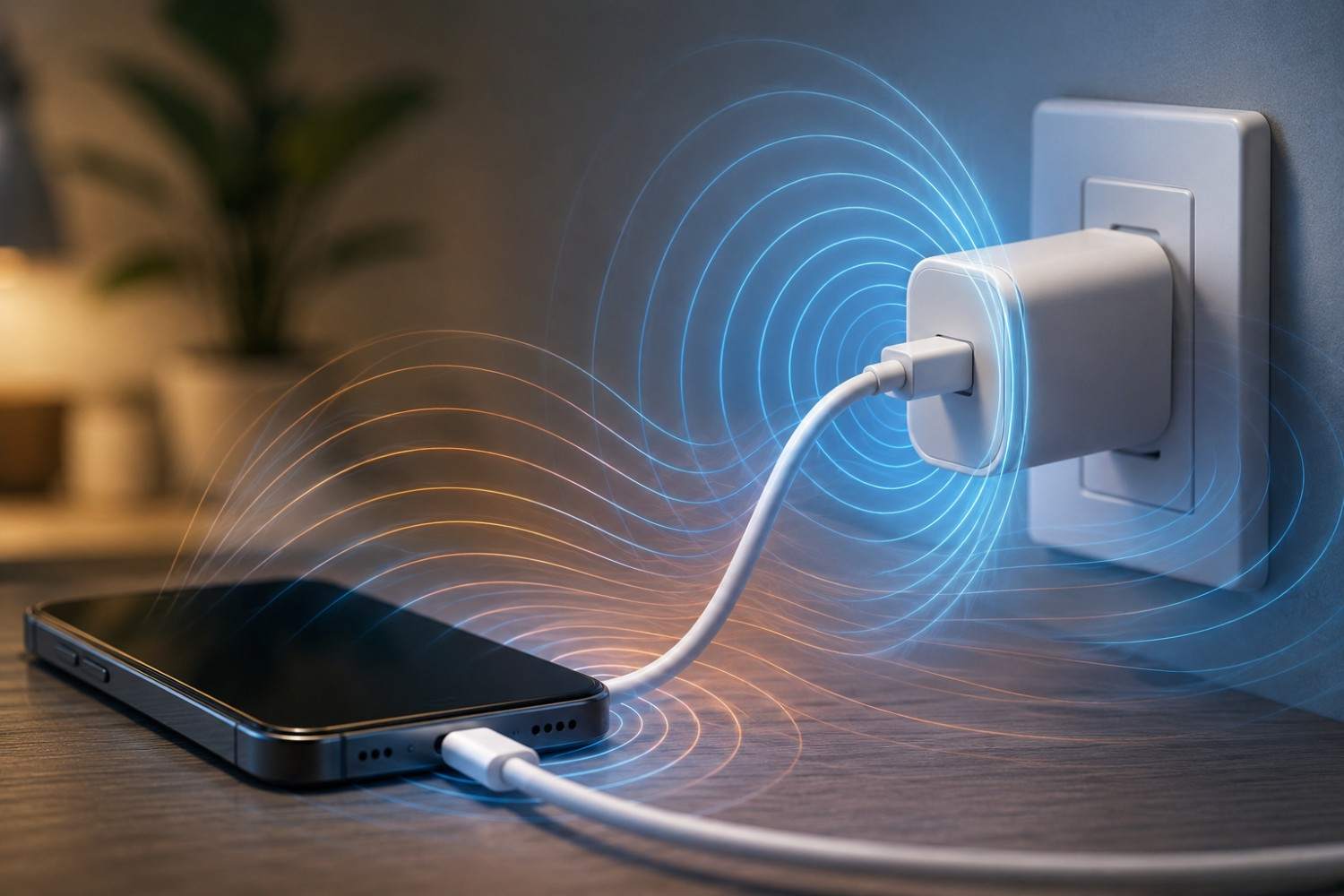
When you plug a phone into the wall, it is tempting to think of the charger as a single EMF source. In reality, the charging system contains several components that can contribute to the electromagnetic environment.
Understanding those individual components makes it easier to determine what you are actually measuring.
The Wall Adapter
The charging brick converts electricity from the wall into the type of electrical power required by your device.
Inside a modern charger are transformers, switching electronics, capacitors, and other components responsible for regulating and converting electrical power. Electric and magnetic fields can exist around these components while the charger is operating.
The Charging Cable
The cable carries electrical current from the charging adapter to the device.
Current flowing through a conductor creates a magnetic field around that conductor. The design of the cable and arrangement of conductors can affect the field around it.
This doesn’t mean a charging cable should be viewed as inherently dangerous. It simply explains why the cable itself can be part of an EMF measurement.
The Phone
The phone has its own charging and battery-management electronics. Electricity entering the device must be controlled and delivered appropriately to the battery.
At the same time, the phone may be producing RF electromagnetic energy through cellular, Wi-Fi, Bluetooth, or other wireless communication.
Therefore, an EMF reading taken directly against a charging phone should not automatically be described as “charger radiation.”
There may be multiple sources contributing to the measurement.
Fast Wired Charging vs. Wireless Charging
Wired and wireless charging accomplish the same basic objective – transferring energy into a battery – but they do it in different ways.
A wired charger sends electrical current through physical conductors in a cable.
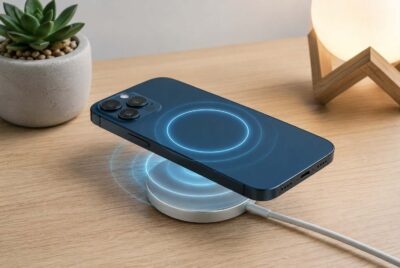
Wireless charging intentionally uses electromagnetic coupling to transfer power across a small air gap. A coil in the charging pad produces a changing magnetic field, which interacts with another coil inside the phone.
Technologies such as Qi use this principle. Newer magnetic alignment systems can help position the device’s charging coil correctly over the charging pad’s coil.
Because wireless charging relies on electromagnetic fields for power transfer, its electromagnetic environment is different from that of a conventional wired USB charging cable.
This does not mean that every wired charger has a particular EMF level or that every wireless charger has another predictable level. Charger design, power output, coil alignment, distance, and other factors matter.
It does mean that someone specifically attempting to minimize exposure to the electromagnetic fields involved in wireless power transfer may prefer wired charging when it is convenient.
Efficiency is another consideration. Poor alignment between wireless charging coils can reduce charging efficiency and create additional heat. Proper alignment is therefore important both for charging performance and for reducing unnecessary energy loss.
Does Distance From a Fast Charger Matter?
Distance is one of the most useful concepts to understand when discussing everyday EMF exposure.
Electromagnetic fields from localized sources generally become weaker as you move away from the source, although the exact relationship depends on the type of field, frequency, source geometry, and measurement conditions.
You can demonstrate this yourself with appropriate measuring equipment.
Take a measurement very close to a powered charging adapter and then repeat the measurement progressively farther away. Depending on the equipment and the type of field being measured, you may see the reading decrease considerably.
This principle provides an extremely simple option for people who prefer to minimize unnecessary exposure.
There is usually no reason for a charging brick to be pressed against your body.
If your phone can charge on a table rather than in your pocket, or the charging adapter can remain several feet from where you sit or sleep rather than immediately beside you, you can create additional distance without changing chargers at all.
Distance also costs nothing.
You don’t need to purchase a specialized accessory to move a charging phone farther away.
Should You Use Your Phone While It Is Fast Charging?
Using your phone while it charges introduces another variable because the phone itself may be transmitting wireless signals.
Imagine plugging your phone into a fast charger and then holding it against your body while streaming a video.
Several things may now be occurring at once.
The charging adapter is converting power. Electrical current is moving through the charging cable. The phone’s battery-management system is operating. The phone may also be transmitting and receiving data through Wi-Fi or a cellular connection.
If Bluetooth headphones or a smartwatch are connected, Bluetooth communication may be occurring as well.
Trying to attribute an EMF measurement in this situation exclusively to fast charging would therefore be difficult.
For someone taking a precautionary approach to EMF, charging time offers an easy opportunity to create distance.
Put the phone on a desk, countertop, or table and allow it to charge rather than continuously holding it.
You don’t have to stop using fast charging to do this.
What About Airplane Mode While Charging?
Airplane mode can be useful if you want to distinguish the phone’s wireless RF activity from the electrical fields associated with charging.
When cellular and other wireless transmitters are disabled, the phone isn’t performing the same type of wireless communication it normally would.
Keep in mind that airplane-mode behavior can vary by device, and Wi-Fi or Bluetooth can sometimes be manually re-enabled while airplane mode remains active.
If you are conducting your own comparison, you could measure the phone under several conditions: unplugged with wireless services operating, charging normally, and charging with wireless connections disabled.
This type of comparison can tell you much more about your own setup than simply assuming every meter reading comes from the charger.
Does Fast Charging at Night Matter?
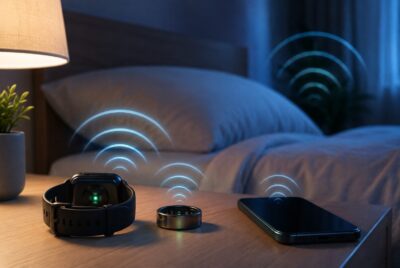
Nighttime charging deserves special attention because many people keep their phones remarkably close to where they sleep.
A nightstand may place a phone only a foot or two from someone’s head for six, seven, or eight hours. Some people place phones even closer or leave them on the bed.
If you are concerned about reducing unnecessary EMF exposure, this is one situation where a simple change can make sense.
Move the charging location farther from the bed.
You might place the phone on a dresser or another piece of furniture instead of directly beside your pillow. If you don’t need to receive calls overnight, you can also consider airplane mode.
Avoid placing a charging phone underneath a pillow or bedding. This recommendation has an additional benefit unrelated to EMF: electronic devices and chargers need appropriate conditions for heat to dissipate.
Keeping a charging device uncovered is a sensible charging practice regardless of your position on EMF exposure.
Practical Ways to Reduce EMF While Fast Charging
You don’t necessarily need to abandon fast charging if your goal is to reduce unnecessary electromagnetic-field exposure. Many of the most practical approaches involve changing where and how you charge rather than buying specialized equipment. The following strategies are inexpensive, easy to test, and generally don’t interfere with the convenience that makes fast charging useful.
- Create More Distance
Avoid keeping the charging brick unnecessarily close to your body.
If an outlet is beside your chair, for example, position the adapter and phone where you don’t need to rest against them.
The same principle applies at night. A charging phone does not necessarily need to sit inches from your head.
- Put the Phone Down While It Charges
Fast charging can actually make this easier because the phone may not need to remain plugged in as long.
Instead of holding and using the phone continuously during charging, leave it on a table or counter when practical.
This creates distance from both the charging equipment and the phone’s own wireless transmitters.
- Consider Wired Charging
If your specific goal is reducing exposure to the electromagnetic fields intentionally used for wireless power transfer, conventional wired charging is an alternative.
A USB cable still carries electrical current and should not be described as producing zero EMF. It simply transfers power differently than an inductive wireless charger.
- Disable Wireless Connections When You Don’t Need Them
If you are charging your phone overnight and don’t need cellular, Wi-Fi, or Bluetooth connectivity, airplane mode can reduce wireless RF transmissions from the phone.
You can also selectively disable wireless features you don’t need.
- Don’t Carry a Charging Phone Against Your Body
Some people use portable power banks while carrying the phone in a pocket.
If minimizing exposure is your objective, place the charging phone and power bank in a bag or another location rather than keeping both devices pressed against your body whenever practical.
- Use Reputable Charging Equipment
Choose chargers and cables from established manufacturers that meet appropriate electrical safety and compatibility standards.
A charger should be appropriate for the device being charged. Extremely cheap, poorly made, or damaged electrical accessories aren’t worth using simply to save a few dollars.
Affiliate Advertisement

Can You Measure Fast Charger EMF Yourself?
If you want to know how your own charging equipment behaves, measurement can be more informative than speculation.
This is particularly useful because chargers vary considerably.
A useful experiment would involve comparing your regular charger with your fast charger under similar conditions.
Before starting, establish a baseline measurement in the room. Then plug in the first charger and take measurements at consistent locations around the adapter, cable, and phone.
Repeat the test using the fast charger.
For a meaningful comparison, try to keep as many variables consistent as possible. Use the same phone, similar battery levels, the same outlet, the same measurement distances, and the same meter orientation.
You could record readings:
- Directly near the charging adapter.
- Several inches from the adapter.
- One foot away.
- Near the cable.
- Near the phone.
- One foot from the phone.
The purpose of taking measurements at several distances is not simply to find the highest possible number. It helps you see how the field changes as you move away from the equipment.
You could also compare the phone with Wi-Fi, cellular, and Bluetooth active versus airplane mode.
If your meter measures multiple types of EMF, make sure you understand which measurement mode you are using. A magnetic-field measurement and an RF measurement aren’t interchangeable.
This is particularly important when evaluating fast charger EMF because the phone itself can introduce RF signals that have little to do with the charger’s wattage.
Is More EMF Automatically More Dangerous?
This is where careful terminology matters.
The ability to detect an electromagnetic field does not, by itself, establish that the exposure is harmful.
Electromagnetic fields exist across an enormous range of frequencies and energy levels. The non-ionizing electromagnetic fields associated with household electrical equipment and wireless devices should not be confused with ionizing radiation such as X-rays and gamma rays.
When evaluating an electromagnetic exposure, factors can include frequency, field strength, duration, distance, and how the energy interacts with the body.
That is why statements such as “this charger produces radiation” provide very little useful information on their own.
What type of electromagnetic energy?
At what frequency?
At what intensity?
Measured at what distance?
Those details matter.
People who prefer a precautionary approach can still reduce unnecessary exposure without assuming that every detectable field represents a demonstrated health hazard.
Increasing distance is an especially practical approach because it doesn’t require making claims about exactly what level of exposure is or isn’t harmful.
Is a Slower Charger Better for EMF?
Not necessarily.
A slower charger transfers less power, but wattage isn’t the only characteristic determining the electromagnetic fields around a charging system.
A low-quality slow charger could have different electrical characteristics from a well-designed fast charger. Two fast chargers with identical wattage ratings could also produce different measurements.
The cable, connected device, electrical outlet, charging state, and measurement location introduce additional variables.
If your goal is simply to minimize unnecessary exposure, switching from fast charging to slow charging may be less useful than improving your charging habits.
Creating distance, putting the phone down while charging, disabling unnecessary wireless connections, and moving nighttime charging away from the bed are all straightforward options.
If you want to know whether your particular slow charger actually measures differently from your fast charger, test both under comparable conditions.
Frequently Asked Questions About Fast Charging and EMF
Several questions naturally come up when discussing chargers and electromagnetic fields. The answers below summarize the most important points while also highlighting why charging wattage should not be considered in isolation.
Do fast chargers emit more radiation?
Fast chargers can create electromagnetic fields because they are electrical devices carrying and converting power. However, you cannot determine the EMF level simply by looking at the charger’s wattage. Current, voltage, circuitry, switching electronics, construction, load, and measurement distance can all influence readings.
Does a 65W charger produce more EMF than a 20W charger?
Not necessarily at every location or for every type of EMF measurement.
A 65-watt charger is capable of delivering more power, but the connected device determines how much compatible power it actually accepts. The internal design of the chargers can also differ.
Measuring both chargers under comparable conditions is a better way to answer the question for particular models.
Does airplane mode reduce EMF while charging?
Airplane mode can reduce RF transmissions from the phone by disabling cellular and other wireless communications, depending on the device and settings.
It does not stop electricity from flowing through the charger or eliminate the electric and magnetic fields associated with the charging system.
Is wired charging lower EMF than wireless charging?
They use different methods of transferring energy.
Wireless charging intentionally transfers power through electromagnetic coupling between coils. Wired charging transfers electrical energy through conductors.
It is therefore more accurate to say that they create different electromagnetic environments than to claim that every wired charger always produces a specific amount less EMF than every wireless charger.
Does fast charging cause harmful radiation?
Fast charging equipment involves non-ionizing electromagnetic fields. These should not be confused with ionizing radiation such as X-rays.
Simply detecting EMF around a charger does not demonstrate that the exposure is harmful. Anyone concerned about unnecessary exposure can use practical measures such as increasing distance without assuming that ordinary charging equipment has been proven to cause harm.
Conclusion
Fast charging allows phones and other portable electronics to replenish their batteries much more quickly than older charging systems, but higher charging speed doesn’t translate into a simple, predictable increase in electromagnetic fields. Current, voltage, charger circuitry, switching electronics, cable design, device activity, and distance can all influence measurements. When comparing fast charger EMF levels with those of a conventional charger, looking at the entire charging setup is much more useful than focusing solely on the wattage printed on the adapter.
For people who prefer to minimize unnecessary EMF exposure, the simplest approaches don’t require abandoning fast charging. Create some distance from charging equipment, put your phone down while it charges, consider wired charging when practical, disable wireless connections when they aren’t needed, and avoid sleeping with a charging phone immediately beside your head. If you want to know exactly how your own equipment behaves, taking measurements under controlled conditions can provide much more useful information than assuming every fast charger behaves the same way.
Before You Go…
Get Weekly EMF Protection Tips
Enjoy this article? Join the EMFLuLu newsletter for simple weekly tips to reduce everyday EMF exposure from phones, WiFi routers, laptops, and smart home devices.
Try Our Free EMF Calculators
Curious how much EMF exposure you may experience each day?
These simple tools can help you estimate your exposure and identify possible problem areas in your home.
Try these free calculators:
Like this article? Pin it on Pinterest!
More to Explore