Protecting a home from unexpected electrical surges has become more important than ever. Modern households depend on expensive electronics, smart appliances, computers, televisions, home offices, and connected devices that can all be vulnerable to sudden voltage spikes. As homeowners look for ways to safeguard these investments, many also begin asking questions about electromagnetic fields (EMFs) and whether electrical protection devices influence their everyday exposure.
One question that comes up frequently is whether a whole-house surge protector EMF relationship exists. Does installing one create additional EMFs? Can it reduce EMFs? Is it simply an electrical safety device, or does it also contribute to a healthier home environment? These are excellent questions because surge protection and EMF awareness often become part of the same conversation, even though they serve different purposes.
The truth is that a whole-house surge protector EMF discussion requires separating facts from common misconceptions. While surge protectors are designed to shield electrical systems from damaging voltage spikes, they are not intended to block wireless signals or eliminate electromagnetic fields. Understanding exactly what they do—and what they do not do—can help you make informed decisions about protecting both your home and your electronic equipment.
In this guide, we’ll explain how whole-house surge protectors work, whether they contribute to EMFs, how they fit into a low-EMF lifestyle, and why they remain one of the smartest electrical upgrades many homeowners can make.
What Is a Whole-House Surge Protector?
Before discussing EMFs, it helps to understand exactly what a whole-house surge protector is designed to accomplish. Many people are familiar with plug-in surge protector power strips, but a whole-house system protects your home’s electrical system at a much larger scale.
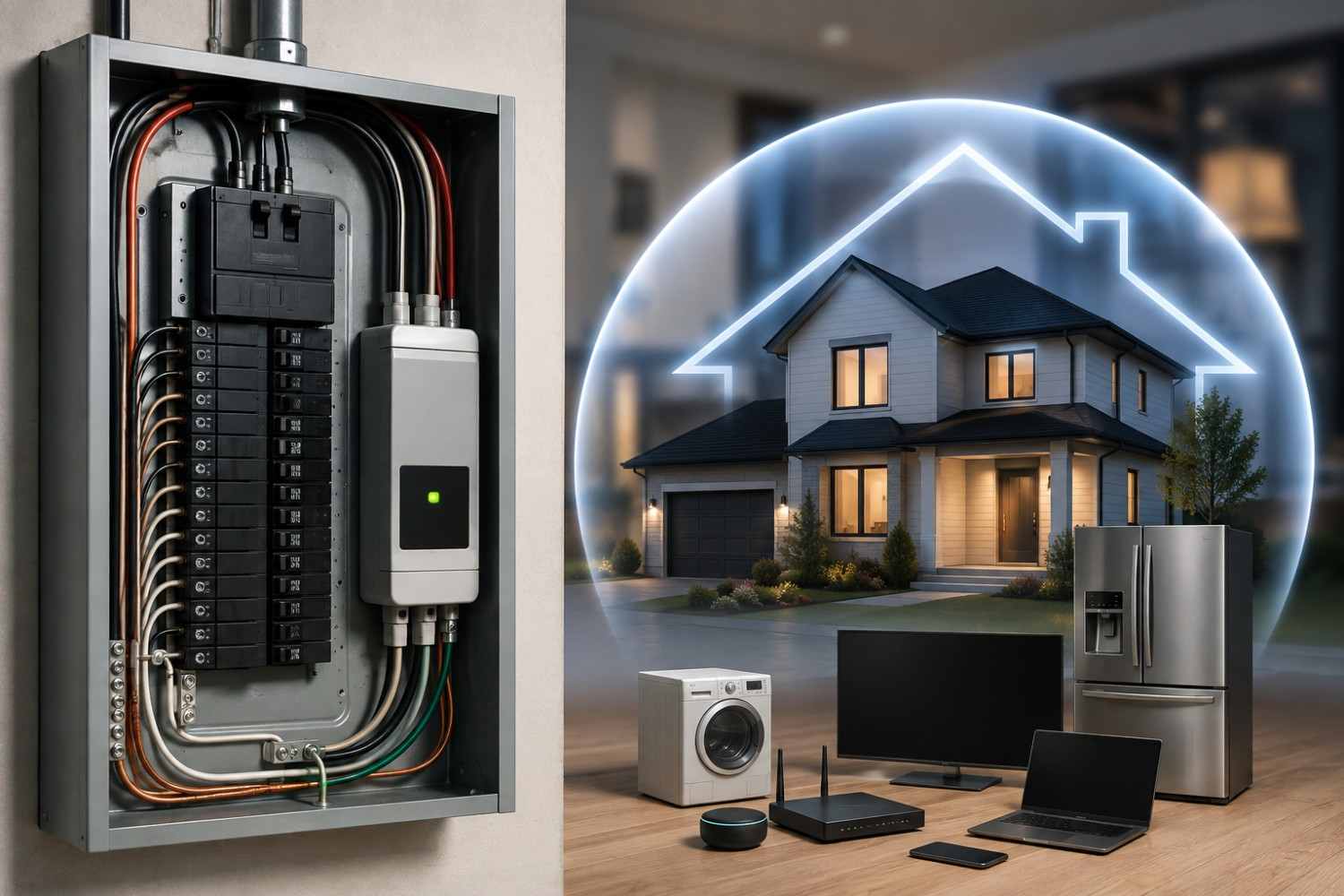
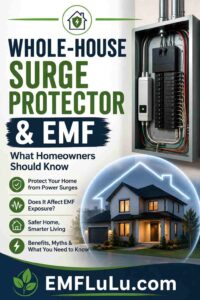
A whole-house surge protector is installed directly at your home’s main electrical service panel, where electricity first enters the house. Rather than protecting a single television or computer, it works to shield nearly every circuit in the home from sudden increases in voltage.
Under normal operating conditions, electricity flows through your home’s wiring at a relatively stable voltage. Occasionally, however, that voltage can spike dramatically for a fraction of a second. Although these surges are brief, they can be powerful enough to damage delicate electronic components inside appliances and other equipment.
When a surge occurs, the protector detects the excess voltage and safely redirects much of that excess energy into the home’s grounding system before it reaches connected electronics. This process happens automatically and extremely quickly, often within microseconds.
Unlike many household devices that operate continuously, a whole-house surge protector spends most of its life simply waiting. It remains inactive until an abnormal surge occurs. This passive design becomes especially important when discussing whether the device itself produces meaningful electromagnetic fields.
It is also important to understand that whole-house surge protectors are designed to complement – not replace – other protective measures. Sensitive electronics often still benefit from quality point-of-use surge protectors, especially equipment like desktop computers, entertainment systems, and networking hardware that contain sophisticated electronic circuitry.
What Causes Electrical Surges?
Many homeowners picture lightning when they think about power surges. While lightning certainly can create enormous electrical spikes, it is actually responsible for only a small percentage of the surges most homes experience. In reality, many voltage fluctuations begin inside the house itself.
Understanding where surges originate helps explain why surge protection has become increasingly valuable as modern homes rely on more electronic devices than ever before.
Some of the most common causes of electrical surges include:
Lightning Activity
Nearby lightning strikes can induce massive voltage spikes into power lines. Even if lightning never directly hits your home, a strike several miles away may still create electrical disturbances capable of damaging electronics.
Utility Grid Switching
Electric companies routinely switch equipment, reroute electricity, and perform maintenance on transmission lines. These normal operations sometimes create temporary voltage fluctuations that travel into residential neighborhoods.
Power Outages and Restoration
When electricity returns after an outage, the sudden restoration of power can produce brief voltage spikes. Large neighborhoods coming back online simultaneously may place considerable stress on the electrical system.
Large Household Appliances
Many appliances cycle on and off throughout the day. Air conditioners, refrigerators, freezers, well pumps, furnaces, clothes dryers, and similar equipment all require higher amounts of electricity when their motors start. These repeated cycles can generate small internal surges.
Modern Home Technology
Today’s homes often include electric vehicle chargers, solar inverters, battery backup systems, home offices, gaming computers, and sophisticated entertainment centers. While these technologies offer many conveniences, they also increase the amount of sensitive electronics connected to the home’s electrical system.
Although most internal surges are relatively small, they occur far more often than dramatic lightning events. Over months and years, repeated exposure to these minor voltage spikes may slowly degrade electronic components. This gradual wear often goes unnoticed until a device begins malfunctioning or fails earlier than expected.
For homeowners who have invested thousands of dollars in appliances and electronics, reducing this ongoing electrical stress can be an attractive benefit of installing a whole-house surge protector.
Does a Whole-House Surge Protector Produce EMF?
This is perhaps the most common question among homeowners who are trying to create a lower-EMF environment. Fortunately, the answer is reassuring.
Under normal operating conditions, a whole-house surge protector is generally not considered a significant source of EMF exposure.
To understand why, it helps to distinguish between different types of electromagnetic fields found throughout a home.
Electrical wiring naturally produces electric fields whenever electricity is present. Magnetic fields are created whenever electrical current flows through conductors. These fields already exist around household wiring, outlets, appliances, and electrical panels regardless of whether a surge protector has been installed.
A whole-house surge protector does not continuously generate additional radiofrequency energy like Wi-Fi routers, Bluetooth devices, cordless phones, or cellular equipment. Instead, it remains largely passive during everyday operation.
Only when a voltage surge occurs does the device briefly activate to divert excess electrical energy safely into the grounding system. Because these events are extremely short-lived, they do not result in ongoing EMF emissions that homeowners would experience during normal daily living.
Another important point is the device’s location. Whole-house surge protectors are typically mounted inside or immediately adjacent to the home’s main electrical panel. Electrical panels themselves already contain energized circuits that produce low-frequency electric and magnetic fields while electricity flows throughout the home.
Installing a surge protector does not suddenly transform the electrical panel into a major EMF source. Instead, it becomes one additional component within an existing electrical distribution system.
This distinction often helps clear up confusion surrounding the whole-house surge protector EMF topic. The electrical panel, branch circuits, appliances, and household wiring remain the primary sources of low-frequency EMFs within a home’s electrical infrastructure. The surge protector’s role is to protect that infrastructure from abnormal voltage events rather than continuously generating electromagnetic radiation.
It is also worth remembering that EMFs are measured by strength, frequency, distance, and duration of exposure. Simply having an electrical device present does not automatically mean it creates meaningful exposure levels throughout the home. Distance remains one of the biggest factors influencing EMF strength. Since electrical service panels are commonly located in garages, basements, or utility rooms, most family members spend relatively little time in close proximity to them.
Researchers and electrical engineers generally view whole-house surge protectors as safety devices rather than EMF-producing devices. Their primary function is preserving the integrity of your home’s electrical system during unexpected voltage spikes.
For homeowners who want to balance electrical safety with thoughtful EMF awareness, installing a surge protector typically fits well within that goal. It provides valuable protection for expensive electronics without introducing a significant new source of everyday electromagnetic exposure.
Can a Surge Protector Reduce EMF?
After learning that a whole-house surge protector generally does not produce significant EMFs, many homeowners naturally ask the next question: can it actually reduce EMF exposure?
The short answer is not in the way many people expect.
A whole-house surge protector is designed to protect your home’s electrical system from excessive voltage. Its job is to react to sudden spikes in electricity and redirect that excess energy safely to ground. It is not engineered to shield, absorb, or block electromagnetic fields generated by wireless devices or household wiring.
This distinction is important because many online discussions unintentionally blur the line between electrical protection and EMF reduction. While the two topics are related through your home’s electrical system, they solve different problems.
A whole-house surge protector will not:
- Block Wi-Fi signals.
- Reduce Bluetooth radiation.
- Stop emissions from nearby cell towers.
- Eliminate smart meter radiofrequency transmissions.
- Shield your home from 5G or other wireless communication signals.
Those sources involve radiofrequency (RF) energy, while a surge protector is focused on managing abnormal voltage traveling through electrical wiring.
What a surge protector can do is help maintain a healthier electrical system by minimizing damage caused by unexpected voltage spikes. Every surge has the potential to stress electronic components. Over time, repeated stress may shorten the lifespan of expensive equipment or contribute to intermittent electrical problems.
Keeping your electrical system better protected may indirectly support a more stable home environment, but it should not be viewed as an EMF-reduction device.
If your primary goal is reducing EMF exposure, you’ll typically see much greater benefits from practical habits such as:
- Using wired internet connections whenever practical.
- Turning off wireless features that are not needed.
- Creating distance between yourself and higher-EMF devices.
- Avoiding unnecessary wireless gadgets.
- Positioning beds and seating areas away from major electrical equipment whenever possible.
These strategies directly address common sources of EMF rather than focusing solely on surge protection.
Dirty Electricity vs. EMF: Understanding the Difference
One of the biggest sources of confusion in discussions about electrical health is the difference between dirty electricity and EMFs. Although the terms are sometimes used interchangeably online, they describe different electrical phenomena.
Understanding the distinction can help homeowners choose the right solution for the concern they are trying to address.
What Is Dirty Electricity?
Dirty electricity refers to unwanted high-frequency electrical noise that can ride along standard household wiring. Instead of the smooth 60-Hz alternating current delivered by your utility company, modern electronics sometimes introduce additional high-frequency signals into the wiring.
Potential contributors include:
- LED lighting
- Variable-speed motors
- Solar inverters
- Switching power supplies
- Dimmer switches
- Some battery chargers
- Certain electronic appliances
These high-frequency signals remain on the electrical wiring rather than being broadcast like Wi-Fi.
What Are EMFs?
Electromagnetic fields are generated whenever electricity is present or current is flowing.
Within a home, EMFs generally fall into two broad categories:
Low-frequency EMFs
These come from:
- Electrical wiring
- Breaker panels
- Household appliances
- Power cords
- Motors
- Transformers
Radiofrequency (RF) EMFs
These originate from wireless communication devices such as:
- Wi-Fi routers
- Cell phones
- Bluetooth devices
- Baby monitors
- Cordless phones
- Smart home devices
Although both involve electricity, they behave differently and are measured differently.
Why the Difference Matters
A common misconception is that installing a surge protector will “clean up” all electrical problems inside a home.
In reality, a surge protector is built to handle sudden voltage spikes – not ongoing electrical noise or wireless RF signals.
Homeowners interested specifically in reducing dirty electricity sometimes consider dedicated filtering products that are designed for that purpose.
Knowing which issue you’re trying to solve helps avoid spending money on equipment that isn’t intended for your particular concern.
Benefits of Installing a Whole-House Surge Protector
Although surge protectors should not be viewed as EMF-reduction devices, they still offer numerous advantages that make them one of the most worthwhile electrical upgrades for many homes.
Their value comes from protecting the increasingly expensive electronics that modern families rely on every day.
Protection for Major Appliances
Replacing large appliances has become significantly more expensive over the past decade. Refrigerators, dishwashers, washing machines, dryers, furnaces, and air conditioning systems all contain sophisticated electronic control boards.
A single damaging surge can sometimes destroy these components, leading to repair bills that may reach hundreds – or even thousands – of dollars.
Whole-house surge protection helps reduce that risk by intercepting many voltage spikes before they travel throughout the home’s electrical circuits.
Better Protection for Home Electronics
Many families own multiple televisions, desktop computers, laptops, gaming systems, streaming devices, and networking equipment.
These electronics often contain sensitive microprocessors that can be vulnerable to electrical surges, even relatively small ones that occur repeatedly over time.
A whole-house surge protector provides an additional layer of defense alongside quality point-of-use surge protectors.
Longer Equipment Lifespan
Not every surge causes immediate failure.
In many cases, repeated small surges slowly weaken internal electronic components. The effects may not become noticeable for months or years, making it difficult to identify the original cause.
By reducing exposure to these repeated voltage events, surge protection may help electronic equipment remain reliable for a longer period.
Peace of Mind During Storm Season
For many homeowners, one of the biggest advantages is simply feeling more confident during severe weather.
Thunderstorms, utility interruptions, and unexpected power fluctuations become less stressful when you know your home’s electrical system has an additional level of protection.
Although no surge protector can guarantee complete protection against every possible electrical event, installing one significantly improves your home’s ability to withstand many common surges.
Protection for Smart Homes
Today’s homes often contain dozens of connected devices.
Examples include:
- Smart thermostats
- Security cameras
- Smart televisions
- Smart refrigerators
- Video doorbells
- Home automation hubs
- Voice assistants
Each additional electronic device represents another investment that may benefit from surge protection.
As smart homes continue becoming more common, protecting these systems becomes increasingly important.
Cost-Effective Insurance
Compared to replacing multiple damaged appliances or electronics, installing a whole-house surge protector is often relatively inexpensive.
Many homeowners view it similarly to smoke detectors or carbon monoxide alarms—not something they hope to rely on often, but something they are glad to have when it is needed.
Situations Where Surge Protection Is Especially Valuable
Not every home experiences the same level of electrical activity. Certain situations increase the likelihood that surge protection will provide noticeable long-term value.
If any of the following describe your home, installing a surge protector may be especially worthwhile.
Homes in Thunderstorm-Prone Areas
Regions that experience frequent thunderstorms naturally face greater exposure to lightning-related electrical disturbances.
Even indirect lightning strikes several miles away can induce significant voltage spikes through utility lines.
Rural Properties
Homes located farther from electrical substations may experience more voltage fluctuations, especially where long power lines are exposed to weather conditions.
Tree limbs, wind, and utility maintenance can all contribute to temporary electrical disturbances.
Older Electrical Systems
Older homes often contain wiring systems that were never designed to support today’s large number of electronic devices.
While a surge protector cannot modernize outdated wiring, it can add valuable protection for equipment connected to that system.
Homes with Solar Panels
Residential solar installations introduce additional electrical equipment, including inverters and monitoring systems.
Protecting these investments from unexpected surges is often recommended by installers and manufacturers.
Backup Generators
Whether powered by natural gas, propane, or portable gasoline generators, backup power systems involve additional electrical switching that can make surge protection even more valuable.
Electric Vehicle Charging
Electric vehicle charging equipment represents a significant investment.
Adding surge protection can help safeguard both charging equipment and other connected household electronics.
Home Offices
Many people now work from home full time or part time.
A home office may contain:
- Desktop computers
- Multiple monitors
- Networking equipment
- Printers
- External storage devices
- Video conferencing equipment
Protecting these tools not only reduces replacement costs but may also help prevent disruptions to work.
Homes with Expensive Entertainment Systems
Large televisions, surround sound systems, streaming equipment, gaming consoles, and media servers can represent thousands of dollars in electronics.
A whole-house surge protector provides broad protection for these investments while allowing individual surge protector strips to provide additional localized defense.
For households that have invested heavily in technology, the combination of whole-house protection and quality point-of-use surge protection often provides a practical, layered approach to electrical safety.
Can Whole-House Surge Protectors Help Sensitive Electronics?
One of the strongest arguments for installing a whole-house surge protector has little to do with EMFs and everything to do with protecting the electronics that have become essential to daily life.
Modern electronic devices contain tiny circuits and microprocessors that can be surprisingly sensitive to fluctuations in voltage. While a dramatic lightning strike may cause immediate failure, smaller surges can gradually wear down internal components over time. This slow degradation may not be obvious until a device begins behaving unpredictably or stops working years earlier than expected.
Networking equipment is a good example. Many households depend on reliable internet connections for work, school, streaming, and home automation. Routers, modems, network switches, and wireless access points all contain delicate electronics that can be affected by power disturbances.
Desktop computers, laptops, external hard drives, and network-attached storage (NAS) systems also benefit from stable electrical power. Although many people use battery backups or surge-protecting power strips for these devices, a whole-house surge protector adds another layer of protection by addressing many surges before they travel through the home’s wiring.
Entertainment systems deserve consideration as well. Large televisions, gaming consoles, streaming devices, audio receivers, and smart speakers often represent a significant investment. Protecting them from unexpected voltage spikes can help extend their useful life and reduce the chances of costly repairs or replacement.
Even kitchen appliances now rely heavily on electronic control boards. Refrigerators, ovens, microwaves, dishwashers, and washing machines frequently contain sophisticated electronics that are much more advanced than those found in similar appliances just twenty years ago.
For homeowners who have spent years building a comfortable, technology-filled home, protecting those investments simply makes good financial sense.
Affiliate Advertisement

What Else Should You Do for a Low-EMF Home?
Installing a whole-house surge protector is one step toward maintaining a reliable electrical system, but it should not be viewed as the centerpiece of an EMF-reduction strategy. If your goal is to lower unnecessary EMF exposure, a combination of practical habits is likely to have a much greater impact.
Rather than relying on a single product, think of a low-EMF home as the result of many small, thoughtful decisions that work together.
Use Wired Connections Whenever Practical
Wireless technology is incredibly convenient, but it isn’t always necessary.
If you work from a desktop computer or regularly stream media in one location, using an Ethernet connection can reduce your reliance on Wi-Fi while also providing a faster and more stable internet connection.
Many homeowners find that simply wiring their home office creates a more reliable workspace while reducing the number of wireless devices operating nearby.
Turn Off Wireless Features You Aren’t Using
Many electronics continue broadcasting wireless signals even when those features aren’t needed.
For example, if you rarely use Bluetooth on your desktop computer, printer, or television, disabling it can reduce unnecessary wireless activity. The same applies to Wi-Fi on devices that remain connected by Ethernet.
These small adjustments take only a few moments but can reduce the number of active wireless transmitters operating throughout your home.
Create Distance from Higher-EMF Devices
Distance remains one of the simplest and most effective ways to reduce exposure to many EMF sources.
Instead of placing a Wi-Fi router directly beside your favorite chair or next to your bed, consider moving it to a more central location where it can still provide good coverage without remaining close to areas where you spend long periods.
Likewise, avoid spending extended amounts of time immediately beside your home’s electrical service panel or other large electrical equipment whenever practical.
If you would like to better understand the EMF levels around different devices and situations in your home, our EMF calculators can help. Visit the EMFLuLu EMF Calculators section to explore our free tools and estimate exposure based on factors such as distance and device use.
Keep Bedrooms Focused on Rest
Bedrooms often provide the greatest opportunity for reducing unnecessary exposure because people typically spend seven to nine hours there each night.
Simple improvements may include:
- Charging phones outside the bedroom.
- Turning off unnecessary wireless devices overnight.
- Avoiding large electrical appliances on the opposite side of the bed’s wall when possible.
- Positioning alarm clocks several feet away from the pillow.
These changes are inexpensive, easy to implement, and fit naturally into a broader low-EMF lifestyle.
Maintain Your Home’s Electrical System
A well-maintained electrical system supports both safety and reliability.
Loose wiring, damaged outlets, overloaded circuits, or outdated electrical components should be inspected and repaired by qualified professionals. While these issues are not necessarily EMF concerns, keeping your electrical system in good condition helps ensure everything operates safely.
Common Myths About Whole-House Surge Protectors
There is no shortage of misinformation surrounding surge protection and EMFs. Clearing up a few common myths can help homeowners make better-informed decisions.
Myth: A Whole-House Surge Protector Eliminates EMF
This is probably the most widespread misconception.
A surge protector is designed to divert excess voltage during electrical surges. It is not built to eliminate electromagnetic fields produced by household wiring or wireless devices.
Myth: It Blocks Wi-Fi and Cell Phone Radiation
Wi-Fi, Bluetooth, and cellular signals operate using radiofrequency energy.
A whole-house surge protector does not interfere with these wireless signals or reduce their strength.
Myth: One Device Protects Every Electronic Situation
While whole-house surge protection provides excellent broad coverage, especially for surges entering through the electrical panel, particularly valuable electronics may still benefit from high-quality surge-protecting power strips or uninterruptible power supplies (UPS).
Layering protection often provides the best overall results.
Myth: Once Installed, It Lasts Forever
Surge protectors absorb electrical energy over time.
Repeated surge events gradually wear down their protective components. Many manufacturers include indicator lights that show whether the device is still functioning properly.
Depending on the number and severity of surges experienced, replacement may eventually be necessary.
Myth: Surge Protectors Prevent All Electrical Damage
No device can provide absolute protection against every possible electrical event.
A direct lightning strike, severe wiring failure, or catastrophic utility problem may still overwhelm even high-quality protection equipment.
Surge protectors significantly reduce risk, but they cannot eliminate it entirely.
Should You Install One?
For many homeowners, the answer is yes.
If your home contains expensive appliances, multiple computers, smart home technology, entertainment systems, or home office equipment, a whole-house surge protector is often a worthwhile investment.
It may be especially beneficial if you live in an area that experiences frequent thunderstorms, power outages, utility fluctuations, or if you’ve recently installed solar panels, an electric vehicle charger, or a standby generator.
Although some experienced homeowners are comfortable working around electrical systems, installation is generally best left to a licensed electrician. Because the protector connects directly to your home’s main electrical panel, proper installation is important for both safety and performance.
When selecting a unit, look for products that are UL listed and appropriately rated for your home’s electrical service. Your electrician can help determine the right model based on your home’s size, electrical panel, and expected electrical demands.
Think of the purchase as long-term protection rather than an expense. Compared to replacing multiple appliances or electronics after a damaging surge, the cost of installation is often relatively modest.
Conclusion
While these devices are excellent at protecting your home’s wiring, appliances, and electronics from damaging voltage spikes, they are not designed to block Wi-Fi signals, eliminate radiofrequency radiation, or remove everyday EMFs from your home.
That does not diminish their value. A whole-house surge protector can play an important role in protecting expensive equipment, extending the life of household electronics, and providing added confidence during storms or utility power fluctuations. When combined with sensible low-EMF habits – such as using wired connections when practical, reducing unnecessary wireless devices, creating distance from higher-EMF sources, and maintaining your home’s electrical system – you create a thoughtful approach to both electrical safety and everyday living.
The most effective strategy is one based on realistic expectations. A surge protector is an excellent investment for protecting your home, while practical lifestyle choices remain the foundation of reducing unnecessary EMF exposure. By understanding what each tool is designed to accomplish, you can make informed decisions that support both your technology and your peace of mind.
Before You Go…
Get Weekly EMF Protection Tips
Enjoy this article? Join the EMFLuLu newsletter for simple weekly tips to reduce everyday EMF exposure from phones, WiFi routers, laptops, and smart home devices.
Try Our Free EMF Calculators
Curious how much EMF exposure you may experience each day?
These simple tools can help you estimate your exposure and identify possible problem areas in your home.
Try these free calculators:
Like this article? Pin it on Pinterest!
More to Explore