Preparing a nursery is one of the most exciting parts of welcoming a new baby. Parents carefully select a crib, choose calming colors, and look for products that support a comfortable sleeping environment. In recent years, many families have also become interested in reducing exposure to electromagnetic fields (EMFs) inside the home. As a result, creating an EMF-safe nursery has become an increasingly popular goal among parents who want to make thoughtful decisions about the environment where their child will spend many hours sleeping, growing, and developing.
An EMF-safe nursery does not require expensive renovations or the removal of every electronic device from the home. Instead, it focuses on practical steps that may help reduce unnecessary exposure to wireless technology and electrical devices. By understanding where common EMF sources are located and making a few strategic adjustments, parents can create a nursery that feels both modern and mindful.
What Is an EMF-Safe Nursery?
Before making changes to a nursery, it helps to understand what people mean when they use the term EMF-safe nursery.
EMFs, or electromagnetic fields, are generated by both natural and man-made sources. Natural EMFs have always existed in our environment. The earth itself produces electromagnetic energy, and sunlight is a form of electromagnetic radiation. Modern homes, however, contain many additional sources of EMFs created by electrical wiring, wireless networks, smart devices, and electronic equipment.
A nursery may contain several of these sources, including baby monitors, Wi-Fi signals, smartphones, tablets, smart speakers, nightlights, and other connected devices. An EMF-safe nursery focuses on reducing unnecessary exposure where practical while maintaining convenience and safety.
The goal is not perfection. Instead, it is about making informed choices and creating a sleep environment that minimizes avoidable exposures whenever possible.
Why Parents Are Concerned About Nursery EMFs
Many parents become interested in EMF reduction because infants spend a significant portion of their day sleeping. Newborns often sleep between 14 and 17 hours daily, meaning they spend a great deal of time in the nursery.
Parents naturally want to create the healthiest environment possible. Just as many families choose low-VOC paints, air purifiers, or organic bedding, some also look for ways to reduce unnecessary electromagnetic exposure.
While research on EMFs continues to evolve, many families prefer taking simple precautionary measures when those measures are easy to implement and do not negatively impact daily life. Creating some distance between devices and the crib, reducing wireless transmissions when possible, and eliminating unnecessary electronics are examples of practical steps that many parents find worthwhile.
Start With the Nursery Location
One of the easiest ways to reduce potential EMF exposure involves evaluating the room itself before filling it with furniture and electronics.
If you are planning a nursery in a home with multiple available bedrooms, consider where major sources of wireless signals and electrical equipment are located. A room directly adjacent to the home’s Wi-Fi router may receive stronger wireless signals than a room located farther away. Likewise, a nursery that shares a wall with a large electrical panel may not be the ideal choice if another suitable room is available.
Distance is often one of the simplest and most effective strategies. Electromagnetic field strength generally decreases as you move farther from the source. Even moving a crib a few feet away from a device can make a meaningful difference.
For parents who want more detailed information about their environment, an EMF meter can help identify stronger signal areas within the home.
One popular option available through Safe Living Technologies is the Safe and Sound Pro II RF Meter.
This type of meter can help parents understand where wireless signals are strongest and determine whether moving furniture or devices may help reduce exposure.
Choosing a Low-EMF Baby Monitor
Baby monitors are often one of the largest EMF-related concerns in a nursery because they are designed to transmit information continuously or frequently throughout the day and night.
Fortunately, there are several ways to reduce exposure while still maintaining the convenience and security that baby monitors provide.
Before selecting a monitor, it is helpful to understand how different models operate. Some monitors continuously transmit audio and video regardless of whether the baby is making noise. Others use voice activation features, often called VOX mode, which only transmit when sound is detected.
Voice-activated monitors can reduce wireless transmissions because they are not constantly broadcasting information.
Placement also matters significantly. Many parents mount baby monitors directly above the crib for a better viewing angle. While convenient, placing a transmitting device directly over a baby’s head may not be the best option for families seeking an EMF-safe nursery.
Instead, consider placing the monitor several feet away from the crib while still maintaining a clear view of the sleeping area. This simple adjustment often requires no additional cost and can be implemented immediately.
Managing Wi-Fi in the Nursery
Wi-Fi has become a standard feature in modern homes. Many families use wireless internet for work, entertainment, communication, and home automation. While eliminating Wi-Fi completely is not realistic for most households, there are several ways to manage its presence around a nursery.
One of the simplest approaches involves router placement. If the home’s router sits directly outside the nursery wall, consider relocating it to a more central location if possible. Even moving the router to another room can increase the distance between the nursery and the wireless source.
Some families also choose to turn off Wi-Fi overnight. This may not work for every household, particularly those who rely on connected security systems or smart devices, but it remains an option worth considering.
Another strategy involves using wired internet connections where practical. Desktop computers, televisions, and gaming systems can often function perfectly well through Ethernet cables rather than wireless connections.
These adjustments allow parents to maintain internet access while reducing the number of wireless signals operating throughout the home.
Smart Devices and Connected Nursery Gadgets
Today’s nursery products often include smart features that promise convenience and peace of mind. Smart cameras, connected sound machines, Wi-Fi-enabled temperature sensors, and app-controlled lighting systems are becoming increasingly common.
While these products can be useful, it is worth evaluating whether each device is truly necessary.
Many parents discover that some connected products provide little practical benefit after the first few weeks of use. Eliminating unnecessary devices can simplify the nursery while reducing the number of wireless transmitters operating around the clock.
When shopping for nursery electronics, ask yourself whether the product’s smart features are genuinely valuable or simply a marketing addition. In many cases, simpler products perform the same function without requiring constant wireless communication.
Crib Placement Tips for an EMF-Safe Nursery
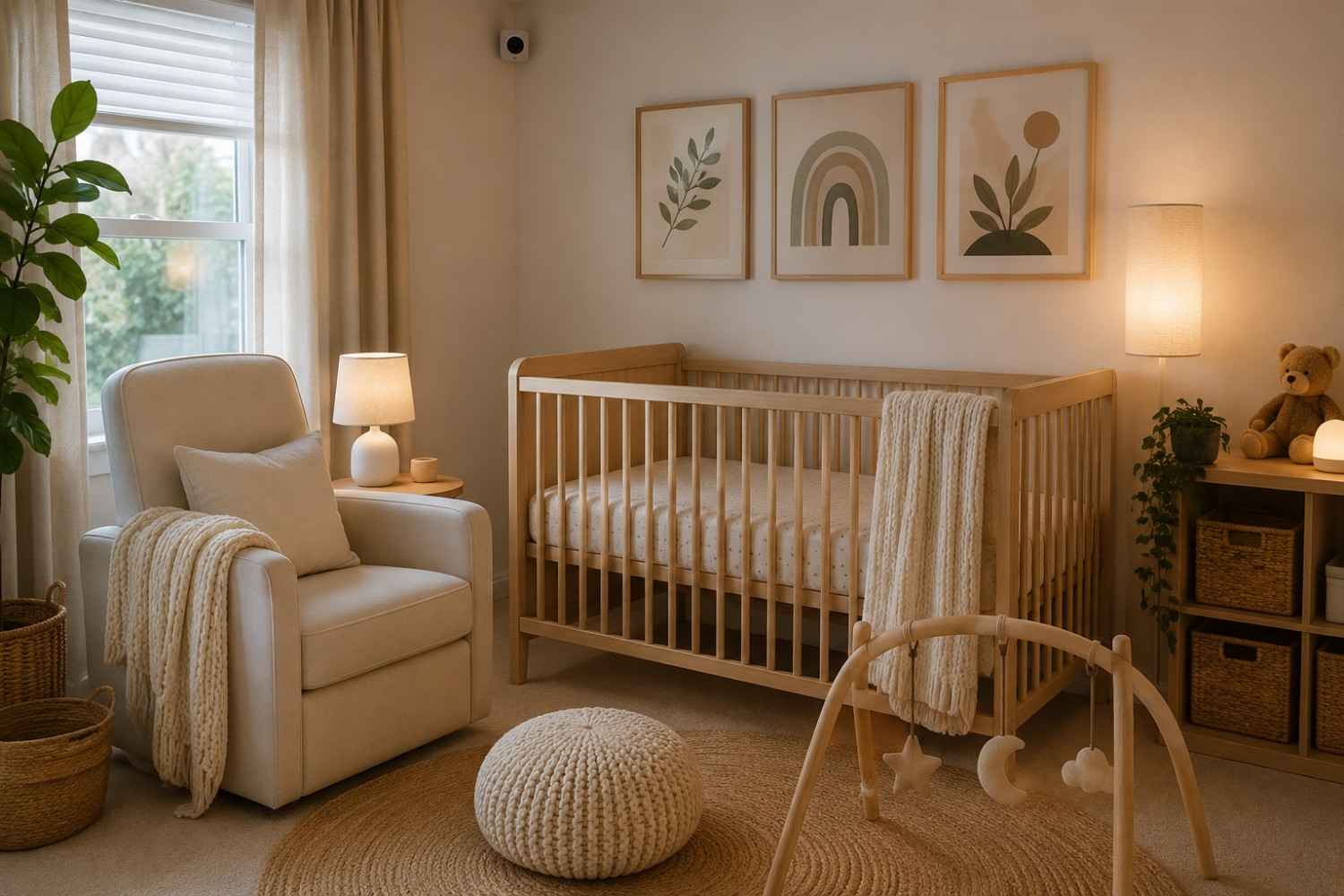
The crib is the centerpiece of any nursery and the place where a baby spends the majority of sleep time. Because of this, crib placement deserves careful consideration.
Many parents focus on decoration and convenience while overlooking nearby electronic devices. Chargers, power strips, extension cords, tablets, and smartphones often end up close to the crib simply because they are easy to access.
Before finalizing the nursery layout, spend a few minutes evaluating the immediate area around the crib.
Avoid placing charging stations next to the crib whenever possible. Keep smartphones off changing tables and away from sleeping areas. If a sound machine or monitor must be used, position it several feet away rather than directly beside the baby.
The objective is not to remove every electrical item from the room but rather to create a sleeping area that is relatively free from unnecessary electronic clutter.
Lighting Choices for the Nursery
Lighting is another factor that often receives less attention during nursery planning.
Many modern LED bulbs are energy efficient and provide excellent illumination. Parents often prefer warm-colored bulbs for nurseries because they create a calming atmosphere that supports bedtime routines.
When selecting lighting, focus primarily on quality, comfort, and functionality. Avoid overcrowding the room with multiple electronic light sources and decorative gadgets that remain powered continuously.
Nightlights are common nursery additions. Choosing a simple, low-energy nightlight often accomplishes the desired effect without introducing additional wireless features.
The most important consideration is creating a calm sleep environment rather than chasing specialized products that make dramatic claims.
Affiliate Advertisement
Simple Daily Habits That May Help Reduce Exposure
Creating an EMF-safe nursery involves more than choosing the right products. Everyday habits can play an equally important role.
Many parents are surprised to learn that some of the most effective adjustments cost nothing at all.
Charging devices outside the nursery whenever possible is one example. Phones, tablets, and other electronics can remain in another room overnight rather than beside the crib.
Using airplane mode on devices that are not actively communicating can also reduce wireless transmissions. This can be especially useful for tablets used to play lullabies or white noise.
Turning off electronics when they are not needed is another straightforward habit that many families adopt. A device that is powered down is not transmitting signals or consuming energy.
Small changes like these may seem minor individually, but together they can significantly reduce the number of active electronic devices operating in the nursery.
Common Mistakes Parents Make
When researching nursery EMFs, some parents focus heavily on purchasing specialized products while overlooking simple environmental improvements.
One common mistake is placing a baby monitor directly above the crib. Another is positioning the nursery immediately next to the home’s Wi-Fi router when other room options are available.
Many families also fill nurseries with smart gadgets that provide limited practical value. Smart toys, connected speakers, multiple wireless cameras, and app-controlled accessories can quickly increase the number of electronic devices operating in a small space.
Another mistake involves becoming overly anxious about every possible EMF source. The goal should be thoughtful reduction rather than constant worry. Parents already have countless responsibilities, and creating a calm, comfortable environment remains more important than achieving perfect EMF elimination.
Building an EMF-Safe Nursery on a Budget
One of the most encouraging aspects of nursery EMF reduction is that many of the most effective strategies cost little or nothing.
Parents can often improve their nursery environment simply by relocating devices, increasing distance between electronics and the crib, reducing unnecessary wireless gadgets, and turning off equipment when not in use.
A family does not need expensive shielding products or major home renovations to make practical improvements. In many cases, thoughtful placement and common-sense habits provide meaningful benefits.
Conclusion
Creating an EMF-safe nursery does not require fear, perfection, or major expense. Instead, it involves making practical choices that reduce unnecessary exposure while maintaining a comfortable and functional environment for your baby. By paying attention to baby monitor placement, managing Wi-Fi thoughtfully, limiting unnecessary smart devices, and adopting simple daily habits, parents can create a nursery that supports both peace of mind and everyday convenience. Ultimately, an EMF-safe nursery is about thoughtful planning, informed decision-making, and creating a space where both parents and babies can rest comfortably.
Before You Go…
Get Weekly EMF Protection Tips
Enjoy this article? Join the EMFLuLu newsletter for simple weekly tips to reduce everyday EMF exposure from phones, WiFi routers, laptops, and smart home devices.
Try Our Free EMF Calculators
Curious how much EMF exposure you may experience each day?
These simple tools can help you estimate your exposure and identify possible problem areas in your home.
Try these free calculators:
Like this article? Pin it on Pinterest!

More to Explore