Most conversations about electromagnetic fields in the home focus on cell phones, WiFi routers, Bluetooth devices, laptops, and other wireless technology. The washing machine probably does not come to mind nearly as often. However, a washer is a powerful electrical appliance containing a motor, wiring, electronic controls, pumps, and, in some newer models, wireless communication technology. All of these components make washing machine EMF an interesting subject for anyone trying to better understand electromagnetic fields inside the home.
The important question is not simply whether a washing machine produces electromagnetic fields. Electrical appliances naturally produce electric and magnetic fields when operating. A more useful question is what happens to those fields when the washing machine’s motor starts working, how measurements change throughout a wash cycle, and how quickly measured fields decrease as you move away from the appliance.
Understanding these differences can put washing machine exposure into perspective. You may find that a measurement taken directly against a washer looks very different from one taken a few feet away. You may also discover that the machine does not produce exactly the same readings throughout every stage of a load of laundry.
Let’s look at why.
What Type of EMF Does a Washing Machine Produce?
Before looking specifically at the motor, it helps to understand that “EMF” is a broad term. Electromagnetic fields can exist across a wide range of frequencies, and a washing machine can potentially involve more than one type.
Traditional washing machines primarily involve extremely low-frequency electric and magnetic fields associated with household electricity. In the United States, household alternating current operates at 60 Hz. Electrical wiring and components carrying current can produce fields around them.
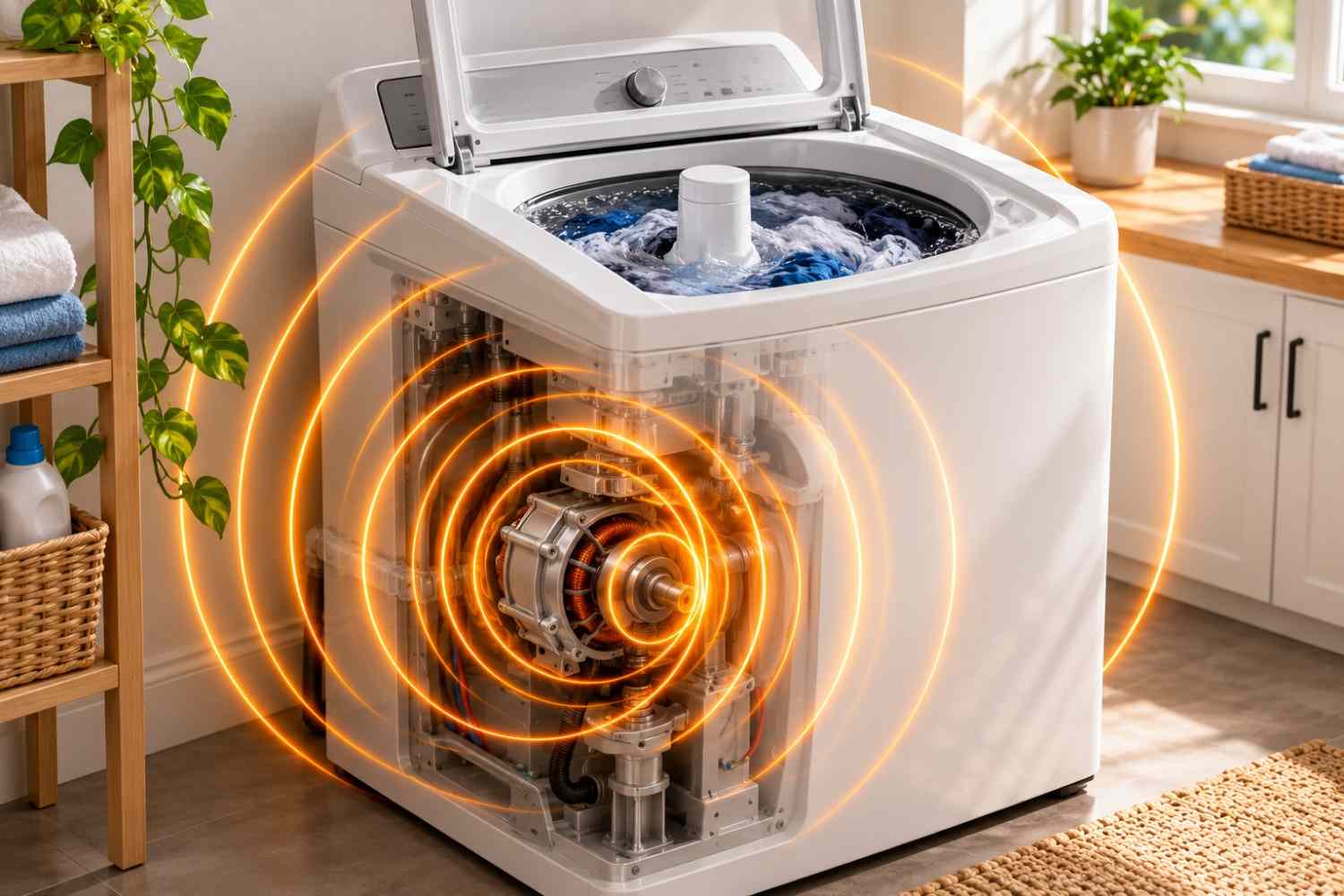
The electric motor is particularly interesting because motors operate through electromagnetic principles. Electrical current and magnetic fields work together to create the mechanical force necessary to rotate the washer’s drum or agitator.
A modern smart washer may introduce another source: radiofrequency electromagnetic fields.
If the washing machine communicates with a smartphone or home network through WiFi or another wireless technology, it can transmit RF signals in addition to the lower-frequency fields associated with the appliance’s electrical components.
This means it is useful to separate two questions.
The first is what the electrical system and motor are producing while the washing machine operates. The second is whether the appliance contains wireless technology that transmits RF signals.
They are not the same type of exposure and should not be treated as though they are.
Why the Washing Machine Motor Matters
A washing machine does considerably more than simply turn on and run at one constant level until the clothes are clean.
During a typical cycle, the machine may fill with water, slowly rotate or agitate the clothes, pause, drain the water, accelerate the drum, rinse the clothing, drain again, and eventually perform a high-speed spin.
The electrical demands placed on the appliance therefore change throughout the cycle.
The motor is responsible for much of the physical movement.
Electric motors work using electromagnetism. Although motor designs vary, electrical current ultimately helps create magnetic forces that produce movement. This is why it makes sense to pay particular attention to the motor when investigating electromagnetic fields around a washing machine.
Modern washers can also use sophisticated motor-control electronics. Some machines employ inverter-controlled motors or direct-drive systems that allow precise control over drum speed.
This makes washing machines a good example of why a single EMF measurement does not necessarily tell the whole story.
Imagine taking a meter reading while the washer is sitting quietly between portions of its cycle. You could record that number and assume you have measured the machine.
A few minutes later, however, the drum may begin rotating.
Later still, the washer may accelerate into its final spin.
Those operating conditions are different, which means measurements around the appliance can change.
Washing Machine EMF: What Happens When the Motor Is Running?
When current flows through electrical components, magnetic fields are produced around those components. Because the washing machine’s motor and associated electronics are active while the drum is moving, measurements near the appliance can change when the motor starts operating.
This is where washing machine EMF becomes particularly interesting to measure.
Instead of thinking of the washer as producing one fixed amount of EMF, think of the measurement as something that may fluctuate during the wash cycle.
For example, imagine placing an EMF meter in the same location throughout an entire load.
Initially, the washer might simply be filling with water. The drum then begins moving. The machine pauses. A pump activates to remove water. The drum starts moving again. Eventually, the washer accelerates into its high-speed spin cycle.
A meter may not display the same reading during all of these stages.
The exact measurements will depend on the washing machine, where its electrical components are located, the type of motor being used, the electrical load, the distance between the meter and appliance, the orientation of the meter, and other electrical sources in the surrounding environment.
That is one reason I would be cautious about any website claiming that all washing machines produce one specific EMF measurement.
Your washing machine may be different.
The more useful approach is understanding how these fields behave and, if you’re interested, measuring your own appliance under consistent conditions.
Does the Spin Cycle Produce More EMF?
It might seem logical to assume that the fastest portion of the washing cycle must automatically produce the highest EMF measurement.
That is possible, but it should not be treated as a universal rule.
During the spin cycle, the drum may rotate hundreds or even more than a thousand times per minute depending on the machine. The motor and its control electronics are managing substantial mechanical activity.
However, washing machines use different motor designs, control systems, power requirements, and operating strategies. A newer direct-drive washer may behave differently from an older belt-driven machine.
Even within one wash cycle, the highest reading may not necessarily occur when the drum reaches its maximum speed. Motor startup, acceleration, pumping, and other operating conditions could potentially produce different readings.
This is why an interesting home experiment is to measure the washer throughout an entire cycle rather than measuring only the final spin.
Record what happens during the wash portion, drain cycle, rinse, acceleration, and final spin.
You may discover that the meter tells a more complicated story than simply “faster drum equals more EMF.”
How Quickly Does Washing Machine EMF Drop With Distance?
Distance is one of the most important concepts to understand when discussing electromagnetic fields around household appliances.
A measurement taken directly beside an electrical appliance should not automatically be interpreted as representing someone’s exposure everywhere in the room.
Magnetic-field strength generally decreases as you move farther from the source.
This means a reading taken with a meter nearly touching the washing machine could be considerably different from a measurement taken several feet away.
This is also why context matters when discussing EMF measurements online.
Suppose someone reports a magnetic-field measurement from a washing machine but doesn’t tell you where the meter was positioned.
Was the meter touching the machine?
Was it six inches away?
One foot?
Three feet?
Was the measurement taken from the front, side, or rear?
Without that information, the number is much less useful.
If you’re measuring your own washer, distance testing can provide a much clearer picture. Instead of searching for a universal “safe distance,” measure at several distances under the same operating conditions.
For example, you might measure directly beside the appliance, then at six inches, one foot, two feet, three feet, and farther away if necessary.
The objective is not to become alarmed by the highest number you can possibly find. It is to understand how the field changes as you move through a realistic living environment.
And that leads to another important consideration: time.
Most people do not spend an hour pressed against their washing machine while their clothes are being washed.
You probably load the clothes, add detergent, start the machine, and walk away.
That behavioral difference matters when thinking about exposure.
How to Measure EMF From Your Washing Machine
If you’re genuinely curious about washing machine EMF, measuring your own appliance is more informative than assuming somebody else’s washing machine measurements apply to yours.
You will want an EMF meter capable of measuring low-frequency magnetic fields. Some meters can also measure electric fields and radiofrequency signals, which can be useful if you’re investigating multiple sources around the home.
You do not need an EMF meter simply to use your washing machine safely. A meter is primarily useful for people who want to investigate their own environment instead of relying on generalized measurements found online.
If you decide to measure your washer, consistency is important. Randomly moving a meter around until you find the largest number is not a particularly useful experiment. A more structured approach gives you measurements that can actually be compared.
Here is a simple testing process you can follow:
- Measure the background first. Before starting the washer, measure the area around it so you have an idea of the existing magnetic-field level in the room.
- Choose specific measurement locations. Pick several repeatable positions, such as directly in front of the washer, beside it, and behind it if the rear can be accessed safely.
- Keep your distances consistent. Measure at predetermined distances such as six inches, one foot, two feet, and three feet.
- Start the wash cycle. Watch what happens to the reading when the machine begins operating.
- Measure while the drum is moving. Compare this reading with the background measurement.
- Check the drain cycle. The drain pump is another electrical component, so note whether the measurement changes.
- Measure during acceleration and spin. Watch the meter as the washer transitions into its high-speed spin cycle.
- Repeat the distance measurements. Determine how the readings change as you move farther from the appliance.
The purpose of this experiment isn’t to prove that your washing machine is dangerous. It is to understand where measurable fields occur and how distance and operating conditions affect them.
You may also find that different sides of the machine produce different readings because the motor, wiring, control electronics, and other components are not necessarily located in the same place.
Try Measuring on the Other Side of the Wall
Here is an experiment that may be even more useful than measuring directly beside the washing machine.
Look at what is located on the opposite side of your laundry-room walls.
Perhaps your washer backs up against a garage or hallway. In that case, there probably isn’t much reason to think about it.
But what if the wall behind the washing machine is shared with a home office?
What if your desk chair is on the opposite side?
What if the laundry room shares a wall with a bedroom and the bed sits directly against that wall?
These situations are worth investigating because they involve places where someone may spend hours rather than minutes.
If you own an EMF meter, take a background measurement on the other side of the wall with the washing machine off. Then start a load and repeat the measurement while the drum is operating.
If you detect an elevated magnetic field, gradually move farther from the wall and see how the reading changes.
This is a practical example of using measurement to make informed decisions rather than assuming every electrical appliance requires special shielding or major lifestyle changes.
Sometimes moving a chair, desk, bed, or appliance slightly is all that would be necessary to substantially change a measurement.
Do Smart Washing Machines Produce RF Radiation Too?
A traditional washing machine and a WiFi-connected smart washing machine can present slightly different EMF environments.
A conventional washer primarily raises questions about electric and magnetic fields generated by the electrical system, motor, pumps, and other components.
A smart washing machine may also contain a wireless transmitter.
Manufacturers increasingly offer washers that connect to home WiFi networks. Depending on the appliance and app, wireless connectivity can allow you to receive notifications when laundry is finished, download specialized wash cycles, remotely check the washer’s status, or integrate it with other smart-home equipment.
WiFi communication uses radiofrequency electromagnetic energy.
This does not mean that a WiFi washing machine should automatically be considered dangerous. It simply means that the wireless system represents a different EMF source than the electric motor.
If you are trying to determine where RF signals are coming from in your home, check whether your washing machine has wireless connectivity enabled.
Some appliances may allow WiFi functionality to be disabled when it isn’t being used. Check the owner’s manual for your specific model before changing connectivity settings.
This can also be another interesting EMF-meter experiment.
Measure RF levels near the washer with its wireless functionality enabled, then compare the reading after WiFi has been disabled according to the manufacturer’s instructions.
Affiliate Advertisement

Should You Be Concerned About EMF From a Washing Machine?
The presence of an electromagnetic field does not by itself establish that something is dangerous.
That’s an important distinction.
Washing machines use electricity, and electrical appliances produce electromagnetic fields. That is expected.
The more meaningful questions involve the type of field, its strength, your distance from the source, how long you spend near it, and how the measurement compares with normal background conditions.
A washing machine is also very different from an electronic device that you hold against your body for extended periods.
Most interactions with a washer are short.
You load your laundry, start the machine, and leave.
Later, you return and remove the clothing.
You generally don’t need to stand directly beside the appliance throughout the wash cycle.
That makes washing machines a good example of why EMF discussions should consider real-world usage rather than simply asking whether an appliance “emits radiation.”
Yes, electrical and magnetic fields can exist around the appliance.
But your actual interaction with those fields depends greatly on where you are while the machine operates.
Simple Ways to Reduce Unnecessary Exposure
You don’t need to redesign your laundry room or purchase expensive shielding products simply because a washing machine produces measurable electromagnetic fields.
If reducing unnecessary exposure is important to you, there are several straightforward habits you can consider. These suggestions focus on practical changes that cost little or nothing and don’t interfere with normal laundry routines.
- Give the washer some space while it’s operating. There is usually no reason to stand directly beside the machine for an extended period after starting a load.
- Avoid leaning against the washer unnecessarily. If you’re waiting for the cycle to finish, sitting or standing elsewhere is an easy way to increase your distance from the appliance.
- Think about nearby occupied rooms. Check what is located on the opposite side of walls surrounding the washer, particularly beds, desks, couches, or children’s play areas.
- Measure instead of guessing. If you’re concerned about a particular location, an EMF meter can tell you far more about your own environment than generalized internet measurements.
- Check wireless settings on smart washers. If your washing machine has WiFi functionality you never use, consult the owner’s manual to see whether it can be disabled.
None of these steps require treating the washing machine as something that needs to be feared. They simply apply two useful EMF-reduction principles: distance and avoiding unnecessary exposure.
Frequently Asked Questions About Washing Machine EMF
Washing machines don’t receive nearly as much attention in EMF discussions as smartphones and WiFi routers, so it’s understandable that homeowners have questions about how these appliances behave. The following answers cover some of the most common issues.
Do Washing Machines Give Off EMF?
Yes. Washing machines are electrical appliances containing wiring, a motor, pumps, control electronics, and other powered components. Electric and magnetic fields can be produced while these components operate.
A smart washer may also produce RF electromagnetic fields if it communicates through WiFi or another wireless technology.
Does a Washing Machine Produce EMF When It Is Turned Off?
This depends partly on what “off” means for the particular washing machine.
A modern appliance may still have electronic circuitry receiving power even when it isn’t actively washing clothes. Displays, standby electronics, network connections, and other features can potentially remain powered.
The motor, however, isn’t performing the same work it does when the drum is actively moving.
If you’re interested in your specific machine, compare meter readings while it is unplugged, plugged in but inactive, actively washing, and spinning.
That gives you a much better comparison.
Does the Spin Cycle Produce More EMF?
It may produce different measurements, but you should not assume the spin cycle always produces the highest reading.
Motor design, power consumption, electronic controls, measurement position, and other factors can influence results.
The best approach is to measure several portions of the cycle under the same conditions.
How Far Should You Stand From a Washing Machine?
There isn’t one universal distance that applies to every washing machine.
Field strength varies according to appliance design and measurement location. Magnetic fields generally decrease as distance from the source increases, so even relatively modest increases in distance can make a meaningful difference in measurements.
Instead of relying on an arbitrary distance, measure your particular appliance if this is an important concern for you.
Do WiFi Washing Machines Produce More EMF?
A WiFi-enabled washing machine introduces an additional potential EMF source: RF transmissions from its wireless communication system.
That doesn’t necessarily mean every smart washer will produce higher readings in every EMF category.
The motor and electrical components are primarily relevant to lower-frequency fields, while WiFi contributes RF electromagnetic energy.
Think of them as separate sources that can be measured separately.
The Bigger Lesson: Measure Before You Worry
One of the most useful lessons from investigating household EMF is that a measurement without context can sound much more alarming than it actually is.
Suppose you place an EMF meter directly against a washing machine motor and discover a relatively high reading.
What does that tell you?
It tells you what the meter detected at that specific location.
It doesn’t automatically tell you what the field measures two feet away.
It doesn’t tell you what it measures in the hallway.
And it doesn’t tell you what your normal exposure looks like while doing laundry.
That is why distance measurements are so valuable.
Instead of searching only for the highest possible number, try to understand the shape of the field around the appliance.
Where does it increase?
Where does it decrease?
Does it change when the motor starts?
What happens during the spin cycle?
How far away do you need to move before readings approach the background level in your particular home?
Those questions provide useful information.
They also help move the conversation away from fear and toward something much more productive: understanding your environment.
Conclusion
A washing machine is an excellent reminder that EMF isn’t limited to smartphones, cell towers, Bluetooth headphones, and WiFi routers. Everyday electrical appliances also produce electric and magnetic fields as part of normal operation.
The motor is particularly interesting because its activity changes throughout a wash cycle. Measuring washing machine EMF while the drum is washing, draining, accelerating, and spinning may produce different results depending on the machine and where the meter is positioned.
The good news is that you don’t need to fear doing laundry. Distance can have a major effect on measured fields, and most people spend relatively little time standing directly beside an operating washer.
If you want to know what is happening around your own machine, measurement is more useful than guessing. Check several stages of the wash cycle, measure at different distances, and consider what’s located on the opposite side of the laundry-room walls.
Understanding where EMF comes from – and how quickly measurements change as you move away – can help you make practical decisions without turning an ordinary household appliance into something it isn’t.
Before You Go…
Get Weekly EMF Protection Tips
Enjoy this article? Join the EMFLuLu newsletter for simple weekly tips to reduce everyday EMF exposure from phones, WiFi routers, laptops, and smart home devices.
Try Our Free EMF Calculators
Curious how much EMF exposure you may experience each day?
These simple tools can help you estimate your exposure and identify possible problem areas in your home.
Try these free calculators:
Like this article? Pin it on Pinterest!


More to Explore