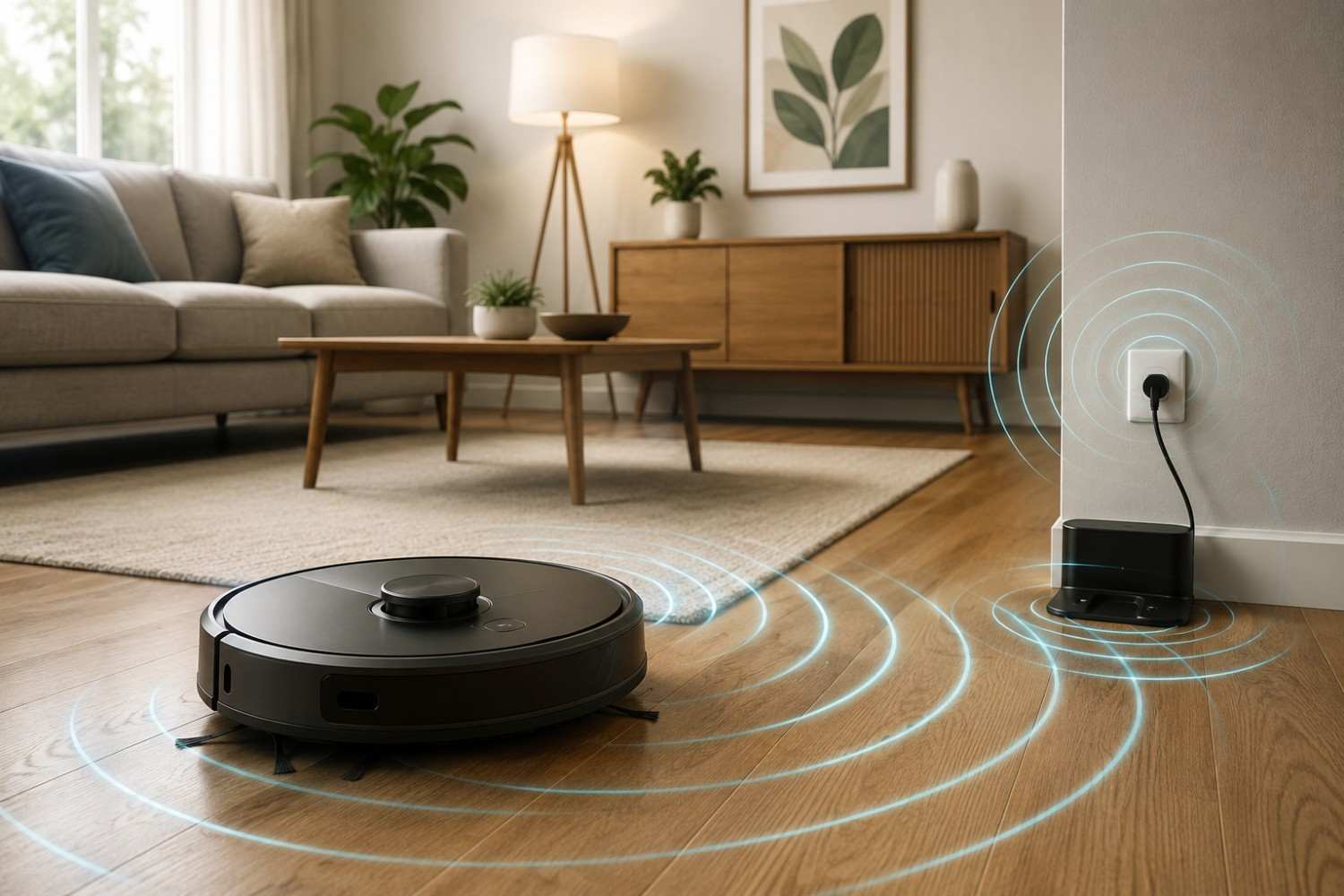
Robot vacuums have become one of the most popular smart home appliances in recent years. They quietly clean floors while you work, relax, or even leave the house, making it easier than ever to keep up with daily cleaning. As these devices have become more advanced, many homeowners have also begun asking questions about robot vacuum EMF. Since these vacuums contain electric motors, rechargeable batteries, wireless communication, and charging stations, it is reasonable to wonder whether they produce electromagnetic fields and whether those fields should be considered when creating a lower-EMF home.
The good news is that understanding robot vacuum EMF does not require a background in engineering or physics. Like nearly every electrical appliance in your home, robot vacuums generate some level of electromagnetic fields during normal operation. The important question is not whether EMF exists—it almost always does around powered electronics—but rather how much is produced, when it is produced, and what practical steps can reduce unnecessary exposure. This guide explains how robot vacuums work, where their EMF comes from, and how you can continue enjoying their convenience while making informed decisions about your home environment.
Understanding EMF in Everyday Appliances
Before looking specifically at robot vacuums, it helps to understand what EMF actually means. Electromagnetic fields are produced whenever electricity is generated, transmitted, or used. They are present around household wiring, appliances, electronic devices, and wireless technologies.
Most household EMF exposure falls into two broad categories:
- Extremely Low Frequency (ELF) fields generated by electricity flowing through motors, transformers, and wiring.
- Radiofrequency (RF) emissions produced by wireless technologies such as WiFi, Bluetooth, and cellular communication.
Neither category is unique to robot vacuums. Refrigerators, washing machines, microwave ovens, televisions, computers, smartphones, and many other common devices also generate electromagnetic fields during operation.
One of the most important concepts to remember is that EMF exposure depends on several factors, including the device’s power, how long it operates, and especially your distance from it.
How Does a Robot Vacuum Work?
To understand where EMF originates, it helps to know what components are inside a modern robot vacuum.
Although different manufacturers offer different features, most robot vacuums include:
- Electric drive motors
- Brush motors
- Rechargeable lithium-ion battery
- Charging circuitry
- Navigation sensors
- Cameras or LiDAR mapping systems
- WiFi connectivity
- Occasionally Bluetooth communication
- Small onboard computer
Each of these components performs a different job, and some generate more electromagnetic fields than others.
Unlike a traditional upright vacuum, a robot vacuum is designed to operate independently. After leaving its charging dock, it moves throughout your home using sensors or maps while cleaning floors with rotating brushes and suction motors before automatically returning to recharge.
Where Does the EMF Come From?
Several different components contribute to the electromagnetic fields produced by a robot vacuum. Understanding each one provides a clearer picture of what is happening during everyday use.
Electric Motors
The electric motors are the largest source of extremely low frequency magnetic fields during operation.
Most robot vacuums contain:
- Drive motors for movement
- Brush motors
- Suction motor
Whenever electricity flows through these motors, magnetic fields are created. The stronger the motor works, the more electricity it generally consumes.
Fortunately, robot vacuum motors are usually much smaller than those found in traditional upright vacuums. While they still produce magnetic fields, they typically operate at lower power levels.
Rechargeable Battery
Modern robot vacuums almost always use rechargeable lithium-ion batteries.
The battery itself stores electrical energy but also works with battery management electronics that regulate charging and power delivery.
During charging, electricity flows between the charging dock and the battery, producing relatively small electromagnetic fields similar to many other rechargeable household electronics.
WiFi Connectivity
Wireless communication is often the feature that concerns EMF-conscious consumers the most.
Many robot vacuums connect to your home’s WiFi network to provide features such as:
- Scheduling cleaning sessions
- Remote control through an app
- Cleaning history
- Firmware updates
- Voice assistant integration
These wireless features require radiofrequency transmissions.
The important point is that the WiFi radio generally communicates in short bursts rather than transmitting continuously at maximum power. Actual transmission patterns depend on the manufacturer, the model, and how often the vacuum exchanges information with your home network.
Bluetooth
Some models also include Bluetooth for initial setup or local communication.
Bluetooth generally operates at lower power than WiFi and typically communicates over much shorter distances.
Charging Dock
The charging dock is another source of EMF.
It contains a power supply that converts household electricity into the voltage required for charging the robot vacuum battery.
Like many electronic chargers throughout your home, this creates low-frequency electromagnetic fields whenever plugged in.
Robot Vacuum vs. Traditional Vacuum
Many people assume robot vacuums create more EMF simply because they contain wireless technology.
The reality is more nuanced.
Traditional upright vacuums often use motors that consume 700 to well over 1,000 watts. Robot vacuums typically use much smaller motors because they clean continuously rather than relying on intense suction alone.
Perhaps even more important than motor size is user proximity.
When operating a traditional vacuum, your hands, torso, and legs remain only inches from the motor throughout the cleaning session.
A robot vacuum usually operates several feet away. Many homeowners schedule cleaning while they are at work, outside, or simply in another room.
This difference in distance can significantly reduce personal exposure during normal operation.
Why Distance Matters So Much
One of the simplest ways to reduce EMF exposure is increasing the distance between yourself and the source.
Magnetic fields produced by household appliances generally decrease rapidly as you move farther away. Even moving from one foot to several feet away can substantially reduce exposure.
This principle works in your favor with robot vacuums.
Unlike handheld appliances that remain close to your body during use, robot vacuums are specifically designed to clean independently.
Instead of following the machine around, you can let it clean while you prepare dinner, work in your home office, spend time outside, or even leave the house.
This makes distance one of the easiest and most effective strategies for minimizing exposure without sacrificing convenience.
Does WiFi Increase EMF Exposure?
Wireless communication naturally introduces radiofrequency emissions, so many readers specifically ask whether WiFi is the biggest concern.
In many homes, the answer depends more on how the vacuum is used than simply whether WiFi exists.
If you regularly control the vacuum through an app, use voice assistants, receive cloud notifications, and allow continuous internet communication, the WiFi radio will naturally be more active than if those features remain unused.
Some robot vacuums allow portions of their smart functionality to be disabled after initial setup. Others require an internet connection to access advanced features.
Before purchasing, it can be worthwhile to review whether manual operation is available if reducing wireless activity is one of your priorities.
The phrase robot vacuum EMF often focuses attention on the vacuum itself, but it is helpful to remember that many homes already contain WiFi routers, smartphones, tablets, laptops, streaming devices, smart televisions, and numerous other wireless products that also contribute to everyday RF exposure.
Practical Ways to Reduce EMF While Using a Robot Vacuum
Fortunately, lowering potential exposure usually involves simple habits rather than giving up the convenience of automated cleaning.
Scheduling cleaning sessions while nobody is home is perhaps the easiest adjustment. Because robot vacuums operate independently, there is little reason to remain nearby while they clean. Running them during work hours or while running errands naturally increases your distance from the operating appliance.
Another helpful practice is placing the charging dock in a utility room, laundry room, mudroom, or another area where family members do not spend extended periods. Although the charging dock produces relatively low levels of EMF, there is generally no advantage to placing it beside a favorite chair or next to the bed.
If your model allows manual operation without maintaining a constant internet connection, disabling unnecessary wireless features may further reduce radiofrequency transmissions. Not every manufacturer offers this flexibility, but it is worth exploring before purchasing if this feature is important to you.
Keeping the vacuum properly maintained also helps it operate efficiently. Clean filters, untangled brushes, and well-maintained wheels reduce strain on the motors and help the unit complete cleaning cycles effectively.
Finally, remember that you do not need to watch the robot vacuum work. One of its greatest advantages is that it cleans independently while you spend your time elsewhere.
Should People with EMF Concerns Avoid Robot Vacuums?
This question does not have a one-size-fits-all answer.
Some individuals actively seek to reduce electromagnetic field exposure wherever practical. Others report personal sensitivity to electronic devices, although scientific research has not established a clear causal relationship between typical low-level household EMF exposure and those reported symptoms.
For many households, robot vacuums may actually offer an advantage over traditional vacuums simply because people spend less time standing close to the operating motor.
Rather than viewing the decision as all-or-nothing, many homeowners choose to adopt practical habits that reduce exposure while continuing to enjoy the convenience these devices provide.
Affiliate Advertisement

What Should You Look for When Buying One?
If you’re shopping for a robot vacuum and would like to make an informed decision, several features deserve consideration beyond cleaning performance alone.
Look for models with reliable scheduling capabilities so they can clean while the home is empty. Consider whether WiFi is optional or required for daily use. Evaluate battery life, navigation accuracy, customer support, replacement part availability, and software updates.
Reading reviews from long-term owners can also provide valuable insight into reliability, battery longevity, and ease of maintenance.
Rather than focusing solely on EMF, choosing a dependable robot vacuum that cleans efficiently and fits your lifestyle will often provide the greatest overall satisfaction.
Frequently Asked Questions
Do robot vacuums emit EMF?
Yes. Like nearly every electrical appliance, robot vacuums generate electromagnetic fields from their motors, batteries, electronics, and—if equipped—wireless communication systems.
Does WiFi make the EMF higher?
WiFi adds radiofrequency emissions because the vacuum communicates wirelessly with your home network. The amount of communication depends on the model and how frequently smart features are used.
Is a robot vacuum safer than a regular vacuum?
Each appliance produces EMF differently. Traditional vacuums often have larger motors, while robot vacuums may include wireless communication. Because robot vacuums usually operate farther away from people, personal exposure during cleaning may often be lower.
Should I unplug the charging dock?
If you rarely use the vacuum for extended periods, unplugging the charging dock when not needed is certainly an option. Otherwise, placing the dock in a less frequently occupied area of the home is a practical compromise.
Conclusion
For most homeowners, robot vacuum EMF should be viewed in the same context as many other household electronics. Robot vacuums do produce electromagnetic fields through their motors, batteries, charging systems, and wireless communication, but they also offer one significant advantage: they clean independently, allowing you to maintain distance while they work. If reducing EMF is important to you, simple habits such as scheduling cleaning sessions when no one is home, locating the charging dock thoughtfully, and disabling unnecessary wireless features when possible can meaningfully reduce everyday exposure. By understanding how these devices operate and making informed choices, you can enjoy the convenience of automated cleaning while creating a home that aligns with your personal comfort level and EMF-conscious goals.
Before You Go…
Get Weekly EMF Protection Tips
Enjoy this article? Join the EMFLuLu newsletter for simple weekly tips to reduce everyday EMF exposure from phones, WiFi routers, laptops, and smart home devices.
Try Our Free EMF Calculators
Curious how much EMF exposure you may experience each day?
These simple tools can help you estimate your exposure and identify possible problem areas in your home.
Try these free calculators:
Like this article? Pin it on Pinterest!


More to Explore