Hair dryers are among the most common electrical appliances used in everyday personal care. Whether you use one for a few minutes after showering or spend considerably longer styling your hair, you probably give little thought to the electrical components operating inside the device. However, hair dryer EMF radiation is an interesting subject because some hair dryers can produce relatively strong magnetic fields at very close distances. These fields are generated by the electrical currents that power the motor, heating element, and internal wiring. Understanding where these fields originate, how they change with distance, and what scientific research says about their potential health effects can help you make informed decisions about your daily routine.
What Causes EMF Radiation From a Hair Dryer?
Every electrical appliance produces some form of electromagnetic field when electricity flows through its components. Hair dryers are no exception. Although their primary purpose is to generate warm airflow, the electrical processes that make this possible also create electric and magnetic fields.
A typical hair dryer contains an electric motor, a heating element, a fan, electrical wiring, and controls that regulate temperature and airflow. Each component contributes differently to the appliance’s electromagnetic environment.
The Electric Motor
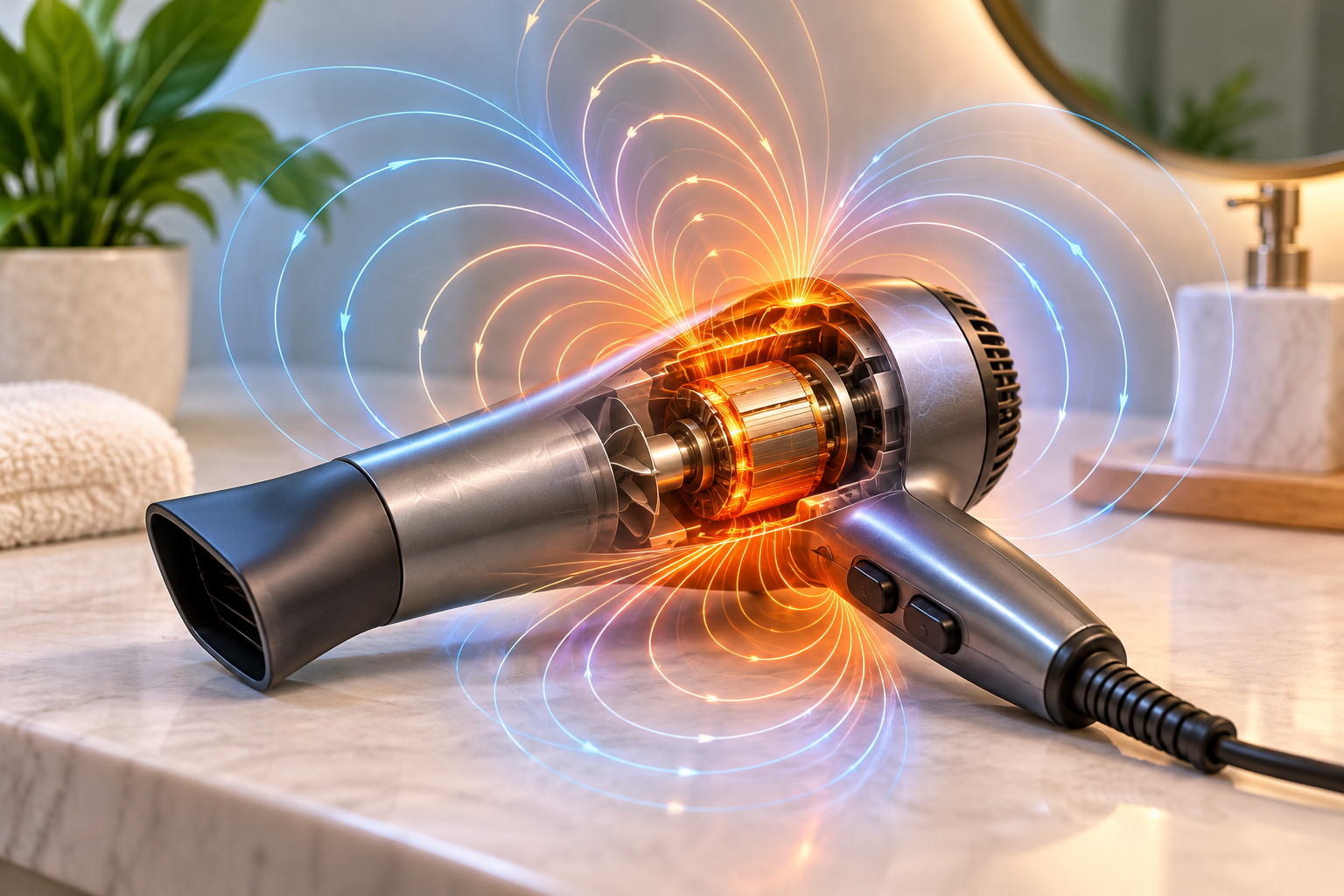
The motor is one of the most important components to understand when examining magnetic fields around a hair dryer.
Electric motors operate by using electromagnetic forces to produce mechanical movement. When electric current passes through motor windings, it creates magnetic fields that interact with other magnetic components inside the motor. These interactions generate the rotation needed to spin the fan.
The magnetic fields produced by the motor can extend beyond the appliance’s housing. Their strength depends on factors such as the motor design, current flow, internal component arrangement, and measurement location.
Because the motor is typically housed inside the body or handle of the dryer, a magnetic-field meter positioned very close to that area may detect stronger readings than one held farther away.
However, the motor is not necessarily the only significant source of magnetic fields. Other electrical components can contribute substantially, and the strongest measurement location varies by appliance.
The Heating Element
Hair dryers generate heat by passing electrical current through a resistive heating element, often made from a nickel-chromium alloy.
As electrical current flows through the element, electrical energy is converted into heat. The fan then pushes air across the heated element and directs the warm airflow toward the hair.
Current flowing through the heating element also generates magnetic fields. The arrangement of the heating wire and its return-current paths can influence how much of that field is measurable outside the dryer.
In some designs, magnetic fields from nearby conductors partially cancel each other. In others, the physical arrangement of components can produce stronger external readings at certain locations.
This is one reason two hair dryers with similar wattage ratings may produce different magnetic-field measurements.
Internal Wiring and the Power Cord
The electrical wiring inside a hair dryer carries current between the power source, switches, motor, and heating element.
These current-carrying conductors generate magnetic fields as well.
The amount of current, spacing between conductors, and direction of current flow all affect the resulting field.
A power cord containing closely positioned outgoing and returning conductors generally produces less external magnetic field than the same currents would produce if the conductors were widely separated.
The key point is that electromagnetic fields are a normal consequence of operating electrical equipment. Their presence does not automatically indicate that an appliance is defective or unsafe.
Why Are Magnetic Fields Stronger Close to the Hair Dryer Motor?
One of the most interesting characteristics of hair dryer EMF radiation is how dramatically magnetic-field measurements can change with distance.
A hair dryer may produce a relatively high reading when a meter is positioned just a few centimeters from its housing. Move that same meter farther away, and the reading can fall considerably.
This behavior is characteristic of magnetic fields around many localized electrical sources.
Understanding Near-Field Magnetic Exposure
When you stand close to a hair dryer, you are near the electrical components producing its magnetic fields.
At these distances, the distribution of the field depends on the geometry of the motor, heating element, wiring, and surrounding materials.
Magnetic fields from compact sources often decrease rapidly as distance increases. However, the precise relationship depends on the source’s physical arrangement and cannot always be described by a single distance formula.
For example, doubling the distance from a hair dryer does not necessarily reduce its magnetic field by a fixed percentage.
Nevertheless, increasing the distance between a measuring instrument and the appliance generally produces lower readings once the instrument is sufficiently far from the main electrical components.
What Published Measurements Show
The World Health Organization has published examples of extremely low-frequency magnetic-field measurements from common household appliances.
Its reference data illustrate how magnetic fields around hair dryers can vary considerably depending on measurement distance.
| Distance from Hair Dryer | Reported Magnetic Field Range |
| 3 centimeters (about 1.2 inches) | 6–2,000 microteslas (µT) |
| 30 centimeters (about 12 inches) | 0.01–7 µT |
| 1 meter (about 39 inches) | 0.01–0.03 µT |
Source: World Health Organization, Electromagnetic Fields and Public Health – Exposure to Extremely Low Frequency Fields.
These figures represent reported ranges from measured appliances, not the expected output of every hair dryer. The upper end of a range should not be treated as a typical reading, and these historical measurements should not be assumed to describe every modern model.
Still, the measurements illustrate an important principle: the distance between an electrical appliance and the measurement point can strongly influence the detected magnetic field.
A meter positioned almost against the housing may produce a very different reading from one held at the approximate location of the user’s head.
This distinction matters when evaluating online videos or product demonstrations that show high EMF readings from hair dryers.
Without knowing the measurement distance, instrument type, frequency settings, and operating conditions, a single number provides limited information about actual exposure.
Is Hair Dryer EMF Radiation Dangerous?
Understanding that an appliance produces electromagnetic fields is only the beginning. The more important question is whether those fields are associated with meaningful health risks during normal use.
Research into extremely low-frequency electromagnetic fields has been conducted for decades. Scientists have examined occupational exposure, residential exposure, biological mechanisms, and possible associations with various health outcomes.
The results require careful interpretation because not all electromagnetic fields behave the same way, and different exposure patterns may have different implications.
What Are Extremely Low-Frequency Magnetic Fields?
Extremely low-frequency, or ELF, magnetic fields are associated with electrical systems operating at low frequencies.
In the United States, household electrical power generally operates at 60 hertz. Electrical appliances connected to household power can generate magnetic fields at this frequency and at additional frequencies associated with their internal components.
Hair dryers may also produce other electromagnetic emissions, including infrared radiation from the heating element and electrical noise from motor controls.
These emissions should not all be treated as interchangeable.
The low-frequency magnetic fields discussed in this article are non-ionizing. They do not carry enough energy per photon to ionize atoms or directly break chemical bonds in the way that X-rays or gamma rays can.
That does not mean electromagnetic fields are incapable of interacting with biological tissue. Sufficiently strong low-frequency fields can induce electrical currents in the body, which is one reason exposure guidelines exist.
However, the presence of a measurable field alone does not establish that harmful effects are occurring.
What Does the World Health Organization Say?
The World Health Organization recognizes that exposure to extremely low-frequency electric and magnetic fields is widespread because electricity is used throughout modern society.
The organization has reviewed research concerning possible health effects, including studies examining long-term exposure and childhood leukemia.
In 2002, the International Agency for Research on Cancer classified extremely low-frequency magnetic fields as possibly carcinogenic to humans, known as Group 2B.
This classification was based primarily on limited epidemiological evidence concerning childhood leukemia and long-term average residential magnetic-field exposure.
Some observational studies reported associations between childhood leukemia and average residential magnetic-field exposures above approximately 0.3–0.4 microteslas.
However, researchers have not established that magnetic fields cause childhood leukemia, and the evidence does not provide a convincing biological explanation for the observed association.
Importantly, these studies involved long-term exposure patterns rather than brief use of individual household appliances.
It would therefore be misleading to interpret the classification as evidence that using a hair dryer causes cancer.
Does a High EMF Meter Reading Mean a High Health Risk?
Not necessarily.
An EMF meter measures certain physical characteristics of electromagnetic fields. It does not directly measure biological harm or determine whether an appliance is dangerous.
For example, a meter placed a few centimeters from a hair dryer might display a relatively high magnetic-field reading.
That number does not tell you how much exposure a person receives throughout the entire drying session.
Exposure depends on several factors, including distance, duration, frequency, field strength, and the position of the body relative to the appliance.
A short period near a localized electrical source is not equivalent to continuous exposure at the same field strength.
Similarly, comparing a brief peak measurement with a guideline intended for another exposure pattern can lead to incorrect conclusions.
For readers concerned about electromagnetic fields, understanding the meaning and limitations of measurements is more valuable than reacting to the highest number displayed on a meter.
Do All Hair Dryers Produce the Same Amount of EMF?
Not all hair dryers produce identical magnetic fields.
Differences in electrical engineering, motor construction, wiring arrangements, and physical design can influence the electromagnetic fields measured outside the appliance.
Even two dryers with similar power ratings may have different magnetic-field patterns.
Traditional Hair Dryers
Many conventional hair dryers use brushed electric motors.
These motors operate through electrical contacts that help control current flow through rotating components.
Their design can produce magnetic fields associated with the motor’s operation, along with additional electrical noise from switching and brush contact.
The resulting field depends on the motor and the overall electrical design.
Brushless Hair Dryers
Some newer hair dryers use brushless motors.
Brushless motors rely on electronic controls rather than mechanical brushes to regulate motor operation.
They may offer benefits such as reduced mechanical wear, improved efficiency, or different noise characteristics.
However, brushless technology does not automatically mean lower EMF exposure.
Electronic motor controls can generate their own electromagnetic emissions, and the measured magnetic fields depend on the complete appliance design.
A manufacturer would need to provide meaningful test results before a particular brushless model could reasonably be described as lower in magnetic-field exposure.
Ionic and Ceramic Hair Dryers
Ionic and ceramic hair dryers are commonly marketed for their hair-styling benefits.
Ionic technology is generally intended to influence static electricity and hair behavior, while ceramic components are often used in heat distribution or heating systems.
Neither term establishes how much low-frequency magnetic field the appliance produces.
An ionic hair dryer can still contain a motor, heating element, and current-carrying wiring.
Likewise, a ceramic heating component does not eliminate magnetic fields from the rest of the appliance.
Consumers should be cautious about assuming that a particular styling technology provides meaningful EMF reduction unless that claim is supported by appropriate testing.
Affiliate Advertisement

How to Reduce EMF Exposure While Using a Hair Dryer
For people who want to take a precautionary approach, there are straightforward ways to reduce unnecessary exposure without abandoning a useful household appliance.
These suggestions focus on distance, drying habits, and normal electrical safety rather than expensive accessories or unverified protective products.
Maintain a Comfortable Distance
Because magnetic fields generally decrease with distance from their source, holding a hair dryer farther from your head can reduce exposure to fields generated by its internal components.
You do not need to hold the dryer an impractical distance away.
Instead, maintain the spacing recommended by the manufacturer for effective drying and protection against excessive heat.
Avoid pressing the appliance’s housing against your head or skin.
The exact reduction in magnetic-field exposure will depend on the model and the location of its electrical components.
Remove Excess Water Before Drying
Using a towel to remove excess moisture can reduce the amount of time needed to dry your hair.
A microfiber towel or another absorbent towel can help remove water before you turn on the dryer.
Shorter drying sessions may reduce cumulative exposure to the appliance’s magnetic fields, although this should not be interpreted as evidence that normal drying times are harmful.
It can also reduce electricity consumption and unnecessary heat exposure to the hair.
Avoid Unnecessarily Long Drying Sessions
If your hair is already dry, continuing to operate the dryer provides little practical benefit.
Using the appliance only as long as necessary is a simple way to avoid unnecessary exposure to heat, noise, and electromagnetic fields.
There is no established health-based maximum number of minutes for ordinary hair dryer use based specifically on ELF magnetic-field exposure.
Follow Manufacturer Safety Instructions
Hair dryers combine electricity, heat, and moving air, making ordinary electrical safety particularly important.
Keep the appliance away from water, avoid using damaged cords, and make sure ventilation openings remain clear.
Do not operate a hair dryer with damaged wiring or signs of overheating.
In bathrooms, use properly installed ground-fault circuit interrupter protection and follow the manufacturer’s instructions.
These precautions address established electrical and burn hazards, which deserve at least as much attention as concerns about electromagnetic fields.
Can You Measure Hair Dryer EMF Radiation at Home?
If you are curious about the magnetic fields generated by your own hair dryer, measuring them can be an informative experiment.
A suitable instrument can help you observe how readings change with distance, appliance orientation, and operating settings.
However, choosing the correct meter is essential.
What Type of EMF Meter Do You Need?
To measure the low-frequency magnetic fields associated with a hair dryer, look for an instrument designed to measure ELF or power-frequency magnetic fields.
These instruments may display measurements in microteslas (µT) or milligauss (mG).
The relationship between the two units is straightforward:
1 microtesla = 10 milligauss.
For example, a magnetic-field reading of 0.5 µT is equivalent to 5 mG.
A meter designed exclusively for radiofrequency signals, such as WiFi or cellular communications, is not suitable for measuring the primary low-frequency magnetic fields discussed here.
When selecting a meter, consider its frequency range, sensitivity, measurement accuracy, and whether it measures one axis or three axes.
A three-axis meter can be convenient because it combines measurements from different orientations, reducing the need to rotate the instrument manually.
It is also important to recognize that some meters have limited frequency ranges or can produce inaccurate readings near strong electrical sources.
How to Perform a Simple Hair Dryer EMF Test
A basic home experiment can help demonstrate how magnetic fields change around an operating appliance.
The goal should be to observe differences under consistent conditions rather than determine whether the hair dryer is medically safe.
You can use the following procedure to make your measurements more meaningful.
- Measure the background field. With the hair dryer switched off, take a reading in the room away from nearby electrical equipment.
- Position the dryer securely. Place it in a safe, dry location where the airflow is unobstructed. Keep it away from water and combustible materials.
- Measure at several distances. Record readings at approximately 5, 15, 30, and 60 centimeters from the same reference point on the dryer, while keeping your hands clear of hot surfaces and openings.
- Compare operating settings. If your meter is suitable, observe whether readings change between different airflow and temperature settings.
- Repeat the measurements. Take several readings at each position and record the results so you can identify consistent patterns.
Avoid opening the appliance, modifying its wiring, or placing the meter inside the housing.
Measurements should be performed only when the appliance can be operated safely, and the meter should not obstruct ventilation.
Understanding Your Results
Suppose your meter shows a noticeably stronger magnetic field close to the dryer and a much lower reading at 30 centimeters.
That pattern would be consistent with the behavior of many localized magnetic-field sources.
However, the numbers should not automatically be compared with residential exposure studies or interpreted as a measure of personal health risk.
Residential epidemiological research generally considers average exposure over long periods, while your experiment captures readings at particular locations and moments.
Your measurements may also include background magnetic fields from wiring, nearby appliances, or other electrical equipment.
For that reason, a home EMF meter is best viewed as an educational measurement tool rather than a medical risk detector.
Should You Buy a Low-EMF Hair Dryer?
Some hair dryers are advertised as low-EMF or reduced-radiation models.
These claims may sound appealing to consumers interested in minimizing electromagnetic exposure, but they deserve careful evaluation.
There is no universally recognized consumer label that guarantees a hair dryer produces the lowest possible magnetic fields under all operating conditions.
Manufacturers may use different instruments, measurement distances, operating settings, and testing methods.
A product described as low-EMF at one measurement location might produce different results when measured elsewhere around its housing.
Before paying extra for a particular model, look for documentation that identifies the measured field strength, measurement distance, frequency range, and testing conditions.
Independent laboratory measurements are especially useful when comparing competing products.
Also consider ordinary purchasing factors such as electrical safety certification, drying performance, temperature control, durability, and ease of use.
A hair dryer that performs well, operates safely, and meets your practical needs may be a more sensible purchase than one relying primarily on unsupported electromagnetic shielding claims.
At present, there is insufficient evidence to recommend replacing a properly functioning hair dryer solely because of concern about its normal magnetic-field emissions.
Frequently Asked Questions About Hair Dryer EMF
People researching electromagnetic fields from personal-care appliances often have similar questions about exposure, technology, and measurement.
The following answers address several common concerns and clarify what can reasonably be concluded from available information.
Do Hair Dryers Emit More EMF Than Other Bathroom Appliances?
Hair dryers can produce relatively strong magnetic fields at very close distances, but the amount varies considerably by model.
Electric shavers, electric toothbrushes, and other motor-driven bathroom appliances can also generate localized magnetic fields.
Comparing appliances requires measurements taken under consistent conditions.
A higher reading directly against one appliance does not necessarily mean it produces greater exposure during normal use than another appliance.
Distance, operating time, and where the appliance is positioned relative to the body all matter.
Does the Cool Setting Reduce Magnetic Fields?
Not necessarily.
On many hair dryers, the cool setting reduces or disables the heating element while allowing the motor and fan to continue operating.
Changing the heating element’s electrical current can alter the magnetic fields generated by the appliance.
However, the motor remains active, and the resulting magnetic-field level depends on the dryer design.
Some models may show lower readings on cool settings, while others may show relatively little change at certain measurement locations.
Actual measurements are needed to determine the difference for a specific model.
Are Ionic Hair Dryers Lower in EMF?
An ionic hair dryer is not automatically a low-EMF hair dryer.
Ionic technology is generally marketed for reducing static electricity and improving hair appearance.
It does not eliminate the electric motor, heating element, or internal electrical wiring.
Some ionic dryers may produce lower magnetic-field measurements than certain conventional models, but that difference cannot be assumed from the ionic label alone.
Reliable comparisons require testing under equivalent conditions.
Can an EMF Meter Tell Me Whether My Hair Dryer Is Safe?
An EMF meter can measure certain electromagnetic-field characteristics, but it cannot independently determine whether a hair dryer is safe for human health.
A meter reading must be interpreted in the context of frequency, duration, distance, measurement accuracy, and applicable exposure guidance.
A consumer meter also cannot assess other important safety concerns, including electrical insulation, overheating, or product defects.
For everyday use, following the manufacturer’s safety instructions and choosing an appropriately certified appliance remain important considerations.
Conclusion: Understanding Hair Dryer EMF Radiation
Hair dryers generate electromagnetic fields because they contain electrical motors, heating elements, and current-carrying wiring. Some models can produce relatively high magnetic-field readings very close to their electrical components, but those readings typically decrease substantially with distance.
Understanding hair dryer EMF radiation means recognizing the difference between detecting an electromagnetic field and establishing that it presents a health hazard. Current scientific evidence does not demonstrate that ordinary hair dryer use causes cancer or other chronic health problems.
If you prefer to minimize unnecessary exposure, maintaining a comfortable drying distance, limiting unnecessary operating time, and using the appliance according to manufacturer instructions are reasonable steps. The most useful approach is to rely on credible measurements, established safety practices, and careful interpretation of scientific evidence rather than alarming claims based on isolated meter readings.
Before You Go…
Get Weekly EMF Protection Tips
Enjoy this article? Join the EMFLuLu newsletter for simple weekly tips to reduce everyday EMF exposure from phones, WiFi routers, laptops, and smart home devices.
Try Our Free EMF Calculators
Curious how much EMF exposure you may experience each day?
These simple tools can help you estimate your exposure and identify possible problem areas in your home.
Try these free calculators:
Like this article? Pin it on Pinterest!
More to Explore