For millions of people, making coffee is one of the first things they do every morning. Whether you use a traditional drip coffee maker, a single-serve pod machine, or a high-end espresso machine, the process is usually simple: add water, prepare your coffee, press a button, and wait for your favorite drink. However, because coffee makers rely on electricity to heat water and operate internal components, they also generate electromagnetic fields. This raises an interesting question about coffee maker EMF: How much electromagnetic radiation does an everyday coffee machine actually produce, and should you be concerned about standing near it while your coffee brews?
Electromagnetic fields, commonly called EMFs, are present around many electrical appliances throughout the home. Refrigerators, dishwashers, microwaves, hair dryers, and coffee makers all produce varying levels of electromagnetic fields during operation. Some appliances also communicate wirelessly, introducing another type of electromagnetic exposure.
The important distinction is that detecting an electromagnetic field does not automatically mean that an appliance presents a health hazard. The type of field, its strength, how long someone is exposed, and the scientific evidence surrounding potential health effects all matter.
In this article, we will examine how coffee makers produce EMF, what available measurements tell us, how different coffee machines compare, and whether simple changes to your morning routine can reduce unnecessary exposure.
Do Coffee Makers Emit EMF?
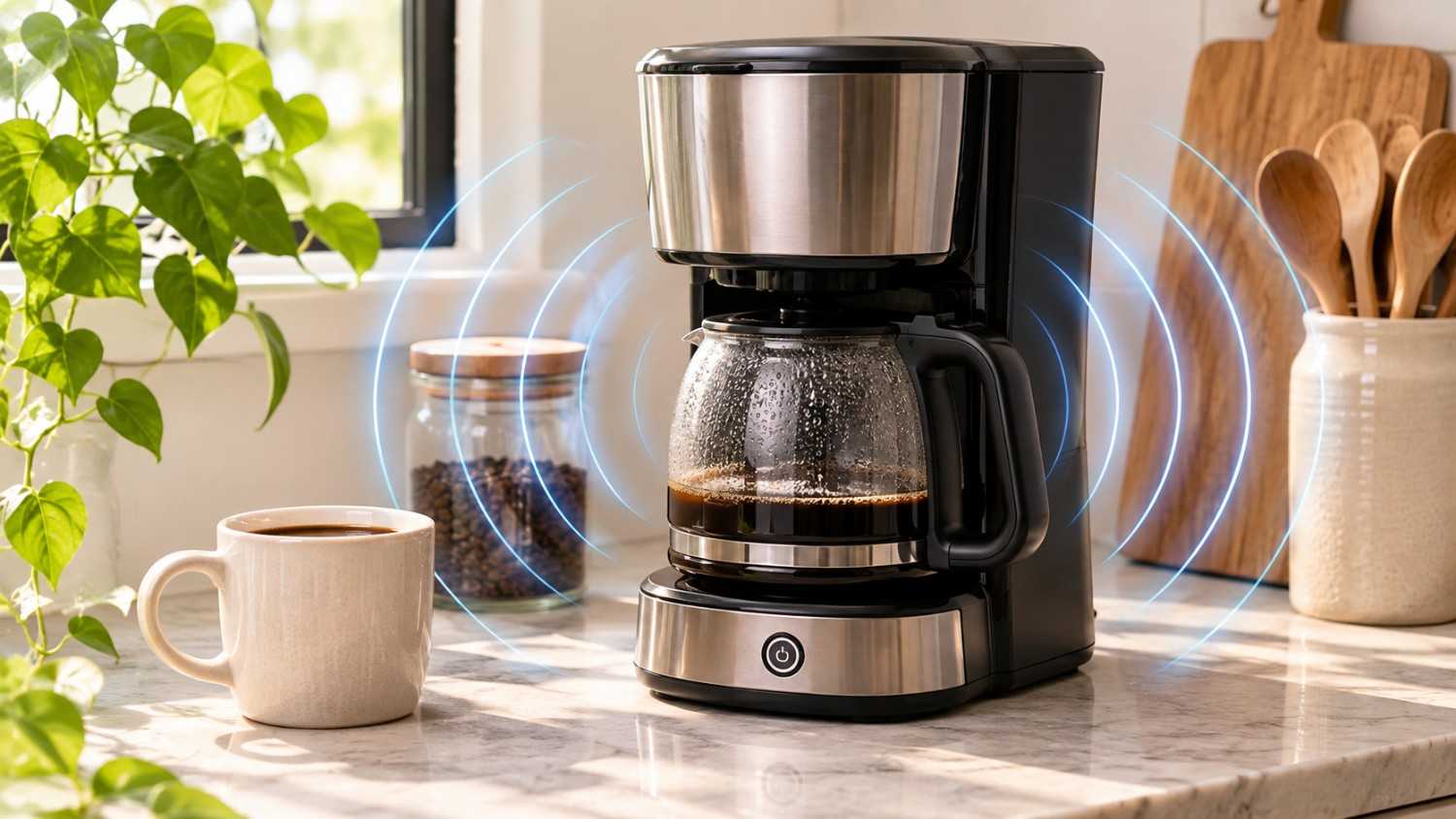
Yes. Electric coffee makers produce electromagnetic fields when electrical current flows through their internal components. This is a normal characteristic of electrical equipment and does not mean that the machine is defective or unusually hazardous.
Most household coffee makers operate using standard alternating-current electricity. In the United States, household electrical systems operate at a frequency of 60 hertz (Hz). When electricity passes through the heating element, wiring, or motor inside a coffee maker, it produces electric and magnetic fields.
These fields belong to the extremely low-frequency, or ELF, portion of the electromagnetic spectrum.
A coffee maker can produce several types of electromagnetic fields depending on its design.
Extremely Low-Frequency Magnetic Fields
Magnetic fields develop when electrical current flows through the machine. The heating element is often one of the most important components because it draws substantial current while heating water.
Some coffee makers also contain pumps, motors, and electrically operated valves. These components can contribute to the magnetic fields measured around the appliance.
Magnetic-field strength depends on factors such as current flow, component arrangement, distance, and the operating stage of the machine.
Electric Fields
Electric fields are associated with voltage. Unlike magnetic fields, which depend on current flow, electric fields can be present around energized electrical equipment even when little or no current is being drawn.
The electrical design of the appliance, its shielding, grounding, and nearby materials can influence electric-field measurements.
Radiofrequency Emissions
Traditional coffee makers generally do not require wireless communication to function.
However, some modern coffee machines include Wi-Fi or Bluetooth connectivity. These features allow users to control brewing schedules, receive notifications, or adjust settings using a smartphone.
Wireless communication introduces radiofrequency, or RF, electromagnetic emissions that are different from the low-frequency fields generated by the appliance’s electrical components.
It is important not to confuse these two categories because they require different measurement methods and are evaluated using different exposure guidelines.
How Much EMF Does a Coffee Maker Produce?
One of the most useful questions to ask about coffee maker EMF is how much exposure someone might receive while standing beside the appliance.
The answer depends on the coffee maker, its electrical components, its operating condition, and the distance between the person and the machine.
Magnetic fields are commonly measured in milligauss (mG) or microtesla (µT). Both units describe magnetic flux density.
One microtesla equals 10 milligauss.
Historical measurements of household appliances published by the U.S. Environmental Protection Agency provide some useful perspective. These measurements illustrate that coffee makers can produce detectable magnetic fields nearby and that field strength generally decreases with distance.
Coffee Maker Magnetic Field Measurements
The following table presents historical EPA-reported ranges for coffee makers at two distances.
| Distance From Coffee Maker | Reported Magnetic Field |
| 6 inches | 4–10 mG |
| 12 inches | Near background to approximately 1 mG |
These values are historical measurements from tested appliances, not universal specifications for every coffee maker sold today. Individual models may produce different readings, and the surrounding electrical environment can affect measurements.
The table also demonstrates an important characteristic of magnetic fields from many household appliances: exposure can decrease considerably as distance increases.
Someone standing immediately beside a coffee maker may experience a stronger field than someone standing several feet away.
However, the relationship between distance and magnetic-field strength is not identical for every appliance. It depends on the shape and arrangement of the electrical components generating the field.
Why Measurements Can Vary
Two coffee makers that appear nearly identical may produce different magnetic-field readings.
One machine might use a larger heating element, while another may contain a more powerful pump or motor. The placement of internal wiring can also influence the magnetic field measured outside the appliance.
The brewing cycle matters as well.
A machine actively heating water may draw more electrical current than it does while waiting between brewing stages. An espresso machine operating its pump may produce a different reading than the same machine sitting idle.
For this reason, a single measurement does not necessarily represent the highest field produced during an entire brewing cycle.
Does a Higher Reading Mean Greater Danger?
Not necessarily.
A magnetic-field measurement describes the strength of the field at a particular location and time. It does not establish that the exposure is harmful.
Health-risk assessments consider the type of electromagnetic field, exposure duration, frequency, intensity, and available scientific evidence.
A short-term reading near an operating coffee maker should not be interpreted as proof of a health risk simply because it is higher than the surrounding background level.
Which Types of Coffee Makers Produce the Most EMF?
Coffee makers use different brewing technologies, and their electrical designs can influence the electromagnetic fields they produce.
However, there is no reliable universal ranking showing that one entire category of coffee maker always produces more EMF than another. Measurements of specific models under comparable conditions would be needed to make that determination.
Understanding the components used in each type of machine can still help explain where electromagnetic fields originate.
Traditional Drip Coffee Makers
Traditional drip coffee makers are among the most common kitchen appliances.
These machines typically use an electric heating element to warm water, which then travels through the coffee grounds and into a carafe.
Many models also contain a warming plate that keeps brewed coffee hot.
The heating element and warming plate draw electrical current during operation, generating low-frequency magnetic fields.
A basic drip coffee maker without wireless connectivity generally does not have an intentional Wi-Fi or Bluetooth transmitter.
Single-Serve Pod Coffee Makers
Single-serve machines, including Keurig-style coffee makers, often use electrical heating systems, pumps, electronic controls, and valves.
These components can operate at different stages of the brewing cycle.
For example, the machine may heat water before activating a pump to move it through the coffee pod.
The magnetic field surrounding the machine may therefore change throughout the process.
It would be inaccurate to assume that a pod machine necessarily produces more EMF than a traditional drip coffee maker. The actual comparison depends on the specific machines being tested.
Espresso Machines
Electric espresso machines can contain heating elements, pumps, electronic control boards, and sometimes built-in grinders.
Some machines also use multiple heating systems to control brewing and steaming temperatures.
Because several electrical components may operate during preparation, magnetic-field measurements can vary depending on whether the machine is heating, grinding, pumping, or steaming milk.
A large commercial espresso machine may also have a substantially different electrical design from a compact home model.
Coffee Makers With Built-In Grinders
Coffee machines with integrated grinders contain an additional electrical motor.
The grinder operates for a relatively short period, but it may generate a measurable magnetic field while running.
Once grinding stops, that particular source of magnetic-field emissions decreases.
The total exposure associated with the machine depends on how long the motor operates and how close someone stands during grinding.
Smart Coffee Makers
Smart coffee makers introduce another consideration because some models communicate through Wi-Fi or Bluetooth.
Their heating elements and motors still generate low-frequency electromagnetic fields, while their wireless communication systems may produce radiofrequency emissions.
Wireless transmissions may occur even when the machine is not actively brewing, depending on its design and settings.
For readers who prefer to minimize unnecessary wireless transmissions, a conventional coffee maker without connectivity may be a straightforward option.
That does not mean smart coffee makers have been demonstrated to be dangerous. It simply means their wireless features introduce an additional source of electromagnetic emissions.
Is Coffee Maker EMF Dangerous to Your Health?
This is probably the most important question for readers concerned about electromagnetic exposure.
Although coffee makers generate measurable electromagnetic fields, there is no established scientific evidence demonstrating that ordinary coffee maker use causes health problems.
It is helpful to distinguish between the existence of electromagnetic fields and the possibility of adverse health effects.
What Research Says About Low-Frequency EMF
Extremely low-frequency magnetic fields have been studied for decades.
Researchers have examined possible associations between long-term magnetic-field exposure and various health outcomes.
One area of investigation has involved childhood leukemia and prolonged residential exposure to relatively elevated average magnetic fields.
The International Agency for Research on Cancer classified extremely low-frequency magnetic fields as possibly carcinogenic to humans, based largely on limited epidemiological evidence concerning childhood leukemia.
However, this classification does not establish that magnetic fields from household appliances cause cancer.
The evidence is complicated by uncertainties about exposure assessment, possible confounding factors, and the lack of a clearly established biological mechanism explaining the observed associations.
Importantly, studies involving long-term average residential exposure cannot be directly applied to brief exposure near a coffee maker during morning brewing.
Affiliate Advertisement

Non-Ionizing Versus Ionizing Radiation
Another important distinction involves the type of radiation involved.
The low-frequency electromagnetic fields generated by coffee makers are non-ionizing.
Non-ionizing radiation does not carry enough energy per photon to ionize atoms or molecules in the way that X-rays and gamma rays can.
This does not mean that every possible non-ionizing exposure is harmless at every intensity. Strong electromagnetic fields can produce established biological effects through mechanisms such as induced electrical currents or heating, depending on frequency.
However, ordinary household appliance exposure is very different from the high-intensity conditions associated with those established effects.
What About Smart Coffee Makers?
Wi-Fi-enabled coffee machines may produce radiofrequency emissions when communicating with a network.
RF exposure has also been extensively studied, particularly in relation to wireless communication technologies.
Major public-health organizations have not established that low-level RF exposure from compliant consumer wireless devices causes adverse health effects.
Actual exposure depends on factors such as transmitter power, distance, transmission activity, and device design.
A coffee maker that communicates occasionally with a home network should not automatically be treated as a significant health hazard.
Should You Be Concerned?
For most households, coffee maker EMF is not a reason to stop using an electric coffee machine.
People who prefer to reduce unnecessary exposure can take simple steps without making major lifestyle changes.
The key is to make decisions based on credible measurements and scientific evidence rather than assuming that every detectable electromagnetic field represents a dangerous exposure.
How to Measure EMF From Your Coffee Maker at Home
If you are curious about the electromagnetic fields produced by your own coffee machine, measuring them can be an interesting educational exercise.
A suitable EMF meter can help you understand how magnetic-field readings change when the appliance is heating water, operating a pump, or sitting idle.
However, selecting the correct type of meter is important.
A meter designed only to measure radiofrequency radiation will not properly measure the 60 Hz magnetic fields associated with ordinary household electrical equipment.
For this type of testing, you need a meter capable of measuring low-frequency magnetic fields, ideally with an appropriate frequency response and clear measurement units.
A Simple Home Measurement Procedure
The following process can help you collect more consistent measurements. The goal is to observe how readings change, not to diagnose a health hazard or determine whether a coffee maker is medically safe.
- Measure the background level. With the coffee maker unplugged, take a magnetic-field reading at the location where the appliance normally sits. This provides a reference for fields from other nearby sources.
- Measure at a consistent distance. Position the meter approximately 6 inches from the coffee maker. Record the reading and note the exact location of the meter.
- Start the brewing cycle. Observe the meter while the machine heats water, activates its pump, or operates other electrical components.
- Repeat at greater distances. Take additional readings at 12 inches, 24 inches, and 36 inches, keeping the meter at approximately the same height.
- Compare the results. Look for changes in magnetic-field strength as the machine operates and as the measurement distance increases.
- Repeat the test. Performing multiple measurements can help identify temporary fluctuations and improve consistency.
Avoid opening the appliance, touching internal electrical components, or positioning measurement equipment near hot surfaces or water.
Understanding Your Results
Suppose a coffee maker produces a reading of 8 mG at a distance of 6 inches, while the meter records 0.5 mG at 3 feet.
This hypothetical example would show that the measured magnetic field decreases substantially with distance.
It would not demonstrate that the closer reading is dangerous or that the more distant reading represents a scientifically established safe threshold.
The measurements simply describe the electromagnetic environment at those locations.
It is also important to recognize that inexpensive consumer meters may have limitations involving calibration, frequency response, directional sensitivity, and accuracy.
For readers who want to understand these measurements better, our EMF meter guides and EMF measurement conversion tools can provide additional background.
Simple Ways to Reduce Coffee Maker EMF Exposure
Although there is no established need for most people to change their coffee-making habits because of electromagnetic fields, some readers may prefer to minimize unnecessary exposure.
Fortunately, reducing exposure from a coffee maker usually does not require specialized shielding materials, expensive accessories, or replacing a perfectly functional appliance.
The following suggestions focus on practical habits that are easy to incorporate into a normal morning routine.
1. Stand a Little Farther Away During Brewing
One of the simplest ways to reduce exposure to magnetic fields from an appliance is to increase your distance from the source.
Rather than standing directly beside the coffee maker throughout the brewing cycle, you can prepare breakfast, organize the kitchen, or complete another task while the machine operates.
Even moving a few feet away can reduce the magnetic-field strength experienced from many small electrical appliances.
There is no need to leave the kitchen or avoid the appliance entirely.
2. Consider Where You Place Your Coffee Maker
Coffee makers are often positioned wherever counter space is available.
If your machine sits immediately beside a kitchen chair or a location where someone spends considerable time, moving it farther away may reduce exposure at that seating position.
For example, placing the coffee maker on a section of counter away from a frequently used breakfast table can be a simple adjustment.
However, proper electrical access, ventilation, stability, and manufacturer clearance requirements should take priority.
3. Avoid Unnecessary Wireless Features
If you own a smart coffee maker, check whether its wireless functions can be disabled when they are not needed.
Some machines allow users to turn off Wi-Fi connectivity through their settings.
Other models may require wireless connectivity for certain features.
Disabling unnecessary wireless communication can reduce RF transmissions from the machine, although the electrical heating system will still generate low-frequency fields while operating.
4. Turn Off the Machine When Finished
Many coffee makers automatically shut off after brewing or after a designated warming period.
If your appliance does not have automatic shutoff, follow the manufacturer’s instructions for turning it off when you are finished.
Unplugging a machine when appropriate can eliminate electricity consumption from standby electronics and reduce associated fields from energized components.
However, some electric fields may still exist around the plugged-in power cord, and magnetic fields from the surrounding household wiring may remain.
Turning off the appliance is also a useful energy-saving habit.
5. Keep Electrical Cords in Good Condition
Damaged electrical cords and plugs should be repaired or replaced according to the manufacturer’s instructions.
Although this recommendation is primarily about electrical safety rather than EMF reduction, it is especially important for appliances used near water.
Avoid pinching cords behind heavy appliances or using damaged extension cords.
Never modify the internal wiring or grounding system of a coffee maker in an attempt to reduce electromagnetic emissions.
6. Avoid Unnecessary EMF Shielding Accessories
Some products claim to block or neutralize electromagnetic radiation from household appliances.
However, the effectiveness of these products depends on the type of field, the shielding material, the product’s design, and how it is installed.
Low-frequency magnetic fields are particularly difficult to shield using ordinary materials.
A decorative sticker, pendant, or adhesive accessory should not be assumed to reduce the magnetic field produced by a coffee maker.
For this application, increasing distance is generally a simpler and more predictable way to reduce exposure.
Are Manual Coffee Makers a Lower-EMF Alternative?
If you enjoy experimenting with different brewing methods, manual coffee makers offer an interesting alternative to electric machines.
A French press, pour-over dripper, or other non-electric brewing device does not need an internal electrical heating element, pump, or motor to prepare coffee.
As a result, the brewing device itself does not generate the same power-frequency electromagnetic fields associated with an operating electric coffee maker.
However, the method used to heat the water still matters.
French Press Coffee
A French press uses hot water, ground coffee, and a manually operated plunger.
The brewing vessel itself requires no electricity.
You simply add coffee grounds, pour in hot water, allow the coffee to steep, and press the plunger to separate the grounds from the liquid.
If you heat the water using an electric kettle, the kettle generates electromagnetic fields while operating.
Once the water has been heated and transferred to the French press, the manual brewing process does not require additional electrical power.
Pour-Over Coffee
Pour-over brewing uses a filter and a dripper placed over a cup or carafe.
Hot water is poured slowly over ground coffee, allowing the brewed liquid to pass through the filter.
Like a French press, a basic pour-over dripper contains no electrical heating system or motor.
This method can also provide greater control over brewing time, water distribution, and coffee extraction.
Manual Espresso Devices
Some manual espresso makers use hand-operated pressure rather than an electric pump.
These devices can reduce the number of electrical components involved in the brewing process.
However, many still require externally heated water, and some manual espresso setups include electrically powered accessories.
Is Switching Worth It?
For most people, switching to a manual brewing method solely because of EMF concerns is unnecessary.
Electric coffee makers offer convenience, consistency, and time savings, and ordinary use has not been established as a health hazard.
However, if you already enjoy French press or pour-over coffee, the reduced reliance on electricity during brewing may be an additional benefit.
Choose the brewing method that best suits your preferences, budget, and routine rather than feeling obligated to replace an appliance that works well.
Frequently Asked Questions About Coffee Maker EMF
Readers often have additional questions about how coffee machines operate and whether certain features affect electromagnetic exposure. The following answers address some of the most common concerns.
Do Coffee Makers Emit EMF When Turned Off?
A coffee maker that is switched off generally produces much less magnetic-field activity than it does while heating water or operating a pump.
However, some appliances continue drawing small amounts of electricity in standby mode.
A plugged-in appliance may also have electric fields associated with energized wiring even when it is not actively brewing.
Unplugging the machine eliminates power to its internal circuits, although electromagnetic fields from other nearby electrical sources may remain.
Do Keurig Coffee Makers Produce More EMF Than Drip Coffee Makers?
There is no reliable evidence establishing that every Keurig-style pod machine produces more EMF than every traditional drip coffee maker.
Pod machines may contain pumps, heating elements, and electronic controls, while drip machines often use simpler heating systems.
The actual magnetic-field strength depends on the specific model, component arrangement, operating stage, and measurement distance.
Testing the individual machines would be necessary for a meaningful comparison.
Does a Coffee Maker Produce More EMF While Heating Water?
It often can.
Heating water requires electrical current, and the resulting current produces a magnetic field.
When a heating element switches off or reduces power consumption, its contribution to the surrounding magnetic field may decrease.
However, pumps, motors, and other electrical components can also contribute to measurements during different stages of operation.
Do Smart Coffee Makers Emit Radiation All Day?
Some smart coffee makers maintain wireless connectivity while plugged in, even when they are not actively brewing.
Depending on the model, the machine may periodically communicate with a router or respond to network activity.
This can produce intermittent radiofrequency emissions.
However, the presence of wireless communication does not establish that the exposure is harmful.
The amount of RF exposure depends on the transmitter, operating conditions, and distance.
Is It Safe to Stand Next to a Coffee Maker While Brewing?
For ordinary household use, there is no established evidence that standing beside a properly functioning coffee maker during brewing creates a health hazard from EMF exposure.
Magnetic fields may be stronger close to the appliance, but detectable fields should not automatically be interpreted as dangerous.
The more immediate safety concerns are hot water, steam, electrical damage, and burns.
Can EMF Shielding Paint Block Coffee Maker Radiation?
EMF shielding paints are generally designed for particular electric-field or radiofrequency applications, depending on their composition and installation.
They should not be assumed to block the low-frequency magnetic fields produced by a coffee maker’s heating element.
Low-frequency magnetic-field shielding requires specialized materials and engineering considerations.
For ordinary kitchen use, shielding paint is not a practical or medically necessary solution to coffee maker emissions.
Can Coffee Maker EMF Affect the Coffee Itself?
There is no established evidence that ordinary electromagnetic fields generated by a coffee maker make the brewed coffee unsafe to drink.
The machine’s electrical heating system warms the water, which extracts flavor compounds from the coffee grounds.
Coffee quality and safety are more directly influenced by factors such as water quality, machine cleanliness, brewing temperature, and the condition of the appliance.
Regular cleaning and following the manufacturer’s maintenance recommendations are more useful than worrying about EMF altering the coffee.
Conclusion: Should You Worry About Coffee Maker EMF?
Coffee makers are a familiar part of everyday life, and like other electrical appliances, they produce electromagnetic fields during operation. The heating element, internal wiring, pumps, and motors can all contribute to measurable low-frequency magnetic fields, while smart models may also produce radiofrequency emissions through wireless communication.
Understanding coffee maker EMF is less about avoiding your morning cup of coffee and more about recognizing how electrical appliances work. Measurements show that magnetic fields can be stronger near a machine and generally decrease with distance, but ordinary coffee maker use has not been established as a health hazard.
If you prefer to minimize unnecessary exposure, simple habits such as standing a little farther away during brewing, turning off unused features, and positioning the machine thoughtfully are reasonable options.
There is no need to purchase expensive shielding products or replace a functioning coffee maker solely because it produces measurable electromagnetic fields.
Ultimately, your coffee-making routine should remain something you enjoy. By understanding the science and focusing on practical information, you can make informed decisions without unnecessary worry.
Before You Go…
Get Weekly EMF Protection Tips
Enjoy this article? Join the EMFLuLu newsletter for simple weekly tips to reduce everyday EMF exposure from phones, WiFi routers, laptops, and smart home devices.
Try Our Free EMF Calculators
Curious how much EMF exposure you may experience each day?
These simple tools can help you estimate your exposure and identify possible problem areas in your home.
Try these free calculators:
Like this article? Pin it on Pinterest!

More to Explore