Wireless technology has become a regular part of everyday life. From Wi-Fi routers and smartphones to smart meters and nearby cell towers, our homes are surrounded by devices that transmit and receive radiofrequency signals. While these technologies make life more convenient, some homeowners are interested in understanding their electromagnetic field exposure and whether certain building materials can help reduce it. One product receiving attention is EMF shielding paint, a specialized coating designed to reduce the transmission of certain electromagnetic signals through walls and other surfaces.
Unlike ordinary household paint, which is primarily intended to protect and decorate surfaces, shielding paint contains conductive materials that can reflect or absorb some electromagnetic energy. Manufacturers often advertise its ability to reduce wireless signals from Wi-Fi networks, cellular communications, and other radiofrequency sources. These claims naturally raise questions about how well the product performs, whether it can shield an entire room, and whether the expense is justified.
The important distinction is that a product can reduce radiofrequency exposure without necessarily providing a measurable health benefit. Understanding that difference is essential when deciding whether shielding paint belongs in your home.
In this article, we will examine how shielding paint works, what types of electromagnetic fields it can reduce, what research and laboratory testing tell us about its effectiveness, and what homeowners should consider before making a purchase.
What Is EMF Shielding Paint?
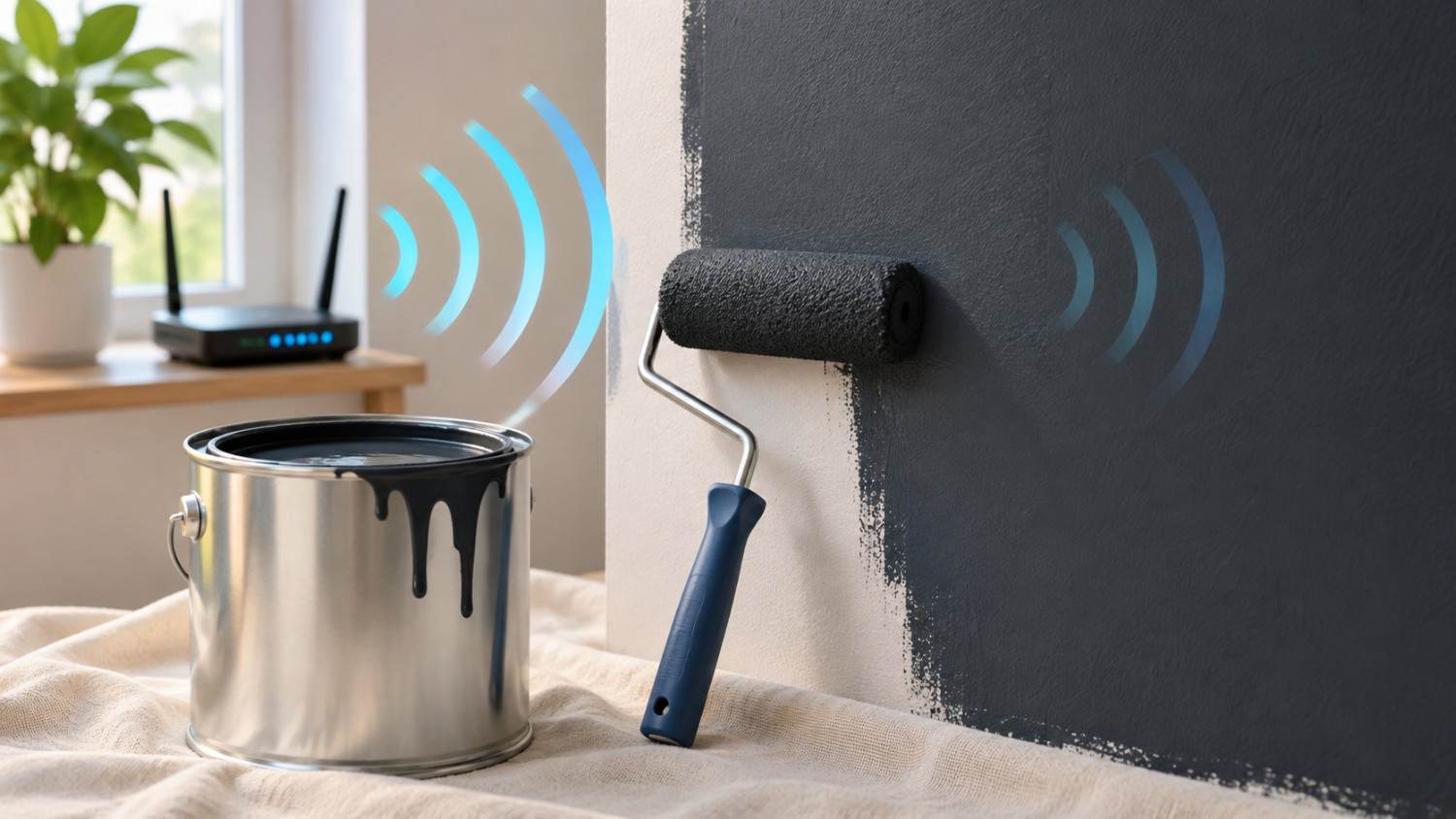
EMF shielding paint is a specialized coating formulated with electrically conductive ingredients that help reduce the passage of certain electromagnetic fields through a treated surface. Although it may resemble ordinary wall paint when applied, its purpose is quite different. Instead of simply adding color or protecting drywall, it creates a conductive layer that can interfere with the transmission of radiofrequency electromagnetic waves.
Many shielding paints use carbon-based conductive materials, while other formulations incorporate metal particles or different conductive compounds. The exact ingredients depend on the manufacturer and the frequencies the product is designed to attenuate.
These coatings are commonly sold for application to interior walls, exterior walls, ceilings, and selected building surfaces. Some products are intended for residential use, while others are designed for laboratories, commercial facilities, or environments where controlling electromagnetic interference is important.
One important characteristic is that shielding paint is usually applied as an undercoat. Many products have a dark appearance, but they can be covered with compatible decorative paint after the shielding layer has cured according to the manufacturer’s instructions.
Shielding paint is not a universal barrier against every form of electromagnetic energy. Most consumer products in this category primarily target radiofrequency signals, although certain properly installed conductive systems can also reduce low-frequency electric fields. Their effectiveness against low-frequency magnetic fields is generally much more limited.
Understanding this distinction helps homeowners avoid assuming that a single coating can address every possible source of electromagnetic exposure.
How Does EMF Shielding Paint Work?
To understand how shielding paint works, it helps to consider what happens when a wireless signal encounters a building material.
Radiofrequency electromagnetic waves can travel through air and penetrate many ordinary construction materials. Drywall, wood, glass, and other common surfaces may weaken a signal to varying degrees, but they generally do not prevent wireless communication from passing through.
Conductive shielding materials behave differently. When electromagnetic waves encounter a conductive surface, some of the energy may be reflected, some may be absorbed, and some may continue through the material. The amount transmitted depends on several factors, including the material’s electrical properties, thickness, continuity, and the frequency of the incoming signal.
Shielding paint attempts to create a continuous conductive layer across the treated surface. When properly applied, that layer can reduce the strength of radiofrequency signals passing through it.
Understanding Shielding Effectiveness and Decibels
Manufacturers frequently describe shielding performance using decibels, abbreviated as dB. This measurement expresses how much a signal is reduced relative to its original strength.
Decibels use a logarithmic scale, meaning that relatively small numerical changes can represent substantial differences in transmitted power.
For example, when comparing incident and transmitted power under equivalent measurement conditions, the following reductions illustrate how attenuation works:
| Shielding effectiveness | Reduction in transmitted power |
| 10 dB | 90% |
| 20 dB | 99% |
| 30 dB | 99.9% |
| 40 dB | 99.99% |
These percentages describe power reduction under the stated measurement conditions. They do not mean that an entire room will experience the same reduction in exposure.
A coating that achieves 30 dB attenuation during a controlled laboratory test may perform differently when installed in a home with windows, doors, electrical outlets, and untreated surfaces.
The frequency of the signal also matters. A paint formulation that performs well at one wireless frequency may offer a different level of attenuation at another.
For this reason, consumers should look for frequency-specific testing rather than relying entirely on a manufacturer’s largest advertised shielding percentage.
Does EMF Shielding Paint Really Block Wireless Radiation?
The short answer is yes. Properly formulated conductive shielding paint can significantly reduce the transmission of radiofrequency electromagnetic energy through treated surfaces. However, the degree of reduction depends on the product, installation quality, frequency, and surrounding environment.
The underlying technology is not imaginary. Electromagnetic shielding is a well-established engineering practice used in electronics, communications equipment, research facilities, and other applications where unwanted electromagnetic interference needs to be controlled.
Conductive coatings are one of several methods used to create shielding barriers. Scientific research into conductive paints, polymers, and composite coatings has demonstrated that these materials can attenuate electromagnetic waves when their composition and application are appropriate.
However, demonstrating that a material works in a laboratory is different from proving that painting one bedroom wall will substantially reduce a person’s total wireless exposure.
Laboratory Results Versus Real-World Performance
Laboratory testing generally evaluates a sample under controlled conditions. Researchers or manufacturers measure the amount of electromagnetic energy passing through the material across specified frequencies.
This allows different formulations to be compared and provides useful information about the coating’s potential effectiveness.
A home presents a much more complicated environment.
Wireless signals may enter through windows, doors, untreated walls, ventilation openings, and other gaps. Signals can also reflect from nearby surfaces, creating complicated patterns of stronger and weaker reception throughout a room.
Even when a painted wall provides substantial attenuation, signals may still reach the room through alternative paths.
The location of the wireless source is another important consideration. A homeowner attempting to reduce signals from a nearby outdoor transmitter may need a different shielding arrangement than someone trying to reduce emissions from a Wi-Fi router located inside the house.
Can Shielding Paint Make a Room Completely Radiation-Free?
No ordinary residential shielding project should be assumed to create a completely radiofrequency-free environment.
A properly designed shielded enclosure can achieve substantial isolation, but doing so requires attention to the entire structure, including openings, seams, penetrations, and other components.
Painting one wall does not create that type of enclosure.
In addition, shielding paint does not eliminate the natural electromagnetic environment or all forms of radiation. It is intended to reduce certain electromagnetic fields, not remove every source of electromagnetic energy.
The realistic goal is measurable attenuation of particular signals, rather than the complete elimination of electromagnetic exposure.
What Types of EMF Can Shielding Paint Reduce?
The term EMF covers a broad range of electromagnetic fields, and not all of them behave the same way. Some are associated with wireless communication, while others are produced by electrical wiring, appliances, and power distribution systems.
Understanding the difference is important because a product designed to reduce one type of field may have little effect on another.
Wi-Fi Signals
Wi-Fi routers commonly operate in the 2.4 GHz and 5 GHz frequency bands, with newer systems also using portions of the 6 GHz band where permitted.
Conductive shielding coatings designed for these frequencies can reduce Wi-Fi signals passing through treated walls.
However, the results depend on the location of the router and the surfaces being shielded.
If a router is located inside the room, shielding the walls may reduce how easily its signal reaches other parts of the house without necessarily reducing exposure near the router itself.
Homeowners should also recognize that weakening Wi-Fi coverage may cause connected devices to experience slower connections, require additional access points, or adjust their transmission behavior.
Cellular Signals and 5G
Cellular networks use numerous frequency bands, including those associated with 4G LTE and 5G communications.
Some shielding coatings can attenuate signals across many of these frequencies, but their performance should be evaluated against the manufacturer’s actual test data.
The term 5G does not describe one single frequency. Some networks use frequencies similar to previous cellular generations, while others use higher-frequency bands.
A paint that reduces one cellular frequency should not automatically be assumed to perform equally well across every 5G band.
Shielding cellular signals can also affect indoor phone reception. In weak-signal conditions, a phone may increase its transmitting power while attempting to maintain a connection, potentially offsetting some of the intended reduction in personal exposure.
Smart Meters
Many smart meters communicate using radiofrequency transmissions, although the frequencies, transmission patterns, and technologies vary by utility and meter model.
A properly selected shielding material may reduce signals passing through a wall between a smart meter and an occupied room.
However, the meter’s location, the construction of the wall, and the direction from which signals enter all influence the result.
Before considering shielding, homeowners should identify the actual meter technology and determine whether measurements indicate a specific issue worth addressing.
Low-Frequency Electric Fields
Electrical wiring and powered equipment can produce low-frequency electric fields.
Conductive surfaces may reduce these fields when installed as part of an appropriately designed shielding system. Grounding requirements can be important for this application.
However, homeowners should not assume that any conductive paint will perform adequately without following the manufacturer’s electrical installation instructions.
Low-Frequency Magnetic Fields
Low-frequency magnetic fields are more difficult to shield using ordinary conductive coatings.
These fields are associated with electrical current flowing through wiring, appliances, transformers, and other equipment.
Effective shielding may require specialized materials with appropriate magnetic properties, along with careful engineering.
Most conventional radiofrequency shielding paints should not be purchased with the expectation that they will substantially reduce magnetic fields from household electrical systems.
Affiliate Advertisement
Where Should You Use EMF Shielding Paint?
The best location for shielding depends on the specific source of electromagnetic exposure and the result a homeowner is trying to achieve.
Applying conductive paint throughout an entire house without first identifying the relevant signals can be expensive and may create unnecessary communication problems.
A more practical approach is to evaluate the areas where people spend significant time and determine whether a particular surface contributes to the signals being measured.
Bedrooms
Bedrooms are a common area of interest because people generally spend several hours there each night.
A homeowner may consider shielding a bedroom wall facing an external radiofrequency source or separating the bedroom from equipment in an adjoining space.
However, the presence of wireless signals does not automatically indicate a health hazard. Major public-health organizations have not established that typical residential exposure below applicable limits causes adverse health effects.
For many households, simpler steps such as moving a router away from the bed or disabling unnecessary wireless equipment overnight may be sufficient to achieve a desired reduction in exposure.
Home Offices
Home offices often contain computers, wireless routers, printers, monitors, and other electronic equipment.
If reducing wireless transmissions is a personal objective, switching stationary devices to wired Ethernet connections may be easier and less expensive than applying shielding paint.
Shielding could be considered when there is a clearly identified external RF source or a technical need to limit signals entering or leaving a room.
Exterior Walls
An exterior wall facing a nearby transmitter may be a candidate for shielding when measurements demonstrate that a substantial portion of the relevant signal enters through that surface.
However, windows and other openings may allow signals to enter even after the wall is treated.
A project focused only on the wall may therefore provide less reduction than expected.
Shared Walls
Some homeowners are interested in reducing wireless signals traveling between apartments, attached homes, or adjoining rooms.
Shielding a shared wall may attenuate signals passing directly through that wall, but wireless energy can still travel around the treated area.
The results should be verified with measurements rather than assumed from the amount of paint applied.
How to Apply EMF Shielding Paint Correctly
Installing conductive shielding paint requires more planning than an ordinary painting project. Surface preparation, product compatibility, coating thickness, and electrical safety can all affect the finished result.
Although some products are marketed for do-it-yourself application, homeowners should read the complete technical documentation before beginning.
The general process involves several important stages.
Preparing the Surface
The wall should be clean, dry, and suitable for the selected coating.
Dust, grease, loose paint, moisture problems, and damaged surfaces can interfere with adhesion or create an uneven finish.
The manufacturer may recommend a specific primer or preparation method depending on whether the paint is being applied to drywall, plaster, concrete, or another material.
Applying the Recommended Number of Coats
Shielding effectiveness depends partly on creating an adequately conductive and continuous layer.
Applying too little paint, leaving thin spots, or failing to follow coverage recommendations may reduce performance.
Some products require multiple coats to achieve their published specifications.
The manufacturer’s coverage rate should be treated as a technical requirement rather than simply an estimate of how far a container will stretch.
Understanding Grounding Requirements
Grounding is one of the most important safety considerations when working with conductive coatings.
Certain products or applications require grounding connections, especially when low-frequency electric-field shielding is intended.
For radiofrequency attenuation, grounding is not inherently necessary for a conductive coating to reduce transmitted RF energy. Nevertheless, grounding may still be required by the product’s installation instructions or electrical safety design.
A conductive coating should never be connected to an electrical outlet, grounding conductor, or other electrical component through an improvised arrangement.
Grounding design and connections should be evaluated and completed by a qualified electrician in accordance with the manufacturer’s instructions and applicable electrical codes.
Applying a Decorative Topcoat
Many conductive shielding paints have a dark appearance that homeowners may not want as their finished wall color.
Some manufacturers allow their coatings to be covered with compatible conventional wall paint after the shielding layer has dried or cured.
The decorative topcoat generally does not provide the shielding effect. Its purpose is to create the desired appearance while protecting the underlying coating.
Homeowners should confirm compatibility before applying another product over the conductive layer.
Testing the Finished Installation
After the paint has cured and the installation is complete, measurements can help determine whether the project achieved its intended result.
Testing should compare conditions before and after application using appropriate equipment, similar measurement locations, and as consistent a signal environment as practical.
A single reading from a consumer EMF meter may not provide a reliable picture of shielding effectiveness, especially when wireless transmissions fluctuate over time.
For demanding applications, professional RF measurements may be more appropriate.
How Much Does EMF Shielding Paint Cost?
Shielding paint is generally more expensive than conventional household paint because it contains specialized conductive ingredients and is manufactured for a technical purpose.
The total project cost depends on the brand, formulation, quantity required, surface area, number of coats, and whether professional installation is necessary.
Grounding components, surface preparation, and decorative topcoats may add to the expense.
Rather than relying on a universal price per gallon, homeowners should calculate the amount of paint required using the manufacturer’s published coverage specifications.
For example, suppose a wall measures 12 feet wide and 8 feet high. Its total area would be 96 square feet before subtracting any openings.
If the manufacturer specifies a coverage rate of 100 square feet per liter per coat and the installation requires two coats, the project would require approximately 1.92 liters, before allowing for waste and other application factors.
This is only an illustrative calculation. Actual coverage rates vary considerably between products and must be confirmed using the specific product’s technical documentation.
For larger projects, the expense can increase quickly. Shielding multiple walls, ceilings, windows, and other openings may require additional materials and specialized installation.
Homeowners should compare the expected benefit with less expensive alternatives before committing to a major project.
Are There Any Disadvantages to EMF Shielding Paint?
Although conductive coatings can reduce radiofrequency transmission, they also have limitations that are worth understanding before purchasing.
One concern is that shielding changes the wireless environment in both directions. A wall designed to reduce signals entering a room may also reduce signals leaving it.
This can affect cellular reception, Wi-Fi coverage, and the performance of connected devices.
Another limitation is that shielding effectiveness depends on installation quality. A coating may provide strong attenuation across a laboratory sample but perform less effectively in a building with untreated openings or incomplete coverage.
Cost is another consideration. Specialized paint, preparation materials, grounding work, and installation labor can make a project substantially more expensive than an ordinary room renovation.
There is also the possibility of spending money without achieving the desired result. If the main source of RF exposure is a device located inside the room, shielding an exterior wall may have little effect on exposure from that device.
Most importantly, reducing measured radiofrequency exposure should not be confused with demonstrating a health improvement.
The World Health Organization and other public-health authorities have reviewed research into radiofrequency electromagnetic fields. Although research continues, established evidence has not demonstrated adverse health effects from typical low-level wireless exposures that comply with applicable safety limits.
This does not mean that shielding materials are ineffective. It means that their engineering performance and their potential health benefits are separate questions.
A product can successfully reduce a signal without there being evidence that the reduction was medically necessary.
Is EMF Shielding Paint Worth Buying?
Whether shielding paint is worth purchasing depends on the problem a homeowner is trying to solve.
For a technical application where radiofrequency attenuation is required, a properly selected conductive coating can be a useful tool. Shielding materials are used in legitimate engineering applications, and their performance can be evaluated through standardized measurements.
For ordinary residential use, however, the decision is less straightforward.
A homeowner who simply wants to reduce unnecessary wireless activity may be able to achieve that goal by moving a router, using wired connections, changing device settings, or turning off equipment when it is not needed.
These measures are generally easier to reverse and may cost considerably less than a shielding project.
If measurements identify a particular external RF source and a homeowner wants to reduce its contribution inside a room, shielding paint may deserve consideration. In that situation, the product should be chosen according to its frequency-specific attenuation data, installation requirements, and suitability for the building.
A Product Worth Researching
One example of a commercially available conductive shielding coating is YSHIELD HSF54 EMF Shielding Paint, available through Safe Living Technologies.
This carbon-based shielding paint is designed for reducing radiofrequency transmission through properly treated surfaces. Before purchasing, readers should review the product’s current technical specifications, coverage requirements, installation instructions, and grounding guidance.
The manufacturer’s attenuation figures should be understood as performance measurements under specified conditions, not guarantees that an entire room will experience the same reduction.
For most homeowners, the sensible first step is to identify what they want to reduce, determine whether shielding is necessary, and estimate the complete project cost before buying materials.
Frequently Asked Questions About EMF Shielding Paint
Homeowners often have practical questions about how shielding coatings perform once installed. The following answers address several common concerns about compatibility, effectiveness, and testing.
Does EMF Shielding Paint Block 5G?
Certain conductive shielding paints can attenuate radiofrequency signals used by 5G networks. However, 5G operates across multiple frequency bands, and performance varies according to the coating’s specifications.
Consumers should examine frequency-specific test results rather than assuming a product blocks every 5G signal equally.
Can You Paint Over Shielding Paint?
Many shielding coatings can be covered with compatible decorative wall paint after the underlying layer has properly dried or cured.
The manufacturer’s instructions should specify acceptable topcoats, drying times, and any preparation requirements.
Does Shielding Paint Need to Be Grounded?
The answer depends on the product, its intended application, and the manufacturer’s installation requirements.
Grounding may be necessary for certain low-frequency electric-field shielding applications and for electrical safety. RF attenuation itself does not always require grounding.
Any required electrical connection should be installed or evaluated by a qualified electrician.
Can Shielding Paint Completely Block Wi-Fi?
A properly applied conductive coating can substantially weaken Wi-Fi signals passing through a treated surface, but it does not guarantee that all Wi-Fi signals will disappear from a room.
Wireless energy may still enter through untreated surfaces, windows, doors, and other openings.
How Can You Test Whether Shielding Paint Works?
The most useful approach is to compare radiofrequency measurements before and after installation under reasonably consistent conditions.
Measurements should account for frequency, signal variability, location, and the limitations of the measuring instrument.
A professional assessment may be worthwhile when reliable attenuation figures are important.
Is Shielding Paint Safe to Use Indoors?
Indoor suitability depends on the product’s ingredients, emissions, application requirements, and safety documentation.
Homeowners should review the manufacturer’s safety data sheet, ventilation instructions, and any relevant indoor-use certifications.
Conductive coatings also introduce electrical considerations that do not apply to ordinary decorative paint. These should be addressed before installation.
Will Shielding Paint Reduce My Electricity Bill?
Shielding paint is not an energy-saving coating in the usual sense. It is not designed to reduce electrical consumption from appliances, wiring, or wireless devices.
Homeowners should not expect meaningful electricity savings simply from applying it to walls.
Conclusion: Does EMF Shielding Paint Really Work?
EMF shielding paint is a legitimate electromagnetic shielding material that can reduce the transmission of certain radiofrequency signals through properly treated surfaces. Its effectiveness depends on the conductive formulation, the frequency being measured, the thickness and continuity of the coating, and the way it is installed.
However, laboratory attenuation figures should not be mistaken for guaranteed results throughout an entire home. Windows, doors, untreated surfaces, and wireless devices inside the room can all influence the final exposure environment.
It is equally important to distinguish between reducing electromagnetic signals and improving health. Although shielding coatings can perform a measurable engineering function, there is no established evidence that applying them in an ordinary home provides a health benefit when existing wireless exposures are already within applicable safety guidelines.
For homeowners interested in reducing specific radiofrequency signals, shielding paint may be a reasonable option after careful evaluation. Measuring the environment, identifying the source, reviewing technical specifications, and considering simpler alternatives can help prevent unnecessary expense.
Ultimately, the best decision is not based on fear of wireless technology, but on understanding what shielding materials can accomplish, recognizing their limitations, and choosing solutions that address a clearly identified need.
Before You Go…
Get Weekly EMF Protection Tips
Enjoy this article? Join the EMFLuLu newsletter for simple weekly tips to reduce everyday EMF exposure from phones, WiFi routers, laptops, and smart home devices.
Try Our Free EMF Calculators
Curious how much EMF exposure you may experience each day?
These simple tools can help you estimate your exposure and identify possible problem areas in your home.
Try these free calculators:
Like this article? Pin it on Pinterest!

More to Explore