Phones and other wireless devices communicate almost constantly. Cellular networks, Wi-Fi, Bluetooth, GPS, NFC and other wireless technologies make modern electronics incredibly convenient, but they also mean that our devices regularly interact with electromagnetic fields and radiofrequency signals. Faraday bags promise a relatively simple solution: put a device inside, close the bag, and isolate it from wireless communication. But do Faraday bags work as advertised? A properly designed and completely closed Faraday bag can substantially attenuate radiofrequency signals and may prevent a device inside from communicating wirelessly. However, that does not mean every Faraday bag performs equally well, nor does it mean that a Faraday bag is the best EMF-reduction solution for every situation.
Understanding the difference between genuine electromagnetic shielding and exaggerated marketing claims is important. In this guide, we’ll look at how Faraday bags work, what types of signals they can block, how you can test one at home, where their limitations lie, and when using one may actually make sense.
What Is a Faraday Bag?
A Faraday bag is essentially a portable version of a Faraday cage. The concept gets its name from scientist Michael Faraday, whose work in the 1800s helped demonstrate how conductive materials can redistribute electrical charge and shield the interior of an enclosure from certain electromagnetic effects.
Traditional Faraday cages can be rigid structures made from conductive metal. A Faraday bag attempts to accomplish a similar type of shielding using flexible conductive materials.
Instead of placing a phone inside a solid metal box, for example, you can place it inside a pouch lined with conductive material. Depending on the design, that material may contain metals such as copper, aluminum, nickel or other conductive components.
When the device is completely enclosed and the bag is properly sealed, the conductive shielding can substantially attenuate radiofrequency energy attempting to enter or leave the enclosure.
The word “attenuate” is important here. In electromagnetic shielding, effectiveness is often measured in decibels, or dB, representing how much a signal has been reduced. A quality Faraday product should therefore be evaluated based on measurable shielding performance rather than vague promises about “neutralizing” or “balancing” EMF.
How Does a Faraday Bag Work?
The easiest way to understand a Faraday bag is to think about the wireless signals traveling between your phone and the outside world.
Your smartphone may communicate with cellular towers, a home Wi-Fi router, Bluetooth headphones and other devices. It can also receive signals from GPS satellites. Normally, radiofrequency energy can travel between the phone and these outside sources.
Put that phone inside an effective Faraday enclosure, however, and the conductive material creates a barrier that greatly reduces the electromagnetic energy passing through it.
The enclosure is the important part.
Simply placing conductive fabric against one side of a phone isn’t the same thing as putting the phone inside a properly sealed Faraday bag. Effective signal isolation depends on surrounding the device.
This is also why openings, seams and closures matter so much. You can have excellent shielding material and still end up with a poorly performing bag if its construction allows significant signal leakage.
Think of it somewhat like trying to keep light out of a room. Covering the walls with an opaque material doesn’t accomplish much if you leave the door wide open.
Faraday shielding is more complicated than that analogy, but the basic lesson is useful: the complete enclosure matters.
Do Faraday Bags Work for EMF?
This is where terminology can create confusion.
When people ask do Faraday bags work for EMF, it’s important to establish what type of EMF they’re talking about.
“EMF” stands for electromagnetic field, and it covers a broad range of frequencies and sources. The radiofrequency electromagnetic fields associated with cellular communication, Wi-Fi and Bluetooth are not the same as extremely low-frequency fields associated with household electrical systems.
A Faraday bag designed to shield radiofrequency signals should not automatically be assumed to provide the same performance against every electromagnetic frequency.
That’s why it is better to look at a manufacturer’s actual tested frequency range and attenuation measurements than simply look for the words “EMF blocking.”
For smartphones and other wireless electronics, the main purpose of a Faraday bag is typically RF signal isolation.
When that isolation is effective, several things happen.
Cellular Signals
A phone inside a properly functioning Faraday bag should lose its cellular connection because communication between the phone and nearby cellular infrastructure has been sufficiently attenuated.
That means you normally won’t be able to receive calls or ordinary cellular text messages while the phone remains isolated.
Mobile data also becomes unavailable.
Once you remove the phone from the bag and it reconnects to the network, normal communication resumes.
Wi-Fi
Wi-Fi is another form of radiofrequency communication.
An effective Faraday bag designed to cover the relevant Wi-Fi frequencies should prevent the enclosed phone or other device from maintaining a usable connection with a wireless router.
This is actually one of the easiest characteristics to test yourself.
Bluetooth
Bluetooth operates wirelessly over relatively short distances, but it still relies on RF communication.
If your phone is connected to Bluetooth headphones or a speaker and you place the phone inside an effective Faraday enclosure, that connection should be interrupted.
GPS
GPS is slightly different because your phone isn’t communicating with GPS satellites in the same way it communicates bidirectionally with a cellular tower.
Your phone receives navigation signals transmitted by satellites. Shielding the phone can prevent those satellite signals from reaching the device adequately for positioning.
This is why Faraday bags are sometimes used when location privacy is an important consideration.
RFID and NFC
Faraday shielding can also be used with technologies such as RFID and NFC.
This is one reason you may have seen RFID-blocking wallets, passport holders and credit card sleeves. The principle is related: conductive material interferes with the radiofrequency communication necessary for the system to function.
However, a product’s performance still depends on its design and the frequencies it was designed to shield.
What Happens to Your Phone Inside a Faraday Bag?
One misconception about Faraday bags is that they somehow reduce RF exposure while allowing a phone to function exactly as usual.
That’s not what a true signal-isolating Faraday bag is designed to do.
If the bag is successfully isolating your phone, you sacrifice wireless connectivity.
Your phone shouldn’t normally be able to maintain cellular service, Wi-Fi or Bluetooth connections while completely isolated. Incoming calls won’t reach it normally, mobile data won’t function, and GPS reception may be lost.
That’s both the advantage and disadvantage of a Faraday bag.
If your objective is complete wireless isolation, that’s exactly what you want.
If you need to use your phone throughout the day, however, keeping it sealed inside a Faraday bag isn’t particularly practical.
This distinction also separates Faraday bags from some other shielding products. For example, some phone shielding products are designed to reduce exposure in a particular direction while still allowing the device to communicate with a cellular network.
A true Faraday enclosure has a different objective: isolation.
Does a Faraday Bag Stop a Phone From Emitting RF?
If an effective Faraday bag prevents wireless RF signals from leaving the enclosure, the emissions from the phone should be greatly attenuated outside the bag.
However, there’s an important detail to understand.
Putting your phone into a Faraday bag doesn’t necessarily mean that the electronics inside the phone stop operating. Rather, the enclosure prevents wireless communication from successfully passing between the device and the outside environment.
This distinction is one reason I prefer practical EMF-reduction strategies that start with the simplest solution.
If you don’t need your phone overnight, for example, you may be able to turn it off.
If you need it for an alarm but don’t need connectivity, airplane mode may be sufficient depending on your phone’s settings.
If you need the phone to remain connected, simply increasing the distance between your body and the phone can be another practical step.
Faraday bags are useful tools, but they aren’t necessarily required for every EMF-reduction situation.
Faraday Bag vs. Airplane Mode
If your main concern is reducing unnecessary wireless activity from a phone, you might wonder why you wouldn’t simply use airplane mode.
In many everyday situations, that’s a reasonable question.
Airplane mode is convenient, free and built into virtually every modern smartphone. It can disable the phone’s cellular radio, although exactly what happens with Wi-Fi and Bluetooth can vary depending on the device and settings.
Modern phones may allow Wi-Fi or Bluetooth to be turned back on independently while airplane mode remains enabled. That means users should verify which wireless radios are actually active rather than assuming that an airplane icon guarantees every wireless function has been disabled.
A Faraday bag approaches the problem physically rather than through software settings. If the bag provides sufficient attenuation and is properly closed, the device is isolated from outside RF communication regardless of whether someone remembered to disable Wi-Fi or Bluetooth.
Neither approach is automatically “better.”
If you’re simply putting your phone on a dresser overnight, airplane mode may be easier.
If you specifically want complete wireless isolation without relying on the phone’s settings, a tested Faraday bag provides another option.
How to Test Whether a Faraday Bag Actually Works
You don’t need to accept a manufacturer’s claims without doing any checking yourself.
Professional laboratory testing provides much more useful information about shielding effectiveness than a simple household experiment can provide. Still, there are several easy tests you can perform to see whether your particular bag is preventing common wireless connections.
Before performing any of these tests, make sure you understand how the bag is supposed to close. Some designs require the opening to be folded a particular way or a closure to be pressed firmly across its entire length. Putting a phone into the pouch while leaving the shielding compartment partially open doesn’t provide a fair test.
Call Your Phone
Start with one of the simplest tests.
Place your phone inside the Faraday compartment and close the bag completely according to the manufacturer’s instructions. Then use another phone to call it.
If your enclosed phone actually rings and receives the call normally, that’s a reason to investigate further.
Keep in mind that voicemail behavior can sometimes make the results confusing. You’re interested in whether the enclosed device itself actually receives the incoming communication, not simply whether the caller is eventually directed to voicemail.
Test Wi-Fi
Connect the phone to your home Wi-Fi network and confirm that the connection is functioning.
Put the phone into the Faraday bag and seal it properly.
After giving the device a little time, remove it and inspect its connection behavior. Depending on the phone, you may also be able to use an ongoing stream or another connection-dependent activity to determine when connectivity disappears.
Test Bluetooth
Bluetooth provides another useful experiment.
Connect your phone to Bluetooth headphones or a speaker. Play audio and then seal the phone inside the Faraday compartment.
A properly functioning RF enclosure covering Bluetooth frequencies should interrupt the wireless connection.
Test a Key Fob
If you’ve purchased a Faraday pouch specifically for your vehicle’s key fob, test it.
Put the key inside the correct compartment, seal it according to the instructions and approach the vehicle.
If the car continues responding normally to the enclosed key, investigate whether you’re using the pouch correctly or whether the shielding is performing as expected.
Consider an RF Meter
EMF-conscious households sometimes own an RF meter, which can provide another way of investigating shielding performance.
Testing shielding accurately is more complicated than simply taking one reading, however. Signal strength varies by source, distance, orientation, frequency and the meter itself.
A consumer RF meter can be useful for experimentation, but don’t treat a home test as equivalent to controlled laboratory attenuation testing.
Affiliate Advertisement

Why Some Faraday Bags Don’t Work Well
The question isn’t simply do Faraday bags work. A better question when shopping is whether a particular Faraday bag works effectively across the frequencies you care about.
There can be considerable differences between products.
Before purchasing one, it helps to understand the factors that can affect real-world performance.
Shielding material matters. Conductive fabrics and composites don’t all provide identical shielding effectiveness. A manufacturer should ideally provide meaningful information about the frequency range and attenuation of its material.
Construction matters. Excellent shielding fabric doesn’t guarantee excellent finished-product performance. Seams, openings and other construction details can create weak points.
The closure matters. A Faraday enclosure needs to surround the device effectively. A poorly designed or improperly closed opening can undermine the shielding provided by the rest of the bag.
Condition matters. A bag is a physical product. Repeated folding, crushing, abrasion and other damage may eventually affect its shielding layers or closure. Follow the manufacturer’s care instructions and periodically retest a bag you depend on.
Usage matters. Putting a phone halfway inside the shielding compartment won’t provide the same isolation as sealing it properly. Read the instructions rather than assuming every Faraday bag closes in the same manner.
Do Faraday Bags Block 5G?
A good Faraday bag can attenuate 5G signals if its shielding is effective across the relevant frequencies.
But the phrase “blocks 5G” deserves more scrutiny than it sometimes receives.
5G isn’t one single frequency. Different networks and applications can operate across different portions of the radio spectrum. Some 5G services use frequencies below 6 GHz, while millimeter-wave 5G uses considerably higher frequencies.
Therefore, don’t judge a product solely because the packaging contains a large “5G” symbol.
Look for actual technical specifications.
What frequency range was tested? How much attenuation was measured? Was the shielding material tested, or was the completed product evaluated? Does the manufacturer make its testing methodology or laboratory reports available?
Those questions tell you much more than a generic “5G protection” claim.
What About EMP Protection?
Faraday products are also frequently marketed for protection against electromagnetic pulses, or EMPs.
This is an area where consumers should be particularly cautious about assuming too much from ordinary signal-blocking tests.
A bag preventing your phone from connecting to Wi-Fi does not, by itself, prove that the same bag will protect sensitive electronics under every conceivable electromagnetic-pulse condition.
EMP performance depends on factors such as the nature and strength of the electromagnetic event, frequency characteristics, enclosure construction and the device being protected.
If EMP protection is specifically why you’re purchasing a Faraday bag, look for relevant testing and documentation rather than relying only on cellular or Wi-Fi blocking claims.
When Does Using a Faraday Bag Make Sense?
A Faraday bag isn’t something everyone needs to carry everywhere. Its usefulness becomes much clearer when you start with a specific objective.
There are several situations where complete RF isolation may be desirable.
Temporary smartphone isolation: If you want a physical way of isolating your smartphone from wireless networks without depending entirely on software settings, a Faraday bag can accomplish that.
Travel and privacy: Someone carrying sensitive electronics may prefer to isolate a device during certain portions of a trip.
Key-fob protection: Faraday pouches can be used to prevent the wireless signal from a compatible key fob from being detected outside the enclosure, which is why small Faraday pouches are marketed as a defense against certain relay attacks.
Device storage: A Faraday bag can provide a convenient way of storing an electronic device while keeping it disconnected from wireless communication.
EMF-conscious habits: Someone attempting to reduce unnecessary RF exposure may choose to isolate devices during periods when connectivity isn’t needed.
The common thread is that a Faraday bag is most useful when you don’t need the enclosed device to communicate wirelessly.
When a Faraday Bag Probably Isn’t Necessary
One of the easiest mistakes in EMF reduction is turning every possible source into a problem that requires another product.
It doesn’t.
Sometimes changing how you use technology is simpler than purchasing something to shield it.
If you’re concerned about having your phone close to you overnight, for example, consider whether it actually needs to be beside the bed. Moving it several feet away or placing it outside the bedroom may be a simpler solution.
If connectivity isn’t required, turning the device off or appropriately using airplane mode may accomplish your objective without any shielding product.
If you’re concerned about prolonged wireless use, wired Ethernet, wired headphones and other wired alternatives can reduce reliance on wireless communication without preventing you from using your devices.
Faraday bags are another tool, not a requirement for a low-EMF lifestyle.
What Should You Look for When Buying a Faraday Bag?
If you’ve decided that a Faraday bag makes sense for your needs, don’t choose one based solely on price, appearance or marketing terminology.
A few specifications are particularly worth investigating before purchasing.
Tested frequency range: Look for information showing which frequencies the shielding has been evaluated against. This becomes especially important when a product makes broad claims about cellular, Wi-Fi, Bluetooth or 5G.
Attenuation: Shielding effectiveness is commonly expressed in decibels. Actual measurements are more useful than an unsupported statement that a product “blocks radiation.”
Complete enclosure: Look carefully at how the device is surrounded and how the opening is sealed.
Finished-product performance: Testing the shielding material is useful, but performance of the finished bag matters because seams and closures are part of the enclosure.
Proper sizing: The device needs to fit completely inside while still allowing the Faraday compartment to close correctly.
Durability: Consider how frequently you’ll use the bag. A product intended for everyday travel needs to tolerate much more handling than one kept in a drawer for occasional use.
Testing documentation: Manufacturers willing to provide detailed shielding specifications or independent testing give consumers more information with which to evaluate their claims.
One Faraday Bag Option Worth Considering
You don’t need to purchase a Faraday bag simply because you’re interested in reducing EMF exposure. However, there is a relevant product available through one of EMFLuLu’s affiliates for readers who specifically want complete phone signal isolation.
DefenderShield Ultra Armor ConcealShield Cell Phone Faraday Travel Bag
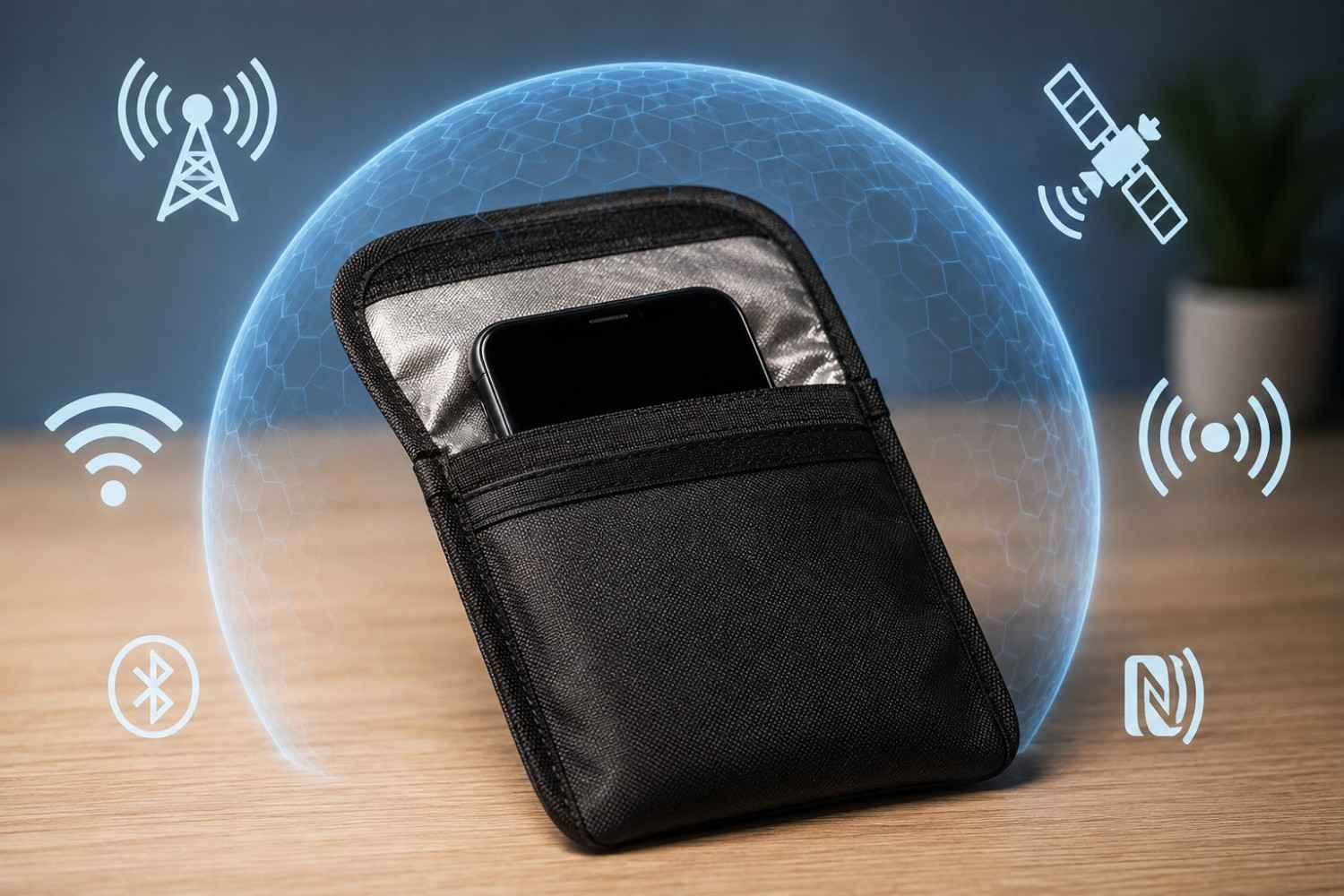
DefenderShield states that its ConcealShield uses its Ultra Armor shielding technology and is designed to block incoming and outgoing cellular, GPS, Wi-Fi, Bluetooth, RFID and NFC communication when the phone is properly enclosed in the Faraday compartment. The company publishes specifications for its shielding technology and describes the bag as providing 360-degree shielding.
As with any Faraday product, don’t simply put it in a drawer and assume it’s working forever. Follow the manufacturer’s closure instructions, test it after purchasing it, and periodically test it again if reliable signal isolation is important to you.
Should You Buy a Faraday Bag for EMF Reduction?
For most people, the answer depends less on the technology and more on what they’re actually trying to accomplish.
If your goal is to use your smartphone normally while reducing RF exposure, a Faraday bag isn’t an ideal solution. A phone that is properly isolated inside one can’t function normally as a wireless communication device.
Instead, you might focus on increasing distance, reducing unnecessary wireless connections, using wired alternatives where practical and avoiding carrying an actively transmitting phone directly against your body for extended periods when it isn’t necessary.
A Faraday bag becomes more interesting when your goal is complete or near-complete RF isolation during periods when the device isn’t being used.
For example, you might want your phone physically with you but disconnected during a meeting, while traveling, during sleep or during another period when you don’t need connectivity.
The key is matching the solution to the problem.
Faraday Bags Are About Signal Isolation, Not Fear
Perhaps the most useful way to look at Faraday bags is to remove some of the dramatic language surrounding them.
A Faraday bag is fundamentally a shielding enclosure.
It doesn’t “clean” the radiation coming from a phone. It doesn’t magically make wireless technology harmless. It isn’t proof that everyone needs to worry about carrying a smartphone.
Instead, it uses conductive materials to attenuate electromagnetic energy passing between a device and its surroundings.
That’s useful technology when you actually need signal isolation.
For EMF-conscious consumers, understanding this distinction can make purchasing decisions much easier. You don’t need every product marketed as EMF protection. Start by identifying the source you’re concerned about, determine whether reducing that exposure is practical, and then decide whether shielding is even necessary.
Sometimes the best solution is a specialized shielding product.
Sometimes it’s moving a phone farther away.
Sometimes it’s turning off Bluetooth.
Sometimes it’s connecting a computer through Ethernet.
And sometimes it’s simply switching a device off.
Conclusion: Do Faraday Bags Really Work?
So, do Faraday bags work? Yes, the underlying electromagnetic shielding principle is legitimate, and a properly constructed, properly sealed Faraday bag can substantially attenuate radiofrequency signals entering and leaving an enclosed device. An effective bag can interrupt cellular, Wi-Fi, Bluetooth, GPS and other RF-based connections when its shielding covers the relevant frequencies.
The more important question is whether the particular Faraday bag you’re considering actually performs as claimed.
Look beyond phrases such as “EMF blocking”, “5G protection” or “military grade.” Examine the tested frequency range, attenuation data, construction, closure design and available testing documentation. Once you have the bag, perform your own basic tests by checking cellular, Wi-Fi and Bluetooth connectivity.
Most importantly, remember that a Faraday bag is a specialized tool. You don’t necessarily need one simply because you own a smartphone or want a lower-EMF home. Increasing distance, turning off wireless functions you aren’t using, choosing wired connections and powering devices down can often accomplish your goals without purchasing anything.
But when complete wireless isolation is what you actually want, a well-designed and properly used Faraday bag can be a practical way to achieve it.
Before You Go…
Get Weekly EMF Protection Tips
Enjoy this article? Join the EMFLuLu newsletter for simple weekly tips to reduce everyday EMF exposure from phones, WiFi routers, laptops, and smart home devices.
Try Our Free EMF Calculators
Curious how much EMF exposure you may experience each day?
These simple tools can help you estimate your exposure and identify possible problem areas in your home.
Try these free calculators:
Like this article? Pin it on Pinterest!

More to Explore