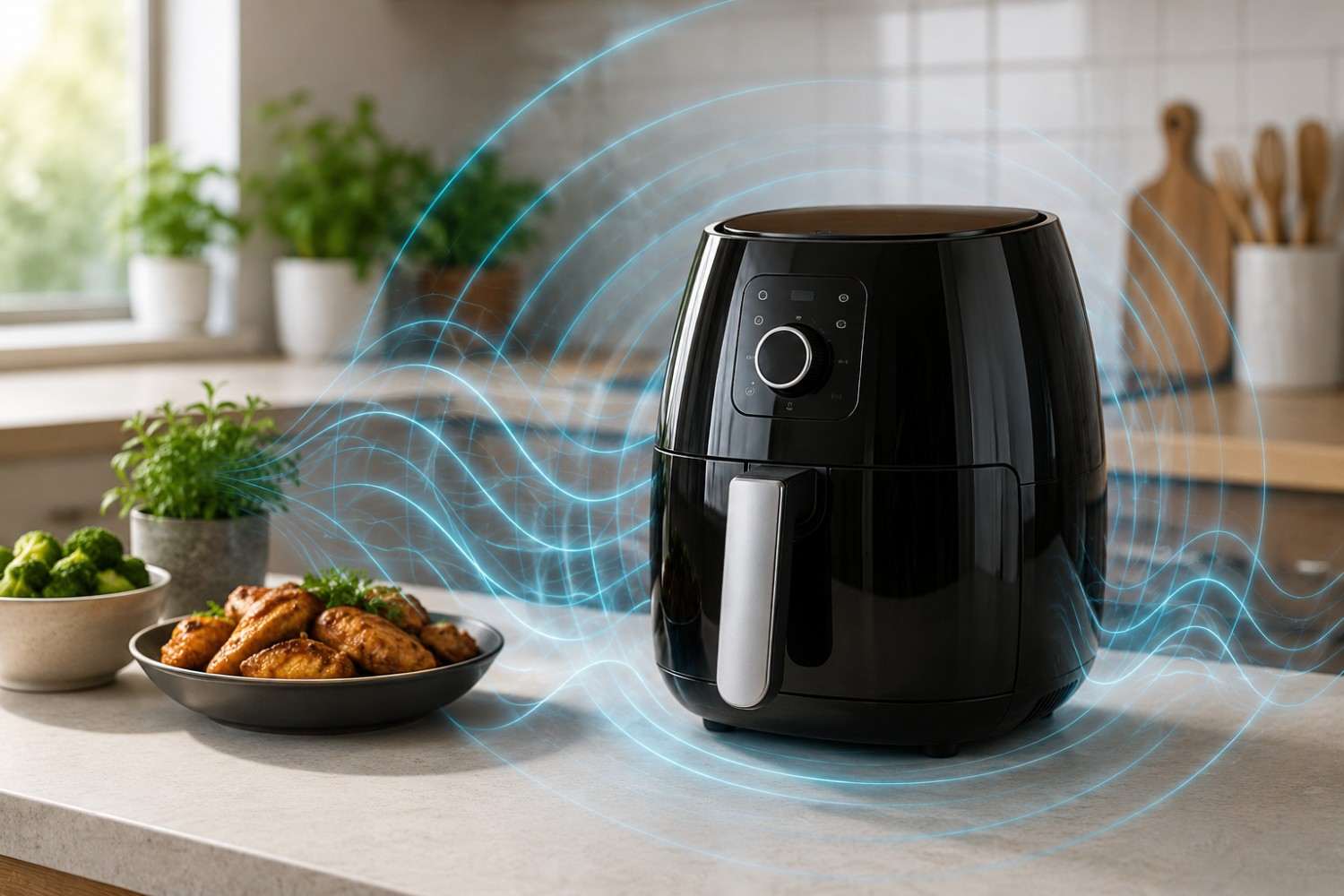
Air fryers have become a fixture in many kitchens because they can cook food quickly while producing a crisp texture without requiring a large amount of cooking oil. But like nearly every appliance that runs on electricity, an air fryer also raises an interesting question for people who pay attention to electromagnetic fields: what happens around the appliance while it is operating? Air fryer EMF can come from the electrical components used to generate heat, power the fan, and operate the controls. Smart models may also use wireless signals for app connectivity. Understanding these different sources can help put the subject into perspective and make it easier to decide whether you want to make any changes to the way you use your air fryer.
One important point should be established from the beginning. An air fryer is not a microwave oven. It does not cook your food by intentionally generating microwave-frequency radio waves. Instead, it uses an electric heating element along with rapidly circulating hot air.
That difference matters when discussing EMF.
Rather than treating all forms of electromagnetic energy as though they are the same, it is more useful to understand what an air fryer actually does, where electromagnetic fields may originate, and how simple factors such as distance can affect your exposure.
How Does an Air Fryer Work?
Despite the name, an air fryer does not really “fry” food in the traditional sense. It operates more like a small, powerful convection oven.
Inside the appliance is an electrical heating element that becomes hot when the air fryer is operating. A fan circulates heated air rapidly around the food. The combination of high heat and moving air helps brown and crisp the exterior of food while cooking the inside.
The appliance also contains other electrical components. Depending on the model, these can include a fan motor, thermostat, temperature sensors, digital display, control board, internal wiring, timer, touch-sensitive controls, and other electronics.
All of these components require electricity.
That is where the EMF discussion begins.
An electrical appliance does not need to be designed specifically as a wireless device to have electromagnetic fields around it. Electrical current and voltage are associated with electric and magnetic fields, so some measurable fields around operating household appliances are expected.
This is very different, however, from saying that an air fryer cooks your food using electromagnetic radiation.
Does an Air Fryer Produce Electromagnetic Fields?
Yes. Because an air fryer is an electrical appliance, electromagnetic fields can exist around parts of the appliance while it is operating.
The important question is not simply whether EMF exists. A more useful question is what type of field is present, how strong it is at the location being measured, and how that measurement changes as you move away from the appliance.
When discussing air fryer EMF, several different things may be involved.
Electric fields can occur around energized wiring and electrical components. Magnetic fields are associated with electrical current flowing through the appliance. The heating element, motor, internal wiring, and power cord may therefore contribute to the electromagnetic environment around an operating air fryer.
A smart air fryer introduces another potential source. If it communicates through Wi-Fi or Bluetooth, the appliance can also transmit radiofrequency, or RF, signals.
These different fields should not automatically be grouped together as one form of “radiation.” Their frequencies, sources, purposes, and behavior can differ substantially.
Where Does Air Fryer EMF Come From?
An air fryer contains several components that could contribute to measurable electromagnetic fields. The exact configuration varies from one manufacturer and model to another, but understanding the major components helps explain why measurements may not be identical everywhere around an appliance.
The Heating Element
The heating element is responsible for generating the heat necessary to cook your food.
Air fryers can draw a considerable amount of electrical power while heating. The current flowing through the appliance and its heating circuitry contributes to low-frequency electromagnetic fields associated with normal electrical operation.
The heating element may also cycle on and off during cooking as the air fryer attempts to maintain the selected temperature. As a result, measurements taken at one moment might differ from measurements taken a short time later.
The Fan and Motor
Rapidly circulating hot air is one of the defining features of an air fryer.
That circulation requires a motor-driven fan. Electric motors can produce magnetic fields while operating, which means the fan assembly can be another potential source of measurable fields.
This also helps explain why taking a single measurement at one point on an air fryer doesn’t necessarily tell you everything about the appliance.
Internal Wiring and Electronics
Electricity has to travel from the power cord to the various components inside the air fryer.
Modern digital models may also contain control boards, displays, switches, sensors, and other electronics. The design and placement of these components vary considerably among manufacturers.
Consequently, one side of an air fryer could potentially produce a different meter reading from another side.
The Power Cord
The electrical cord carries power from the wall outlet to the appliance. Electric and magnetic fields can therefore also be associated with the cord and wiring.
If you are testing an air fryer with an EMF meter, it makes sense to pay attention to the cord as well as the appliance itself.
Wi-Fi and Bluetooth
This source only applies to certain models, but it is becoming more relevant as kitchen appliances become increasingly connected.
A smart air fryer might allow you to check cooking progress, receive notifications, access recipes, or interact with the appliance through an app. Those features may require Wi-Fi, Bluetooth, or another wireless technology.
In that situation, you are dealing with something a traditional air fryer does not require: intentional RF transmissions for wireless communication.
Do Air Fryers Emit Radiation?
This question can become confusing because the word “radiation” covers a very broad range of phenomena.
Air fryers do not produce the type of ionizing radiation associated with X-rays and gamma rays. Ionizing radiation has enough energy to remove electrons from atoms. The electromagnetic fields associated with normal household electrical equipment fall into the non-ionizing portion of the electromagnetic spectrum.
Air fryers also should not be confused with microwave ovens.
A microwave oven is specifically designed to generate microwave-frequency electromagnetic energy inside its cooking cavity. That energy interacts with the food and produces heating.
An air fryer uses a heating element to generate heat and a fan to circulate hot air around the food.
Air fryers also produce thermal energy, including infrared radiation associated with hot objects. That is a normal part of heat transfer and isn’t unique to air fryers.
Therefore, asking whether an air fryer “has radiation” isn’t quite specific enough to give someone a useful understanding of what is happening.
A better approach is to distinguish between heat, low-frequency electric and magnetic fields associated with electrical operation, and RF signals that may be transmitted by wireless smart models.
How Much EMF Does an Air Fryer Produce?
There isn’t one number that accurately describes every air fryer.
An air fryer from one manufacturer may be designed differently from another. Even two appliances with similar cooking capacities could contain different motors, heating elements, wiring arrangements, power supplies, electronics, and wireless features.
Measurements can also depend on how the test is performed.
Before comparing EMF readings, several variables should be considered because each can influence the number displayed on a meter. These include the meter being used, the type of field being measured, the distance between the meter and appliance, the measurement location around the appliance, the operating mode, whether the heating element is active, and whether wireless features are transmitting.
This is why a statement such as “my air fryer measured X milligauss” doesn’t necessarily tell you what another air fryer will measure.
It also doesn’t tell you what the field strength will be where you normally stand.
That last distinction is particularly important.
A measurement taken with a meter touching the back of an appliance isn’t representative of the field level several feet away.
Why Distance Matters With Air Fryer EMF
One of the easiest things you can do if you want to reduce air fryer EMF exposure is simply avoid spending unnecessary time immediately beside the appliance while it operates.
Electromagnetic field strength from localized household sources generally decreases as distance from the source increases, although the exact relationship depends on the source and type of field.
Fortunately, an air fryer is particularly well suited to using distance.
Think about the normal cooking process. You place food in the basket, insert it into the air fryer, choose the temperature and cooking time, and press Start.
There is usually no reason to stand directly in front of the appliance for the next 10, 15, or 20 minutes.
You can prepare another part of the meal, clean the kitchen, sit at the table, or leave the immediate area.
This is an important principle when trying to reduce unnecessary EMF exposure because it costs nothing and doesn’t interfere with the appliance’s operation.
Air Fryer EMF vs. Microwave EMF
Air fryers and microwaves are sometimes grouped together because both are countertop appliances that heat food quickly. From an EMF standpoint, however, they shouldn’t be considered identical.
The primary difference is the way the food is heated.
| Appliance | Primary Cooking Method | Electrical EMF | RF Used to Cook Food? |
| Air Fryer | Heating element and circulating hot air | Yes | No |
| Microwave Oven | Microwave-frequency electromagnetic energy | Yes | Yes |
| Toaster Oven | Electrical heating elements | Yes | No |
| Conventional Electric Oven | Electrical heating elements | Yes | No |
| Induction Cooktop | Electromagnetic induction | Yes | Electromagnetic fields are intentionally used for heating |
A microwave oven intentionally generates microwave-frequency RF energy for cooking.
An air fryer does not.
This doesn’t mean an air fryer has no electromagnetic fields. It means that the source and purpose of those fields are different.
For someone trying to understand EMF in the home, that distinction is much more useful than simply labeling both appliances as sources of “radiation.”
How Do Air Fryers Compare With Other Kitchen Appliances?
The air fryer is hardly the only electrical appliance in a modern kitchen.
Refrigerators, blenders, coffee makers, electric kettles, dishwashers, toaster ovens, induction ranges, microwave ovens, conventional electric ranges, and other devices all use electricity.
Some also use wireless communication.
Rather than becoming overly focused on whether one appliance produces any detectable EMF, it can be more useful to think about your total interaction with electrical and wireless devices.
For example, a refrigerator may run periodically throughout the day, but you usually don’t stand directly against it for long periods. A blender can use a powerful motor, but it normally operates for only a short time. An induction cooktop intentionally generates electromagnetic fields as part of its cooking process, while a traditional electric cooktop uses resistive heating elements.
An air fryer is somewhat convenient from an exposure-reduction standpoint because it usually doesn’t require continuous interaction.
Once it is running, you can generally move away.
Do Smart Air Fryers Produce More EMF?
A smart air fryer can have an additional source of electromagnetic energy because of its wireless capabilities.
A standard air fryer needs electricity to operate its heater, fan, and controls. It does not need Wi-Fi to cook chicken, vegetables, french fries, or anything else.
A smart model may add Wi-Fi or Bluetooth so that it can communicate with a phone, home network, or other connected system.
Wireless communication uses RF electromagnetic energy.
This doesn’t necessarily mean a smart air fryer should be considered dangerous. It simply means its EMF profile can differ from that of an appliance without a wireless transmitter.
If you are intentionally trying to reduce the number of wireless devices in your home, ask yourself whether you actually need a connected air fryer.
For many people, setting the temperature and timer directly on the appliance is perfectly adequate.
If you already own a smart model, check the manufacturer’s instructions to determine whether Wi-Fi or Bluetooth can be disabled while retaining normal cooking functionality.
Affiliate Advertisement

Practical Ways to Reduce EMF Exposure From an Air Fryer
If you prefer a precautionary approach to EMF, you don’t necessarily need to stop using your air fryer. Several straightforward changes can reduce unnecessary proximity to the appliance without making cooking inconvenient.
The following ideas focus primarily on reducing unnecessary exposure through appliance placement, distance, and usage habits rather than relying on special shielding products.
Increase Your Distance While It Cooks
After starting the air fryer, move away from it rather than standing directly beside it.
Even a modest increase in distance can make a substantial difference for many localized EMF sources. Exactly how much depends on the appliance and field being measured, which is another reason measurements at realistic distances are more useful than measurements directly against the housing.
Don’t Lean Against the Counter Beside It
People often wait for food while standing at a kitchen counter.
If your air fryer is running, consider moving elsewhere instead of leaning beside it throughout the cooking cycle.
You aren’t changing the appliance at all. You are simply reducing the amount of time spent close to it.
Think About Where You Put the Air Fryer
Countertop placement can matter.
Suppose your air fryer sits on a counter directly against a wall, and someone’s favorite chair or home-office desk is immediately on the other side. If another countertop location is available, repositioning the appliance may make sense.
You should still follow all manufacturer instructions regarding ventilation, clearances, heat-resistant surfaces, and safe placement. Never reposition an appliance in a way that creates a fire or burn hazard merely to address an EMF concern.
Consider Whether You Need Smart Features
When purchasing a new air fryer, decide whether Wi-Fi connectivity actually provides a meaningful benefit.
If you don’t plan to control the appliance with your phone, a conventional model may accomplish everything you need without adding another wireless device to your home.
Turn Off Wireless Functions When Possible
If you already have a connected model, check whether the manufacturer provides a way to disable Wi-Fi or Bluetooth.
Don’t assume that simply closing the phone app turns off the appliance’s wireless transmitter. Consult the owner’s manual for your specific model.
Unplug the Appliance When Appropriate
Many people already unplug countertop cooking appliances when they’re not being used.
Follow the manufacturer’s instructions for your particular air fryer. If normal unplugging between uses is permitted, doing so means the appliance isn’t continuously connected to household electrical power while sitting unused.
Measure Your Own Appliance
If you are particularly interested in EMF levels, measuring your own air fryer can provide more relevant information than relying on someone else’s numbers.
Test at the distances where you actually spend time.
For example, compare a measurement immediately beside the air fryer with readings at one foot, two feet, three feet, and farther away.
This gives you a much better understanding of your actual environment.
Can You Measure Air Fryer EMF Yourself?
Yes, but you need to understand what your meter measures.
Not every EMF meter measures every part of the electromagnetic spectrum. Some primarily measure magnetic fields. Others measure RF radiation. Multi-field meters may provide measurements for electric fields, magnetic fields, and RF.
Before using a meter, read its instructions carefully.
It is also worth creating a repeatable testing procedure. Measure the same appliance at several distances and positions while keeping other variables as consistent as possible.
You might test the air fryer while it is turned off but plugged in, immediately after starting a cooking cycle, while the heating element is operating, and during different parts of the cooking process.
For a smart air fryer, you could also compare measurements with wireless functionality enabled and disabled if the manufacturer provides that option.
Most importantly, record the distance for every measurement.
A number without a distance has limited usefulness.
Should You Buy EMF Protection for an Air Fryer?
For most readers, I would start with the simplest options before buying anything.
Distance is free. Strategic appliance placement is free. Turning off unnecessary wireless functionality is free if your air fryer supports it. Choosing not to stand immediately beside an appliance throughout its cooking cycle is also free.
Those steps are straightforward and don’t interfere with how the air fryer cooks.
Be cautious about products marketed specifically as shields, stickers, chips, or other accessories claiming to eliminate radiation from an appliance. If a product makes a significant claim, look for clear information explaining what type of electromagnetic field it addresses and objective testing showing what it actually does.
Also remember that interfering with airflow, ventilation, wiring, or the appliance enclosure could create a safety problem. Never cover, wrap, modify, or otherwise alter an air fryer in a manner that conflicts with its manufacturer’s instructions.
Should You Stop Using an Air Fryer Because of EMF?
Finding a measurable electromagnetic field around an electrical appliance does not, by itself, demonstrate that the appliance presents a health hazard.
This is an important distinction.
EMF meters can detect fields around many common household devices. The fact that a meter displays a number shouldn’t automatically be interpreted as evidence that something dangerous is happening.
If you prefer to minimize unnecessary EMF exposure, you can still take a precautionary approach.
Use your air fryer when it provides a useful cooking benefit. Start it, move away, and return when you need to shake the basket, turn the food, check its progress, or remove the finished meal.
If you don’t need smart features, consider a conventional model the next time you purchase an air fryer.
And if you are curious about your particular appliance, measure it rather than assuming that numbers reported for a different make and model apply to yours.
That approach keeps the focus on practical information rather than fear.
Frequently Asked Questions About Air Fryer EMF
There are several closely related questions people commonly have about air fryers and electromagnetic fields. The answers below provide a quick reference while reinforcing some of the most important distinctions discussed throughout this article.
Do Air Fryers Emit EMF?
Yes. Air fryers are electrical appliances, so electric and magnetic fields can be associated with their wiring and electrical components during operation. Smart air fryers may also produce RF transmissions through Wi-Fi or Bluetooth.
Do Air Fryers Emit Radiation?
The word “radiation” is extremely broad. Air fryers do not produce ionizing radiation such as X-rays. They also don’t cook food using microwave-frequency RF energy like a microwave oven. Their electrical components can produce electromagnetic fields, and their hot components emit thermal energy, including infrared radiation.
Is Air Fryer Radiation the Same as Microwave Radiation?
No.
A microwave oven intentionally generates microwave-frequency electromagnetic energy to heat food. An air fryer primarily cooks using an electrically heated element and rapidly circulating hot air.
Does an Air Fryer Produce a Magnetic Field?
An operating air fryer can produce magnetic fields associated with electrical current and components such as its motor and heating system.
The strength of the field can vary depending on the appliance, operating condition, measurement location, and distance.
Do Smart Air Fryers Produce RF Radiation?
If a smart air fryer communicates using Wi-Fi, Bluetooth, or another RF-based wireless technology, it can transmit RF electromagnetic energy for that communication.
Check the specifications and owner’s manual for your particular model to determine which wireless technologies it uses.
How Far Should You Stand From an Air Fryer?
There isn’t one scientifically established distance that applies to every air fryer and every EMF concern.
If your goal is simply to reduce unnecessary exposure, increasing your distance whenever you don’t need to interact with the appliance is a practical approach. Measurements from your own appliance can show how field levels change as you move farther away.
Does Unplugging an Air Fryer Reduce EMF?
An unplugged air fryer isn’t drawing electricity from the outlet, so electrical fields associated with the energized appliance itself are removed.
Always follow the manufacturer’s recommendations concerning plugging, unplugging, and storage.
Can I Test My Air Fryer With an EMF Meter?
Yes, provided you use a meter designed for the type of field you want to measure.
Testing at several distances is particularly useful. Rather than only taking a reading directly against the appliance, compare readings at realistic locations where you normally stand, sit, or work.
Conclusion: Putting Air Fryer EMF Into Perspective
Air fryers are convenient electrical appliances that combine a powerful heating element with a motor-driven fan and electronic controls. Because these components use electricity, it is reasonable to expect measurable electromagnetic fields around certain parts of an operating appliance. Smart models may add another component through Wi-Fi or Bluetooth RF transmissions.
However, an air fryer should not be confused with a microwave oven. It does not intentionally generate microwave-frequency energy to cook food. It primarily cooks using an electrical heating element and rapidly circulating hot air.
If air fryer EMF is something you want to minimize, the most practical steps don’t require giving up your appliance or purchasing a collection of specialty products. Give the appliance some space while it cooks, avoid standing directly beside it unnecessarily, consider whether you need wireless features, and pay attention to where the appliance is positioned in your home.
And if you want to know what is happening around your particular air fryer, consider measuring the actual appliance at multiple distances rather than relying on a number reported for someone else’s model.
Understanding the source, type, distance, and duration of exposure provides much more useful information than simply asking whether an appliance “gives off radiation.” That perspective can help you make practical decisions about your kitchen without turning an everyday electrical appliance into something it isn’t.
Before You Go…
Get Weekly EMF Protection Tips
Enjoy this article? Join the EMFLuLu newsletter for simple weekly tips to reduce everyday EMF exposure from phones, WiFi routers, laptops, and smart home devices.
Try Our Free EMF Calculators
Curious how much EMF exposure you may experience each day?
These simple tools can help you estimate your exposure and identify possible problem areas in your home.
Try these free calculators:
Like this article? Pin it on Pinterest!


More to Explore