On a cold winter morning, a portable space heater can make a home office, bedroom, or living room considerably more comfortable. These compact appliances provide warmth without requiring homeowners to heat an entire house. However, because space heaters operate using electricity, some people wonder whether sitting close to one increases their exposure to electromagnetic fields. Understanding space heater EMF begins with recognizing how electric heaters generate magnetic fields, why those fields change with distance, and what the available scientific evidence tells us about potential health concerns.
Unlike wireless devices that transmit radiofrequency signals, most conventional electric space heaters produce extremely low-frequency electromagnetic fields associated with household electrical power. These fields are present around many everyday appliances, including refrigerators, washing machines, hair dryers, and electric blankets.
The strength of the magnetic field surrounding a space heater is not necessarily the same everywhere. A measurement taken directly beside the appliance may be considerably different from one taken several feet away. The heater’s electrical components, operating settings, and design can also influence the readings.
This article explains how space heaters produce electromagnetic fields, how distance changes magnetic field exposure, whether different heater designs produce different levels, and how to measure these fields at home. It also examines what scientific research says about potential health effects and offers practical ways to manage exposure without sacrificing comfort or overlooking essential heating safety precautions.
Do Space Heaters Emit EMF?
Yes. Electric space heaters generate electromagnetic fields when electrical current flows through their internal components. This is a normal characteristic of electrical equipment and does not automatically mean the appliance presents a health hazard.
Electromagnetic fields can be divided into different categories depending on their frequency and source. For conventional electric space heaters, the most relevant fields are associated with the alternating current supplied by household electrical outlets.
In the United States, residential electricity generally operates at a frequency of 60 hertz (Hz). This means the direction of alternating electrical current changes periodically, producing electric and magnetic fields that vary at the same fundamental frequency.
Electric fields are associated with voltage, while magnetic fields are associated with electrical current. A space heater plugged into an outlet may have an electric field around its energized components even when it is not actively producing heat. Magnetic field levels, however, generally increase when electrical current flows through the heating element, fan motor, or other powered components.
The strength and distribution of these fields depend on several factors, including the amount of current flowing through the appliance, the arrangement of its electrical wiring, and the location of its internal components.
An important distinction is that these low-frequency fields are not the same as the radiofrequency signals transmitted by WiFi routers or Bluetooth devices.
A basic electric heater does not need to communicate wirelessly to operate. Some newer smart heaters include WiFi or Bluetooth functionality, but those features introduce a separate type of electromagnetic emission from the low-frequency fields generated by the heater’s electrical components.
It is also important to distinguish electromagnetic fields from the heat produced by the appliance. Space heaters transfer thermal energy into their surroundings through convection, radiation, or a combination of both. Infrared heat is electromagnetic radiation, but it is different from the 60 Hz magnetic fields discussed throughout this article.
Understanding these distinctions helps explain why the term EMF can refer to several different physical phenomena rather than one single type of exposure.
Why Space Heater Magnetic Fields Change With Distance
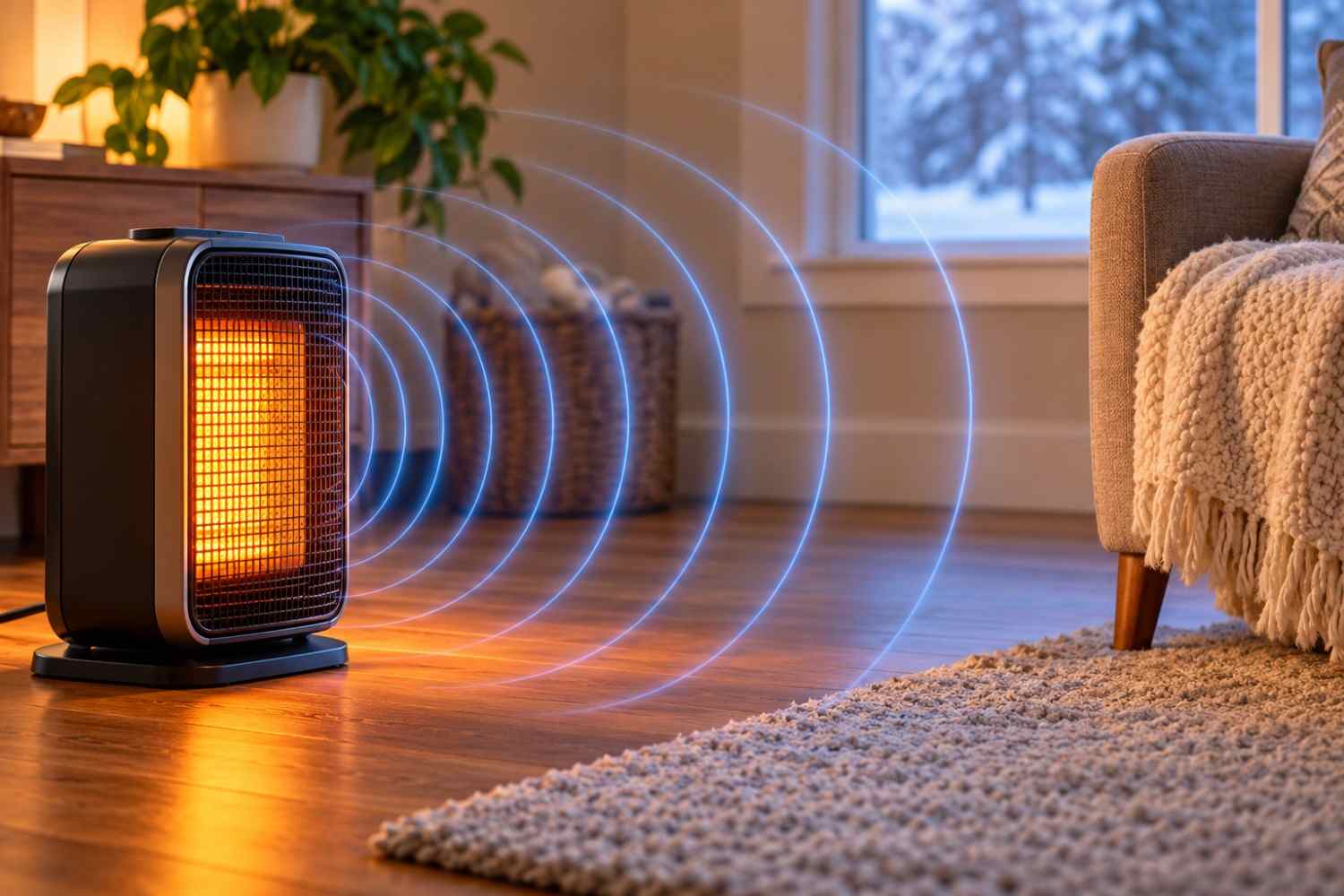
One of the most useful characteristics of magnetic fields generated by household appliances is that their strength generally decreases as the distance from the source increases.
This relationship is especially relevant when examining space heater EMF because portable heaters are often positioned close to people. Someone working at a desk might place a heater beside their feet, while another person might use one near a favorite chair.
Magnetic fields are produced by moving electrical charges. In a space heater, electrical current travels through internal wiring, heating elements, switches, and sometimes a fan motor.
The resulting magnetic field extends into the surrounding space. However, the field’s strength and direction depend on the geometry of the current-carrying components.
As a person moves farther away from the heater, the magnetic field contributed by the appliance generally becomes weaker.
This does not mean every heater follows an identical mathematical pattern. The relationship between distance and magnetic field strength depends on the size and arrangement of the electrical components, the direction of the current, and the position of the measuring instrument.
For example, the magnetic field surrounding a long, straight electrical conductor behaves differently from the field surrounding a compact motor or a group of wires carrying currents in opposite directions.
In many household appliances, nearby electrical components create magnetic fields that partially cancel one another at greater distances. This can contribute to the relatively rapid reduction in field strength observed as the measurement location moves away from the appliance.
Magnetic Fields at 6 Inches, 1 Foot, 3 Feet, and 6 Feet
Consider a space heater positioned on the floor of a home office.
A magnetic field meter placed six inches from the heater might detect a noticeable contribution from the electrical components inside the appliance.
Moving the meter to one foot could produce a lower reading, depending on the heater’s design and the location of the measurement.
At three feet, the magnetic field generated by the heater may be substantially weaker. At six feet, the heater’s contribution could be difficult to distinguish from the background magnetic fields already present in the room.
These are examples of how measurements might behave, not guaranteed readings. A specific heater could produce a different pattern, and the only reliable way to determine the actual field strength at each location is to measure it.
The table below provides a useful framework for understanding what to investigate.
| Distance From Heater | What to Evaluate |
| 6 inches | Magnetic field close to the appliance’s electrical components |
| 1 foot | Whether field strength decreases after moving a short distance |
| 3 feet | Whether the heater’s contribution is approaching the room’s background level |
| 6 feet | Whether the reading is distinguishable from background magnetic fields |
These distances are measurement examples, not recommended operating clearances. Always follow the heater manufacturer’s instructions and maintain the required separation from combustible materials.
Why Small Changes in Distance Can Matter
A person does not necessarily need to move across an entire room to observe a reduction in magnetic field strength.
Depending on the source, moving from a few inches away to a foot or more may produce a meaningful difference in the measured field.
However, there is no universal rule stating that doubling the distance from a space heater will reduce its magnetic field by a specific percentage.
For certain simplified electrical sources, mathematical models describe predictable relationships between distance and field strength. Actual household appliances contain multiple electrical components, making their magnetic field patterns more complicated.
This is why taking measurements at several distances is more useful than relying on a general formula.
Does the Magnetic Field Eventually Disappear?
The magnetic field contributed by a heater generally becomes weaker with increasing distance, but a magnetic field meter may continue displaying a reading even when the heater is far away or switched off.
That is because the heater is not the only possible source of low-frequency magnetic fields in a home.
Electrical wiring, appliances, transformers, and other equipment can contribute to the background field. Some magnetic field meters may also detect fields from nearby electrical cords or devices.
Consequently, a reading that remains at a particular level does not necessarily mean the heater is still contributing significantly to the measurement.
Comparing readings with the heater operating and switched off can help identify its contribution.
Do Different Types of Space Heaters Produce Different EMF Levels?
Portable electric heaters come in several designs, and their internal electrical components are not identical.
Some rely primarily on a heating element, while others include electric motors that circulate warm air. Thermostats, electronic controls, and power-management circuits may also affect how electricity flows through the appliance.
These differences can influence magnetic field measurements, although the heater category alone is not enough to determine which model produces the lowest readings.
Ceramic Space Heaters
Ceramic space heaters typically use a ceramic-based heating element and, in many models, a fan to distribute warm air throughout the room.
When the heater operates, current flowing through the heating element generates magnetic fields. If the heater includes a fan, its electric motor can contribute additional fields.
The resulting measurements may change depending on whether the heating element and fan are operating simultaneously.
A ceramic heater should not automatically be considered either high-EMF or low-EMF simply because it uses a ceramic heating element.
The actual magnetic field depends on the design of the appliance and its electrical components.
Oil-Filled Radiator Heaters
Oil-filled electric radiators use an internal heating element to warm a sealed reservoir of thermal oil. Heat then transfers through the radiator’s metal housing into the surrounding air.
Many conventional oil-filled radiators do not require a fan, which means they lack the fan motor found in numerous ceramic and fan-forced heaters.
However, the absence of a fan does not mean the radiator produces no electromagnetic fields.
Electrical current still flows through the heating element when it operates, and internal wiring and controls can contribute to the surrounding magnetic field.
An oil-filled radiator may produce a different field distribution from a fan-forced heater, but comparative measurements are necessary before determining whether one has lower magnetic field levels.
Infrared Electric Heaters
Infrared electric heaters warm people and objects primarily through infrared radiation rather than relying entirely on circulating heated air.
Infrared radiation is a form of electromagnetic radiation, but it is not the same as the extremely low-frequency magnetic fields associated with household electrical current.
An infrared heater can produce both infrared thermal radiation and low-frequency electric and magnetic fields.
The amount of magnetic field exposure depends on the electrical design, current flow, and distance from the appliance.
Therefore, describing an infrared heater as having no EMF would be inaccurate.
Fan-Forced Electric Heaters
Fan-forced heaters use an electric fan to move air across a heating element and distribute warmth throughout the room.
Because these heaters contain both a heating element and an electric motor, they have multiple components capable of generating low-frequency magnetic fields.
Measurements may vary depending on fan speed, heating output, and the position of the meter.
A reading near the motor could differ from one taken near another part of the appliance.
The presence of a fan does not prove that a heater produces greater exposure than every fanless model. It simply means there is another electrical component to consider when comparing measurements.
How to Measure Space Heater EMF at Home
One of the most practical ways to understand magnetic field exposure from an electric heater is to take measurements rather than relying entirely on assumptions about appliance design.
A suitable extremely low-frequency magnetic field meter can measure the magnetic flux density associated with household electrical equipment.
These measurements are commonly displayed in milligauss (mG) or microtesla (µT).
One microtesla equals 10 milligauss.
When selecting a meter, it is important to confirm that the instrument measures low-frequency magnetic fields and includes the 60 Hz frequency used by household electricity in the United States.
Not every device advertised as an EMF detector measures the same types of fields. Some instruments are designed primarily for radiofrequency signals, while others measure electric fields, magnetic fields, or several categories.
A radiofrequency-only meter would not be suitable for evaluating the 60 Hz magnetic field generated by a conventional electric heater.
Affiliate Advertisement

A Simple Home Measurement Procedure
You can compare magnetic field readings at different distances using a consistent measurement process. The objective is not to establish whether the heater is medically safe or unsafe, but to observe how its magnetic field contribution changes with distance.
- Measure the background magnetic field. With the heater switched off, record the magnetic field at the locations you intend to test. Keep other nearby electrical appliances in the same operating condition throughout the experiment.
- Turn on the space heater. Allow the appliance to reach a normal operating condition. If the heater cycles automatically, note whether the heating element is energized when each measurement is taken.
- Measure at several distances. Record readings at six inches, one foot, three feet, and six feet where this can be done safely. Keep the meter at approximately the same height and use the same side of the heater for each measurement.
- Compare operating settings. If the heater offers different heat or fan settings, repeat the measurements under those conditions. Record the settings rather than assuming every mode produces the same magnetic field.
- Repeat the measurements. Taking multiple readings can help identify variations caused by thermostat cycling, meter positioning, or nearby electrical equipment.
During testing, never touch exposed electrical components, open the heater housing, defeat safety switches, or place the meter where it could be damaged by heat.
It is also important to keep the heater on a stable surface and maintain the manufacturer’s required clearances from combustible materials.
Recording Your Results
A simple measurement table makes it easier to compare results and identify patterns.
| Distance | Heater Off (mG) | Heater On (mG) |
| 6 inches | ______ | ______ |
| 1 foot | ______ | ______ |
| 3 feet | ______ | ______ |
| 6 feet | ______ | ______ |
When interpreting these measurements, remember that the reading with the heater operating may include magnetic fields from other electrical sources.
Comparing heater-on and heater-off measurements can provide useful information about the heater’s contribution, but subtracting the two readings does not always produce an exact result because magnetic fields have direction and can combine in complex ways.
For the most consistent results, use the same meter, position, and operating conditions throughout the experiment.
Can a Smartphone Measure These Fields?
Smartphones contain magnetic sensors used for functions such as compass orientation. However, these sensors are generally designed to detect static or slowly changing magnetic fields rather than accurately measure 60 Hz household magnetic fields.
As a result, a smartphone EMF application should not be considered a reliable substitute for a properly specified ELF magnetic field meter.
For meaningful measurements, use an instrument designed for the relevant frequency and measurement range.
Is Space Heater EMF Harmful to Your Health?
The presence of electromagnetic fields around an appliance does not, by itself, demonstrate that the exposure is harmful.
When considering possible health effects, scientists examine several factors, including field frequency, exposure intensity, duration, and the biological mechanisms through which an effect might occur.
Extremely low-frequency magnetic fields are non-ionizing. Unlike X-rays and gamma rays, they do not carry enough energy per photon to ionize atoms or directly damage DNA through ionization.
Research has investigated whether long-term exposure to certain levels of extremely low-frequency magnetic fields might be associated with health effects.
One area of research concerns statistical associations between prolonged residential magnetic field exposure and childhood leukemia. The International Agency for Research on Cancer has classified extremely low-frequency magnetic fields as possibly carcinogenic to humans, based largely on limited epidemiological evidence.
This classification does not establish that magnetic fields from ordinary household appliances cause cancer. Researchers have not established a causal relationship explaining the observed associations, and experimental evidence has not consistently supported such a relationship.
It is also important to distinguish long-term average residential exposure from brief exposure near a portable heater.
A magnetic field measurement taken close to a space heater cannot be used by itself to predict an individual’s risk of developing a health condition.
Public-health guidance generally emphasizes that ordinary low-level environmental exposures have not been established as causes of adverse health effects, while research continues into certain unresolved questions.
Readers interested in the scientific background can consult the World Health Organization’s information on extremely low-frequency fields and the National Cancer Institute’s overview of electromagnetic fields and cancer.
For someone concerned about exposure, increasing distance from an appliance is a straightforward way to reduce its contribution to the surrounding magnetic field. However, reducing an already low exposure should not be presented as a proven method of preventing disease.
How Far Away Should You Sit From a Space Heater?
There is no single scientifically established EMF-based seating distance that applies to every electric space heater.
Different models have different electrical designs, and the magnetic field surrounding each appliance may vary.
From an exposure standpoint, sitting farther away generally reduces the magnetic field contributed by the heater.
However, the most important distance requirements for portable heaters are related to fire prevention and burn safety.
Space heaters can become extremely hot, and nearby combustible materials may ignite if placed too close to the appliance.
The U.S. Consumer Product Safety Commission recommends keeping portable heaters at least three feet away from combustible materials such as bedding, curtains, and furniture.
This three-foot recommendation is a fire-safety precaution, not a scientifically established EMF exposure threshold.
Users should always follow the manufacturer’s instructions, which may require additional clearance around particular parts of the heater.
For a home office, placing the heater at a suitable distance from the desk may provide comfortable warmth while avoiding unnecessary close contact.
Similarly, a heater used in a living room should be positioned where it cannot be easily knocked over and where children or pets cannot accidentally touch hot surfaces.
The ideal arrangement balances effective heating, manufacturer instructions, electrical safety, and personal comfort.
Practical Ways to Reduce Magnetic Field Exposure From a Space Heater
For readers who prefer to minimize unnecessary electromagnetic field exposure, several straightforward approaches can reduce proximity to the electrical components of a heater.
These measures do not require purchasing specialized shielding products or replacing a properly functioning appliance.
The following suggestions focus on practical positioning and operation while preserving essential heating safety precautions.
Increase the distance between yourself and the heater. Because the magnetic field contributed by an appliance generally decreases with distance, moving the heater farther from your usual sitting position can reduce its contribution to your exposure.
Avoid placing the heater directly against your body. Portable heaters are not intended to operate in contact with clothing, blankets, or skin. Maintaining appropriate separation also reduces the risk of burns and overheating.
Choose heater placement carefully. Position the appliance where it can provide effective warmth without obstructing walkways or sitting immediately beside frequently occupied areas. Always maintain the required clearance from combustible materials.
Use measurements when comparing appliances. If magnetic field exposure is an important purchasing consideration, actual measurements are more informative than marketing descriptions such as low radiation or EMF-free.
Turn off the heater when it is no longer needed. Switching off an appliance reduces the current flowing through its heating components when they are no longer energized. Unplugging it when appropriate also eliminates energized components associated with the power connection.
These practices can help readers make informed decisions without assuming that every detectable magnetic field represents a health concern.
Frequently Asked Questions About Space Heater EMF
Questions about electric heater radiation often involve confusion between heat, magnetic fields, and wireless signals. The following answers address several common concerns.
Do Space Heaters Emit Radiation?
Yes, but the word radiation can describe different physical phenomena.
Space heaters emit thermal radiation as part of the heating process, and electrically powered models generate low-frequency electromagnetic fields associated with their electrical components.
Infrared heat is non-ionizing electromagnetic radiation. It is not the same as ionizing radiation produced by sources such as X-ray equipment.
Are Ceramic Space Heaters Lower in EMF?
Not necessarily.
Ceramic heaters use electrical heating elements and often include fans. Their magnetic field measurements depend on the design and operation of those components.
A ceramic heater cannot be assumed to produce lower magnetic fields than an oil-filled radiator or infrared heater without comparative measurements under similar conditions.
Does a Space Heater Produce EMF When Turned Off?
A heater that is switched off but remains plugged into an electrical outlet may still have electric fields associated with energized wiring or internal components.
Some heaters also use standby electronics that draw a small amount of electrical current.
However, when the heating element and fan are no longer operating, their current-related magnetic field contributions generally decrease substantially.
Unplugging the heater removes its connection to household electrical power, although background fields from other sources may remain.
Can You Measure Space Heater EMF With a Smartphone?
A smartphone is generally not a reliable tool for measuring 60 Hz magnetic fields from household appliances.
Most smartphone magnetic sensors are intended for compass functions and are not calibrated for accurate measurements of alternating magnetic fields at household power frequencies.
A properly specified ELF magnetic field meter is the more appropriate instrument.
Does Moving a Space Heater Three Feet Away Reduce EMF?
Moving farther from a heater generally reduces the magnetic field contributed by the appliance.
However, the amount of reduction depends on the heater’s internal electrical design, operating conditions, and the surrounding environment.
Three feet should not be interpreted as a universal EMF safety boundary. It is also a commonly recommended minimum separation from combustible materials for fire safety.
Actual magnetic field measurements can help determine how much the heater’s contribution decreases at a particular distance.
Conclusion: Understanding Space Heater EMF and Distance
Electric space heaters are convenient appliances that can provide comfortable warmth during colder months. Like other electrically powered household devices, they generate electromagnetic fields when current flows through their internal components.
The most important factor for understanding magnetic field exposure is that field strength generally decreases as distance from the source increases. Measurements taken close to a heater may differ considerably from those taken several feet away, although the exact relationship depends on the appliance’s design and operating conditions.
Different heater types can produce different magnetic field patterns, but no particular category should automatically be considered EMF-free or universally safer without supporting measurements.
For homeowners interested in space heater EMF, the most useful approach is to understand the basic science, maintain appropriate distance, and use a suitable measuring instrument when actual readings are desired.
Above all, follow the manufacturer’s operating instructions and prioritize fire prevention, electrical safety, and proper heater placement. With a balanced understanding of magnetic fields and distance, readers can make informed decisions about using portable heaters without unnecessary concern or misleading assumptions.
Before You Go…
Get Weekly EMF Protection Tips
Enjoy this article? Join the EMFLuLu newsletter for simple weekly tips to reduce everyday EMF exposure from phones, WiFi routers, laptops, and smart home devices.
Try Our Free EMF Calculators
Curious how much EMF exposure you may experience each day?
These simple tools can help you estimate your exposure and identify possible problem areas in your home.
Try these free calculators:
Like this article? Pin it on Pinterest!

More to Explore