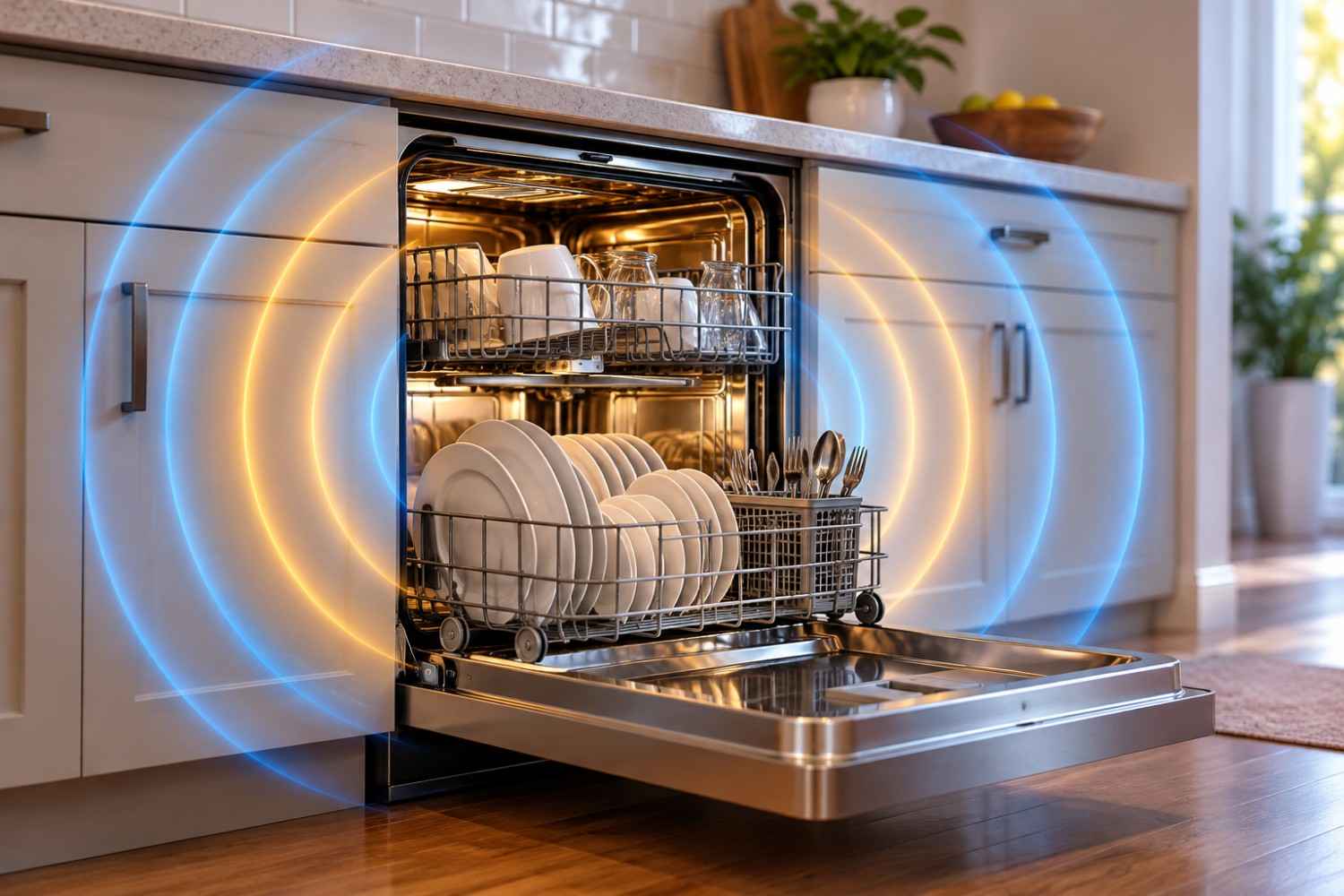
Dishwashers have become an everyday convenience in modern kitchens. They save time, reduce the effort of cleaning dishes, and often use less water than washing everything by hand. Yet, like many household appliances, dishwashers rely on electricity, motors, heating elements, and electronic controls to operate. These components naturally generate electromagnetic fields, raising questions about dishwasher EMF exposure and whether standing near a running dishwasher could affect your health.
Most people rarely think about electromagnetic fields while loading dishes, preparing dinner, or cleaning the kitchen. However, if you are interested in understanding the electromagnetic environment inside your home, the dishwasher is one appliance worth examining.
The good news is that electromagnetic fields produced by dishwashers are not automatically dangerous. Their strength depends on several factors, including the appliance’s design, operating cycle, and your distance from its electrical components. Understanding these differences can help you make informed decisions without unnecessary worry.
In this article, we’ll explore what causes electromagnetic fields in dishwashers, how strong their magnetic fields can be, what scientific research says about potential health effects, and how you can measure and reduce exposure if you choose.
What Causes EMF in a Dishwasher?
Every dishwasher that operates using electricity produces electromagnetic fields to some degree. These fields are a natural consequence of electrical current flowing through wires, motors, and other components.
Dishwashers primarily generate extremely low-frequency (ELF) electric and magnetic fields associated with household electrical power. In the United States, household electricity operates at 60 hertz (Hz), meaning the alternating current changes direction 60 times per second.
Electric fields are associated with voltage, while magnetic fields are produced by moving electrical charges. A dishwasher can have an electric field around energized components even when it is not actively washing dishes. Magnetic fields generally become stronger when electrical current increases, although the actual field strength also depends on the appliance’s wiring and construction.
Several components contribute to the electromagnetic fields generated during normal dishwasher operation.
Circulation Pump Motor
The circulation pump is responsible for moving water through the dishwasher’s spray arms. During washing and rinsing, an electric motor powers the pump, creating a magnetic field as current flows through its windings.
The strength of this field depends on the motor’s design, electrical current, and location inside the appliance. Because circulation pumps often operate for extended portions of a wash cycle, they can be an important source of magnetic fields.
Drain Pump
The drain pump removes dirty water from the dishwasher between washing and rinsing stages.
Like the circulation pump, it uses an electric motor that generates a magnetic field while operating. However, drain pumps generally run for shorter periods, so their contribution to overall exposure may be intermittent.
Heating Element
Many dishwashers use electric heating elements to raise water temperature or assist with drying.
When electricity passes through a heating element, it produces heat and an associated magnetic field. The field’s strength depends partly on the current flowing through the element and the arrangement of its wiring.
Not all dishwashers use the same heating technology. Some modern models rely on condensation drying, heat exchangers, or other methods rather than a traditional exposed heating element.
Electronic Controls and Internal Wiring
Modern dishwashers contain electronic control boards, sensors, switches, and wiring that coordinate the appliance’s functions.
These components may generate low-frequency fields and electrical noise during operation. Some electronic systems also operate at frequencies higher than the standard household power frequency.
However, the presence of electronics does not necessarily mean that the appliance produces unusually strong electromagnetic fields. The amount of electrical current, circuit design, and physical arrangement of components all influence the resulting exposure.
How Strong Is the Magnetic Field Around a Dishwasher?
One of the most important questions about dishwasher EMF is how strong the magnetic field becomes during normal operation.
Fortunately, published measurements provide some useful perspective.
The World Health Organization (WHO) has published a table of magnetic field measurements for common household appliances, based on measurements originally made in Germany. These measurements include dishwashers and demonstrate how magnetic field strength changes with distance.
The results are particularly useful because they illustrate an important characteristic of low-frequency magnetic fields: exposure often decreases substantially as you move away from the source.
Published Dishwasher Magnetic Field Measurements
The following table shows historical measurements for dishwashers operating on 50 Hz electricity. The original WHO figures are expressed in microtesla (µT), but the values below have been converted to milligauss (mG), another common unit used by EMF meters.
| Distance From Dishwasher | Magnetic Field Strength |
| 3 cm (approximately 1.2 inches) | 35–200 mG |
| 30 cm (approximately 12 inches) | 6–30 mG |
| 1 meter (approximately 3.3 feet) | 0.7–3 mG |
Source: World Health Organization, Electromagnetic Fields and Public Health. These figures represent historical measurements and should not be interpreted as measurements of every modern dishwasher.
The difference between the measurements at approximately one inch and three feet is substantial.
At very close distances, the measured magnetic fields were considerably stronger. However, at one meter, the reported values were much lower.
This does not mean that every dishwasher produces exactly these readings. Modern appliances vary in motor technology, electrical consumption, component placement, and internal shielding. Additionally, the published measurements were collected under European electrical conditions, which differ somewhat from the 60 Hz systems used in American homes.
The measurements also do not establish whether a particular exposure is harmful. They simply describe the magnetic field strengths recorded under specific conditions.
Why Distance Makes Such a Difference
Magnetic fields from localized electrical sources generally weaken as distance increases. However, the rate of reduction depends on the source’s geometry, the direction of the field, and the arrangement of electrical currents.
For example, a person standing directly beside a dishwasher’s motor may experience a different magnetic field strength than someone standing the same distance from another part of the appliance.
Likewise, a dishwasher installed beneath a countertop may produce different measurements at the front, side, and rear.
This is why measuring a dishwasher at several locations can provide more useful information than relying on a single reading.
Does Dishwasher EMF Present a Health Risk?
Understanding whether electromagnetic fields are harmful requires distinguishing between measurable exposure and scientifically demonstrated health effects.
Electromagnetic fields exist naturally and are also produced by electrical systems throughout homes, workplaces, and public spaces. Their presence alone does not establish a health hazard.
The electromagnetic fields associated with a conventional dishwasher are primarily non-ionizing. Unlike X-rays and gamma rays, low-frequency electromagnetic fields do not carry enough photon energy to ionize atoms or directly damage DNA through the same mechanism as ionizing radiation.
However, non-ionizing does not automatically mean that every possible exposure level is harmless. Very strong low-frequency fields can produce biological effects, which is why international exposure guidelines exist.
The important question is whether the levels encountered during ordinary dishwasher use are associated with meaningful health risks.
What Does the World Health Organization Say?
The WHO has reviewed scientific research involving extremely low-frequency electromagnetic fields and their possible health effects.
One area of particular interest involves epidemiological studies reporting an association between long-term average residential magnetic field exposure above approximately 0.3–0.4 microtesla (3–4 milligauss) and childhood leukemia.
Based on limited epidemiological evidence, the International Agency for Research on Cancer (IARC) classified extremely low-frequency magnetic fields as “possibly carcinogenic to humans,” or Group 2B.
However, this classification does not establish that magnetic fields cause childhood leukemia. The WHO has noted that the evidence is weakened by methodological limitations and that laboratory research has not provided convincing support for a causal relationship.
It is also important to understand that these studies examined long-term exposure patterns, not occasional proximity to a running dishwasher.
A magnetic field reading measured for a few minutes beside an appliance cannot be directly compared with a person’s average exposure over months or years.
The WHO’s broader conclusion is that evidence for other long-term health effects from low-level ELF magnetic fields remains insufficient to establish causation.
What About Headaches, Fatigue, or Sleep Problems?
Some people report symptoms such as headaches, fatigue, difficulty concentrating, or sleep disturbances that they associate with electromagnetic field exposure.
These experiences deserve to be taken seriously, but controlled scientific studies have generally not demonstrated a consistent causal relationship between low-level electromagnetic field exposure and these reported symptoms.
There is also no convincing scientific evidence that normal dishwasher operation causes these conditions through its electromagnetic fields.
If someone experiences persistent symptoms, it is important to consider other possible explanations rather than assuming that household EMF exposure is responsible.
Should You Be Concerned About Standing Near a Dishwasher?
For most people, standing near a normally operating dishwasher for ordinary kitchen activities is not considered an established health hazard.
International guidelines developed by organizations such as the International Commission on Non-Ionizing Radiation Protection (ICNIRP) address exposure to low-frequency electric and magnetic fields. These guidelines are based primarily on scientifically established effects of sufficiently strong fields.
A dishwasher can produce a measurable magnetic field without approaching levels associated with established acute effects.
Nevertheless, individuals who prefer to minimize unnecessary exposure can generally do so through simple changes in distance and time.
There is no need to stop using a dishwasher or purchase expensive protective equipment solely because the appliance generates electromagnetic fields.
Does Dishwasher EMF Change During Different Wash Cycles?
A dishwasher does not necessarily produce the same magnetic field strength throughout an entire cleaning cycle.
Its electrical components turn on and off at different times, and the amount of current flowing through the appliance changes accordingly.
During the main wash cycle, the circulation pump operates to move water through the spray arms. This motor may be a significant source of magnetic fields while running.
During draining, the circulation pump may stop while the drain pump begins operating. Because these motors differ in size, design, and electrical demand, their magnetic fields may also differ.
Heating stages can create another change in electrical activity. When a heating element is energized, additional current flows through the appliance’s electrical system.
The drying cycle may involve a heating element, fan, or other technology, depending on the dishwasher model.
Some modern dishwashers also use variable-speed motors and electronically controlled pumps. These systems can produce more complex magnetic field patterns than traditional fixed-speed motors.
The practical takeaway is that a magnetic field reading taken during one stage of a dishwasher cycle may not represent the appliance’s maximum or average field strength.
Anyone interested in measuring dishwasher exposure should ideally observe readings during several stages rather than relying on a single measurement.
How Does Dishwasher EMF Compare With Other Kitchen Appliances?
Dishwashers are only one of many household appliances that generate electromagnetic fields.
Refrigerators, microwave ovens, electric ovens, washing machines, vacuum cleaners, and other devices contain electrical components that create magnetic fields during operation.
However, the strength of these fields can vary considerably.
For example, a vacuum cleaner may produce a relatively strong magnetic field near its motor, while a refrigerator may generate a smaller field at a comparable distance.
A microwave oven also produces low-frequency magnetic fields associated with its electrical components, but its primary cooking technology uses radiofrequency electromagnetic energy at approximately 2.45 gigahertz.
These are different types of electromagnetic exposure and should not be treated as interchangeable.
Why Appliance Comparisons Can Be Misleading
When comparing household appliances, distance is one of the most important variables.
A measurement taken one inch from a dishwasher motor cannot be fairly compared with a measurement taken three feet from a refrigerator.
Operating conditions also matter. A refrigerator compressor may cycle on and off, while a dishwasher pump may operate continuously during certain stages.
Additionally, an appliance’s electrical power rating does not directly determine the magnetic field strength measured outside its housing.
Two appliances consuming similar amounts of electricity can produce different magnetic fields because of differences in motor design, wiring configuration, and internal component placement.
For readers interested in reducing overall household exposure, it is generally more useful to understand where they spend the most time than to focus exclusively on which appliance produces the highest momentary reading.
A dishwasher may generate a stronger magnetic field than another appliance at very close range, but that difference may have little practical significance if nobody remains close to it for extended periods.
Affiliate Advertisement

How to Measure EMF From Your Dishwasher
If you’re curious about the magnetic fields around your dishwasher, taking measurements at home can be an interesting and educational exercise.
A suitable EMF meter allows you to observe how magnetic field strength changes as the appliance operates and as you move farther away.
However, choosing the correct type of meter is important.
Some EMF meters are designed primarily for radiofrequency radiation from WiFi routers, cell phones, and wireless devices. These meters may not measure the low-frequency magnetic fields associated with dishwasher motors and household electrical wiring.
For dishwasher measurements, look for an instrument specifically capable of measuring ELF magnetic fields at approximately 50 or 60 Hz.
A meter that displays measurements in milligauss or microtesla is particularly convenient.
A Simple Dishwasher EMF Measurement Test
You can perform a basic comparison using a consistent measurement method. The following process is intended to help you observe relative differences, not determine whether an appliance is medically safe or unsafe.
- Measure the background magnetic field. With the dishwasher turned off, take a reading near the appliance. Record the result to establish a baseline.
- Start a normal wash cycle. Allow the dishwasher to begin operating and observe whether the magnetic field reading changes.
- Measure at different distances. Take readings approximately 3 inches, 12 inches, and 36 inches from the front of the appliance, keeping the meter at a consistent height.
- Observe different operating stages. If practical, repeat measurements during washing, draining, and drying to identify changes in field strength.
- Record your results. Write down the measurements, distances, and operating stages so you can compare them afterward.
For better consistency, keep the meter’s orientation the same throughout testing unless it measures all three magnetic field axes simultaneously.
Nearby appliances, electrical wiring, and other sources can also influence readings.
Avoid opening electrical panels, removing dishwasher covers, or attempting to access internal wiring. All measurements should be performed from outside the appliance while it remains properly installed.
Understanding Milligauss and Microtesla
Magnetic field meters commonly display results in milligauss (mG) or microtesla (µT).
These are simply different units used to express magnetic flux density.
One microtesla equals 10 milligauss. Therefore, a reading of 0.5 microtesla is equivalent to 5 milligauss.
Neither unit indicates danger by itself. A measurement must be interpreted in the context of exposure duration, frequency, measurement conditions, and applicable scientific guidelines.
It is also important not to treat a meter’s highest recorded value as representative of your daily exposure.
A brief reading near an operating motor is very different from the average magnetic field exposure someone experiences throughout the day.
Simple Ways to Reduce Dishwasher EMF Exposure
For people who prefer to minimize unnecessary electromagnetic field exposure, the most practical approach is usually to increase distance from operating electrical equipment.
This does not mean that ordinary dishwasher exposure has been proven harmful. Rather, these suggestions offer simple options for readers who want to reduce exposure without purchasing specialized equipment or making major changes to their kitchens.
Maintain Some Distance While the Dishwasher Runs
Because magnetic fields generally decrease with distance, standing farther from the dishwasher can reduce exposure.
If your dishwasher is running while you prepare dinner, you might choose to work at another section of the countertop when convenient.
Even moving a short distance away can make a noticeable difference in magnetic field measurements, depending on the appliance and its internal components.
However, there is no scientifically established requirement to maintain a specific minimum distance from a normally operating household dishwasher.
Avoid Unnecessary Prolonged Close Contact
Most people spend relatively little time standing directly against a dishwasher while it operates.
Loading dishes, unloading them, and walking through the kitchen generally involve brief periods near the appliance.
If you regularly sit or work immediately beside a running dishwasher for long periods, you could consider changing your position or taking measurements to better understand the actual field strength.
For most households, this is a matter of personal preference rather than a medically necessary precaution.
Keep the Dishwasher Properly Maintained
Proper appliance maintenance is important for electrical safety and reliable operation.
Damaged wiring, faulty connections, and malfunctioning motors should be inspected by qualified professionals.
However, maintenance should not be presented as a proven method for reducing magnetic field exposure. A properly functioning dishwasher still produces electromagnetic fields as part of normal operation.
Likewise, unusually high meter readings do not necessarily indicate an electrical fault.
If you notice burning smells, repeated circuit breaker trips, electrical shocks, or other signs of malfunction, stop using the appliance and seek professional assistance.
Consider Your Kitchen Layout
In most homes, dishwashers are installed beneath countertops near sinks and food preparation areas.
This arrangement is practical and generally does not require modification.
However, if you’re designing a new kitchen and are interested in minimizing time spent near operating appliances, you could consider how the dishwasher’s location relates to seating areas or frequently used workspaces.
There is no need to remodel an existing kitchen solely because of concerns about dishwasher magnetic fields.
Do You Need an EMF Shield or Special Dishwasher?
Products marketed for electromagnetic protection have become increasingly common, but not every electrical appliance requires additional shielding.
For a conventional dishwasher, there is no established scientific basis for recommending EMF-blocking stickers, decorative shielding accessories, or specialized protective products as necessary health measures.
Low-frequency magnetic fields are particularly challenging to shield because many materials commonly used to block radiofrequency signals do not effectively reduce them.
For example, materials designed to reduce WiFi or cellular signals may have little effect on magnetic fields produced by household electrical motors.
Effective magnetic shielding can require specialized materials, appropriate geometry, and careful installation.
Even when shielding reduces a measurable field, that does not automatically establish a meaningful health benefit.
Is an EMF Meter Worth Buying?
An ELF magnetic field meter may be useful if you want to investigate multiple electrical appliances throughout your home.
It can help you understand how magnetic fields vary with distance and operating conditions.
However, purchasing a meter is optional, and there is no need to buy one simply because you own a dishwasher.
For this article, I would prioritize education over recommending shielding products or accessories that lack convincing evidence of practical benefit.
Frequently Asked Questions About Dishwasher EMF
Dishwasher electromagnetic fields can raise several related questions, especially for readers who are new to the subject. The following answers address some common concerns and clarify how ordinary appliance operation relates to electromagnetic exposure.
Does a Dishwasher Emit Radiation?
Yes, a dishwasher produces electromagnetic fields, which are sometimes described broadly as electromagnetic radiation.
However, these fields are primarily associated with low-frequency electricity and are not equivalent to ionizing radiation such as X-rays or gamma rays.
A conventional dishwasher does not use ionizing radiation to clean dishes.
Some smart dishwashers also contain wireless communication technology, which can produce radiofrequency emissions when transmitting data. These emissions are separate from the low-frequency magnetic fields generated by motors and electrical wiring.
Is It Safe to Stand Next to a Running Dishwasher?
Standing beside a normally functioning dishwasher during ordinary kitchen activities is not considered an established health hazard.
Although magnetic fields can be stronger close to operating electrical components, exposure decreases with distance in many practical situations.
Current scientific evidence does not demonstrate that brief, everyday proximity to a dishwasher causes adverse health effects.
People who prefer to minimize exposure can simply avoid spending unnecessary time directly beside the appliance while it operates.
Does a Dishwasher Produce EMF When Turned Off?
A dishwasher may still have energized electrical wiring and standby electronics when it is switched off but remains connected to household power.
These components can produce electric fields and, where current flows, magnetic fields.
However, the larger motors and heating elements are generally inactive when the appliance is not running.
As a result, magnetic field measurements may be substantially lower during standby than during an active wash cycle.
The exact difference depends on the appliance’s design and the surrounding electrical environment.
Do Newer Dishwashers Produce Less EMF?
Not necessarily.
Modern dishwashers are often designed to use less electricity and water, but improved energy efficiency does not automatically guarantee lower magnetic field emissions.
Some newer models use variable-speed motors, electronic inverters, and more sophisticated control systems.
These technologies can change the frequency and characteristics of electromagnetic fields produced during operation.
Without direct measurements, it is difficult to conclude that one dishwasher is consistently lower in EMF than another simply because it is newer.
Can Dishwasher EMF Travel Through Cabinets or Walls?
Yes. Low-frequency magnetic fields can pass through many ordinary building materials, including wood, drywall, and typical kitchen cabinetry.
These materials do not provide substantial shielding against low-frequency magnetic fields.
However, magnetic field strength generally decreases as distance from the source increases.
A dishwasher installed beside a cabinet or on the opposite side of a wall may produce measurable fields nearby, but the actual strength depends on the appliance, distance, and electrical configuration.
The presence of a measurable field does not necessarily indicate a health concern.
Conclusion: Should You Be Concerned About Dishwasher EMF?
Dishwashers produce electromagnetic fields because they contain electric motors, heating elements, wiring, and electronic controls. These fields are a normal consequence of using electricity, and their strength can vary depending on the appliance’s design, operating cycle, and your distance from its components.
Published measurements show that magnetic fields can be relatively strong very close to some dishwashers but generally decrease considerably as distance increases. Importantly, detecting a magnetic field does not mean that the exposure is harmful.
Current scientific evidence does not establish that ordinary dishwasher use causes adverse health effects. Although researchers continue to investigate the possible long-term effects of certain low-frequency magnetic field exposures, those findings should not be confused with brief exposure during everyday kitchen activities.
If you are interested in understanding dishwasher EMF, a suitable magnetic field meter can help you observe how readings change during operation. Otherwise, simple habits such as maintaining a comfortable distance and keeping appliances properly maintained are sensible approaches.
Ultimately, there is no reason to stop using a properly functioning dishwasher solely because it generates electromagnetic fields. Understanding the science allows you to make informed decisions without unnecessary concern.
Before You Go…
Get Weekly EMF Protection Tips
Enjoy this article? Join the EMFLuLu newsletter for simple weekly tips to reduce everyday EMF exposure from phones, WiFi routers, laptops, and smart home devices.
Try Our Free EMF Calculators
Curious how much EMF exposure you may experience each day?
These simple tools can help you estimate your exposure and identify possible problem areas in your home.
Try these free calculators:
Like this article? Pin it on Pinterest!


More to Explore