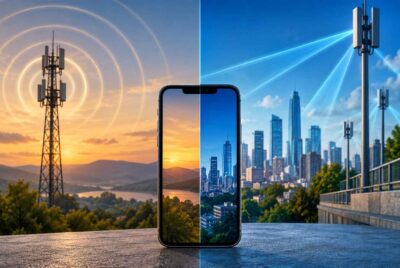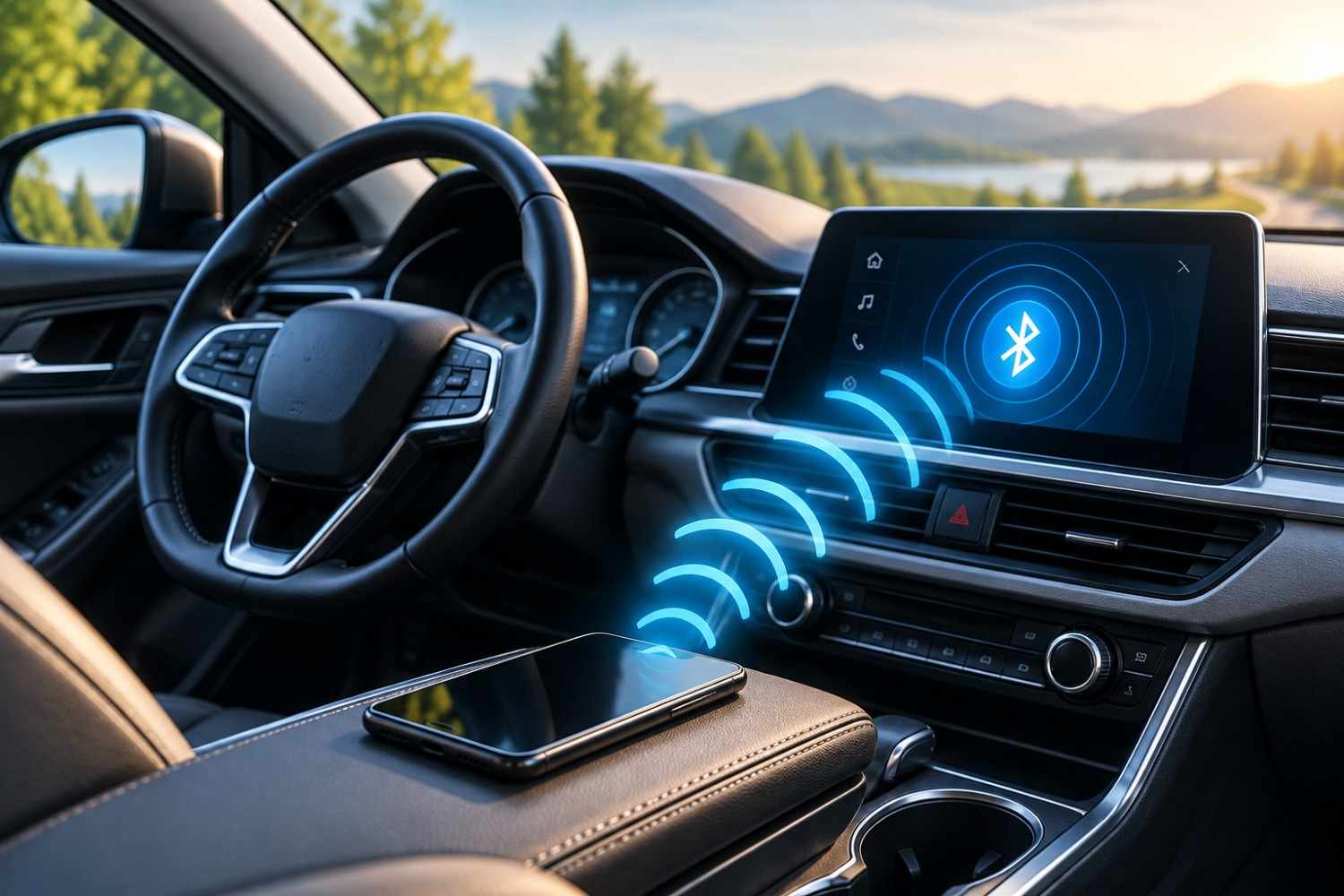
Bluetooth has become so seamless in modern vehicles that many of us barely notice when we are using it. You get into the car, your phone connects automatically, your favorite podcast starts playing, and incoming calls can be answered through the vehicle’s speakers. But all of that wireless communication raises an understandable question: Does Bluetooth car radiation add significantly to the electromagnetic field (EMF) exposure you experience while driving?
The short answer is that Bluetooth does produce radiofrequency electromagnetic fields, so using it adds another RF source to the environment inside your vehicle. However, simply detecting RF energy does not mean that the exposure is dangerous. Bluetooth is designed as a relatively low-power wireless technology, and the RF environment inside a modern car can include much more than Bluetooth alone.
In this article, we’ll look at how Bluetooth works in a vehicle, where the RF signals come from, how Bluetooth compares with cellular and Wi-Fi connections, what current evidence says about potential health risks, and some practical steps you can take if you would simply prefer to reduce unnecessary wireless exposure.
Does Bluetooth in Your Car Emit EMF Radiation?
Yes. Bluetooth relies on radiofrequency electromagnetic energy to communicate between devices.
According to the Bluetooth Special Interest Group, Bluetooth operates within the unlicensed 2.4 GHz ISM frequency band. Bluetooth Classic and Bluetooth Low Energy both use frequencies within this general range. Rather than requiring a physical cable to carry information between your phone and your vehicle, Bluetooth sends information wirelessly using RF signals.
That means a Bluetooth connection in your car is technically another source of RF-EMF.
It is important, however, to understand what the word “radiation” means in this context.
People sometimes hear “radiation” and immediately think of X-rays, nuclear radiation or other forms of ionizing radiation. Bluetooth doesn’t produce that type of radiation. Bluetooth uses non-ionizing radiofrequency radiation.
Non-ionizing RF energy does not carry enough energy per photon to ionize atoms in the way that X-rays and gamma rays can.
This distinction doesn’t mean that questions about RF exposure should be dismissed. It simply means that Bluetooth exposure should not be confused with exposure to ionizing radiation.
How Does Bluetooth Work Inside a Car?
When you pair a smartphone with your vehicle, the phone and the vehicle’s Bluetooth system establish a short-range wireless connection. Once that connection has been established, the devices can exchange information without needing to be physically connected by a cable.
Depending on your vehicle and phone, that connection may allow you to stream music, make hands-free calls, access contacts, use voice commands, hear navigation instructions and perform other functions.
The important point from an EMF perspective is that communication requires radio signals.
Your phone contains a Bluetooth radio, and the vehicle contains compatible wireless hardware. Those devices exchange RF signals so that information can travel between them.
Bluetooth technology operates in the 2.4 GHz ISM band, with Bluetooth specifications using frequencies between approximately 2.402 and 2.480 GHz.
Bluetooth is also designed for relatively short-range communication. Your phone doesn’t need to communicate with a tower miles away using Bluetooth. It generally needs to reach another device nearby.
That is an important difference between Bluetooth and your phone’s cellular connection.
A phone communicating with a cellular network has a very different job. Depending on network conditions and other factors, it may need to communicate with infrastructure located a considerable distance away.
Bluetooth typically only needs to communicate across a much shorter distance.
Bluetooth Isn’t Necessarily the Only Wireless Signal in Your Car
One of the easiest mistakes to make when discussing EMF inside a vehicle is assuming that every RF signal comes from Bluetooth.
Modern cars can contain numerous wireless technologies.
Depending on the vehicle and its features, RF sources could potentially include your smartphone’s cellular connection, Bluetooth, an in-car Wi-Fi hotspot, wireless smartphone integration, keyless-entry systems and other wireless communication systems.
Your passengers may also have phones, tablets, smartwatches, wireless earbuds or other connected devices.
Therefore, detecting RF inside a vehicle doesn’t necessarily tell you which device created it.
This distinction is particularly important if you are trying to determine whether turning Bluetooth off significantly changes the RF environment inside your particular car.
How Much Radiation Does Car Bluetooth Produce?
When discussing Bluetooth car radiation, it helps to separate two different questions:
Does Bluetooth produce RF radiation?
Yes.
Does that automatically mean the exposure is dangerous?
No.
Bluetooth is specifically intended to be a relatively low-power wireless communication technology. Bluetooth Low Energy, as its name suggests, was designed with very low-power operation in mind.
Actual exposure inside a car isn’t represented by one universal number. Different phones, vehicles, Bluetooth versions, transmitter configurations and operating conditions can produce different measurements.
Distance also matters.
RF exposure generally decreases as you move farther from a transmitting source, although real-world environments can be more complicated than a simple laboratory calculation. Vehicle interiors contain metal, glass, seats, electronics, passengers and numerous surfaces that can affect how RF signals propagate.
That is why statements such as “every Bluetooth-equipped car exposes you to exactly X amount of radiation” should be treated cautiously.
If you want to know what’s occurring in your own vehicle, measurement is much more useful than assuming that every vehicle behaves identically.
Does Being Inside a Metal Vehicle Make a Difference?
A car presents an interesting environment for radiofrequency signals.
Vehicles contain large amounts of metal, but they are certainly not completely enclosed metal boxes. Cars have windows, windshields and numerous other openings and materials.
Wireless systems are specifically designed to operate within this environment. Your phone can usually communicate with cellular networks while you’re driving, GPS signals can reach navigation equipment, and Bluetooth devices can communicate within the passenger compartment.
The more useful question may be whether the vehicle changes the way signals propagate inside the cabin.
It can.
Reflections from metal surfaces and the position of antennas can affect RF patterns, which means exposure won’t necessarily be distributed evenly throughout the interior.
This is another reason why a single measurement taken at one location doesn’t tell you everything about a vehicle.
A reading near the center console, for example, could be different from a reading taken near the driver’s seat, dashboard, passenger seat or phone.
What About Your Phone’s Cellular Connection?
This is an important part of the discussion because Bluetooth can become an easy target simply because people recognize its name.
Your phone may simultaneously maintain several wireless connections.
Bluetooth might be communicating with the vehicle while the phone is also communicating with a cellular network. The phone could also have Wi-Fi enabled and be interacting with other wireless systems.
Cellular communication can involve higher transmitting power than short-range Bluetooth communication, and a phone’s transmitting behavior can vary depending on network conditions.
That means someone trying to reduce RF exposure in a vehicle shouldn’t automatically focus exclusively on Bluetooth.
For example, turning Bluetooth off while continuing to stream large amounts of cellular data doesn’t mean you’ve eliminated RF activity from the phone.
It may simply mean you’ve removed one of several wireless connections.
Understanding the source is therefore much more useful than simply knowing that an RF meter is detecting something.
Bluetooth vs. Cellular vs. Wi-Fi in Your Car
Modern vehicles can contain several different wireless systems operating at the same time. Each technology serves a different purpose, so it helps to understand what each one is actually doing before deciding which connections you want or need.
| Wireless Technology | Primary Purpose | Typical Use in a Vehicle | EMF Consideration |
| Bluetooth | Short-range device communication | Calls, music and device pairing | Typically designed for relatively low-power, short-range communication |
| Cellular | Communication with cellular networks | Calls, texts, streaming and internet data | Phone transmission can vary based on network and signal conditions |
| Wi-Fi | Local wireless data connection | Vehicle hotspot and some smartphone-integration features | Adds another RF source when active |
| GPS | Satellite navigation | Navigation and location | GPS receivers primarily receive satellite signals rather than functioning like a cellular transmitter |
The main takeaway is that “wireless” doesn’t describe a single technology.
If you’re concerned about your wireless environment, it makes more sense to understand which technologies are active than to treat every wireless signal as though it were identical.
Is Bluetooth Car Radiation Dangerous?
This is probably the question most readers ultimately want answered.
Based on current scientific evidence, there isn’t good evidence demonstrating that ordinary Bluetooth use in a car causes adverse health effects.
The U.S. Food and Drug Administration states that the weight of scientific evidence has not linked radiofrequency radiation from cell phones with health problems. Bluetooth generally represents a lower-powered, shorter-range RF technology than cellular phone communication.
That doesn’t mean every question involving long-term RF exposure has been permanently answered. Science continues to study wireless technologies, exposure patterns and possible biological effects.
But there is an important difference between saying:
“Bluetooth emits RF energy.”
and saying:
“Bluetooth RF exposure has been demonstrated to cause harm.”
The first statement is factual. The second requires scientific evidence establishing a harmful effect, and current evidence doesn’t establish that normal Bluetooth use in a car causes adverse health effects.
This distinction is central to taking a balanced approach to EMF.
You can recognize that wireless technologies produce electromagnetic fields without assuming that every detectable field represents a proven health hazard.
At the same time, someone who personally prefers to minimize unnecessary wireless exposure can take simple precautions without becoming fearful of the technology.
7 Practical Ways to Reduce Wireless Exposure in Your Car
If reducing unnecessary RF exposure is important to you, you don’t necessarily need to stop using modern technology. Many exposure-reduction strategies simply involve turning off features you aren’t using, increasing distance when practical and understanding which devices are transmitting.
Here are seven practical approaches worth considering.
1 – Turn Bluetooth Off When You Don’t Need It
If you aren’t streaming audio, making hands-free calls or using another Bluetooth feature, you can simply turn Bluetooth off.
This isn’t a claim that Bluetooth must be turned off for safety. It’s simply one of the easiest ways to eliminate an unnecessary wireless connection when you aren’t using it.
2 – Disable an Unused Vehicle Wi-Fi Hotspot
Some newer vehicles have built-in Wi-Fi hotspot capabilities.
If your vehicle has this feature and nobody uses it, check whether it can be disabled.
There’s little reason to keep a wireless feature active simply because the vehicle came equipped with it.
3 – Avoid Keeping Your Phone Directly Against Your Body
Distance is one of the simplest tools available for reducing exposure from a transmitting wireless device.
Rather than keeping a phone in your pants pocket while driving, you might place it in a secure location elsewhere in the vehicle.
Safety comes first, though. Don’t put the phone somewhere that can interfere with driving or become a projectile during sudden braking.
4 – Use a Wired Connection When Practical
Some vehicles allow phones to connect through USB for audio, charging or smartphone integration.
If your vehicle provides the functionality you want through a wired connection, this may allow you to reduce reliance on certain wireless connections.
Keep in mind that plugging in a phone doesn’t necessarily disable all of its radios. Cellular, Wi-Fi and Bluetooth settings are controlled separately.
5 – Download Content Before Long Trips
If you’re taking a long trip, consider downloading music, podcasts, audiobooks and maps before leaving home.
Doing so can reduce the amount of cellular data you need to stream while driving.
Again, this doesn’t mean cellular streaming has been shown to be dangerous. It’s simply an easy option for someone intentionally trying to reduce wireless activity.
6 – Learn What Your Vehicle Is Actually Using
Before buying shielding products or making major changes, read your vehicle’s manual.
Find out whether it has Bluetooth, Wi-Fi, a cellular modem, wireless smartphone integration or other wireless features.
You may discover that some features can be disabled while others remain active whenever the vehicle is operating.
Knowledge is more useful than guessing.
7 – Measure Before Assuming
If you’re genuinely curious about RF levels inside your car, measuring them can be much more informative than relying on generalized claims online.
Take readings under different conditions. For example, compare Bluetooth on versus off, cellular data active versus inactive and the vehicle hotspot on versus off.
Testing individual variables can help you understand which features actually change the readings in your particular vehicle.
Affiliate Advertisement
How Can You Measure Bluetooth EMF Inside Your Car?
An RF meter can help you investigate wireless activity inside your vehicle, although interpreting measurements correctly is just as important as collecting them.
One option is the Safe and Sound Pro II RF Meter – Rechargeable from Safe Living Technologies.
The manufacturer states that the current Pro II measures RF/microwave signals over a true response detection range of 400 MHz to 7.2 GHz and can detect signals from 200 MHz to 8 GHz. Because Bluetooth operates around 2.4 GHz, it falls within the meter’s measurement range.
The meter also includes audio signal identification features intended to help distinguish RF sources.
However, owning an RF meter doesn’t automatically make every reading meaningful.
A broadband meter may detect multiple RF sources at once. If your phone has Bluetooth, Wi-Fi and cellular connections active, for example, a reading shouldn’t automatically be labeled “Bluetooth radiation.”
A better approach is controlled comparison.
Take a baseline reading at the driver’s seat with the vehicle and phone configured normally. Then turn Bluetooth off and repeat the measurement in the same location. You can conduct additional tests with Wi-Fi and other wireless features disabled one at a time.
Try to keep the meter in approximately the same position for each test.
You’re looking for patterns rather than trying to prove that a particular number is “safe” or “dangerous.”
This type of testing can answer a much more useful question:
What changes the RF environment in my vehicle?
What Else Produces EMF in a Modern Car?
Bluetooth is only one part of a much larger electromagnetic environment.
Modern vehicles contain extensive electrical and electronic systems. Depending on the vehicle, these can include wiring, computers, motors, alternators, displays, sensors, wireless communication systems, heated seats, wireless charging systems and numerous other components.
Hybrid and electric vehicles add high-voltage battery systems, inverters and electric motors.
These sources don’t all produce the same kind of electromagnetic field.
That’s an important distinction.
Bluetooth produces RF electromagnetic fields. Electrical equipment can also produce lower-frequency electric and magnetic fields. Measuring one type of EMF doesn’t necessarily tell you about another.
For example, an RF meter designed to measure Bluetooth, Wi-Fi and cellular signals isn’t necessarily the appropriate instrument for evaluating low-frequency magnetic fields near electrical components.
This is why “How much EMF is in my car?” is actually a more complicated question than it first appears.
A better approach is asking which type of EMF you’re interested in and then identifying the sources and measurement tools appropriate to it.
Should You Turn Bluetooth Off in Your Car?
You don’t need to panic if your phone automatically connects to your vehicle every morning.
Bluetooth does emit RF energy, but current evidence doesn’t demonstrate that normal Bluetooth use in a car presents a health hazard.
If you use Bluetooth for hands-free calling, audio or another feature you value, you can weigh that convenience against your personal preference for minimizing wireless exposure.
If you aren’t using Bluetooth, switching it off is an easy precaution.
That’s really the larger lesson.
Reducing exposure doesn’t have to mean fearing technology. It can simply mean avoiding wireless connections you don’t need while continuing to use the ones that genuinely make your life easier.
A Simple Experiment You Can Try
If you already own an RF meter, your own vehicle can make an interesting testing environment.
Rather than taking one measurement and drawing a conclusion, create a small experiment.
Start with the car running normally and your phone connected as you typically use it. Record readings at several consistent locations, such as near the driver’s seat, center console and passenger seat.
Then change one variable.
Turn Bluetooth off and repeat the readings.
Next, if your vehicle has a Wi-Fi hotspot, turn it off and repeat the process.
You could then compare what happens when your phone is idle with what happens during a cellular call or while actively transferring data.
The purpose isn’t to diagnose a health risk. Consumer RF meters cannot tell you whether a particular environment will cause a health problem.
Instead, the experiment helps you identify which devices and features contribute most noticeably to measurable RF levels inside your own car.
That’s far more informative than assuming that Bluetooth must be the primary source simply because it’s the technology you’re most familiar with.
The Bigger Picture: Don’t Focus on One Signal
One of the goals at EMFLuLu is to make EMF easier to understand without turning every electronic device into something to fear.
Bluetooth is a perfect example of why context matters.
Yes, Bluetooth emits RF.
Yes, using Bluetooth adds RF signals to your environment.
But neither statement tells you whether the exposure is harmful.
The FDA states that the weight of scientific evidence has not linked cell-phone RF radiation with health problems. That doesn’t mean research should stop or that you can’t choose to reduce your personal exposure. It means that claims about established health effects should match the strength of the available evidence.
If your goal is precaution, focus first on changes that are free and easy.
Turn off wireless functions you don’t use. Create distance from transmitting devices when practical. Understand what technology your vehicle contains. Measure if you’re curious.
Those steps allow you to reduce unnecessary exposure without letting EMF concerns interfere with enjoying or safely operating your vehicle.
Conclusion
Bluetooth car radiation is real in the straightforward sense that Bluetooth uses radiofrequency electromagnetic fields to communicate between your phone and your vehicle. However, Bluetooth is a short-range wireless technology designed to operate at relatively low power, and current scientific evidence doesn’t establish that ordinary Bluetooth use inside a car causes adverse health effects.
It’s also important not to look at Bluetooth in isolation. A modern vehicle may contain cellular connectivity, Wi-Fi, wireless smartphone integration and numerous electrical systems. Your own phone may be transmitting through several wireless technologies simultaneously.
If you prefer a precautionary approach, you don’t have to abandon Bluetooth or fill your vehicle with shielding products. Start with the simplest steps: disable wireless features you aren’t using, keep transmitting devices away from your body when practical, use wired alternatives when they make sense, and consider measuring your vehicle if you want to understand its RF environment.
The goal isn’t to become afraid of every signal around you. It’s to understand where exposure comes from, separate established facts from assumptions, and make informed choices about the technology you use every day.
Before You Go…
Get Weekly EMF Protection Tips
Enjoy this article? Join the EMFLuLu newsletter for simple weekly tips to reduce everyday EMF exposure from phones, WiFi routers, laptops, and smart home devices.
Try Our Free EMF Calculators
Curious how much EMF exposure you may experience each day?
These simple tools can help you estimate your exposure and identify possible problem areas in your home.
Try these free calculators:
Like this article? Pin it on Pinterest!

More to Explore