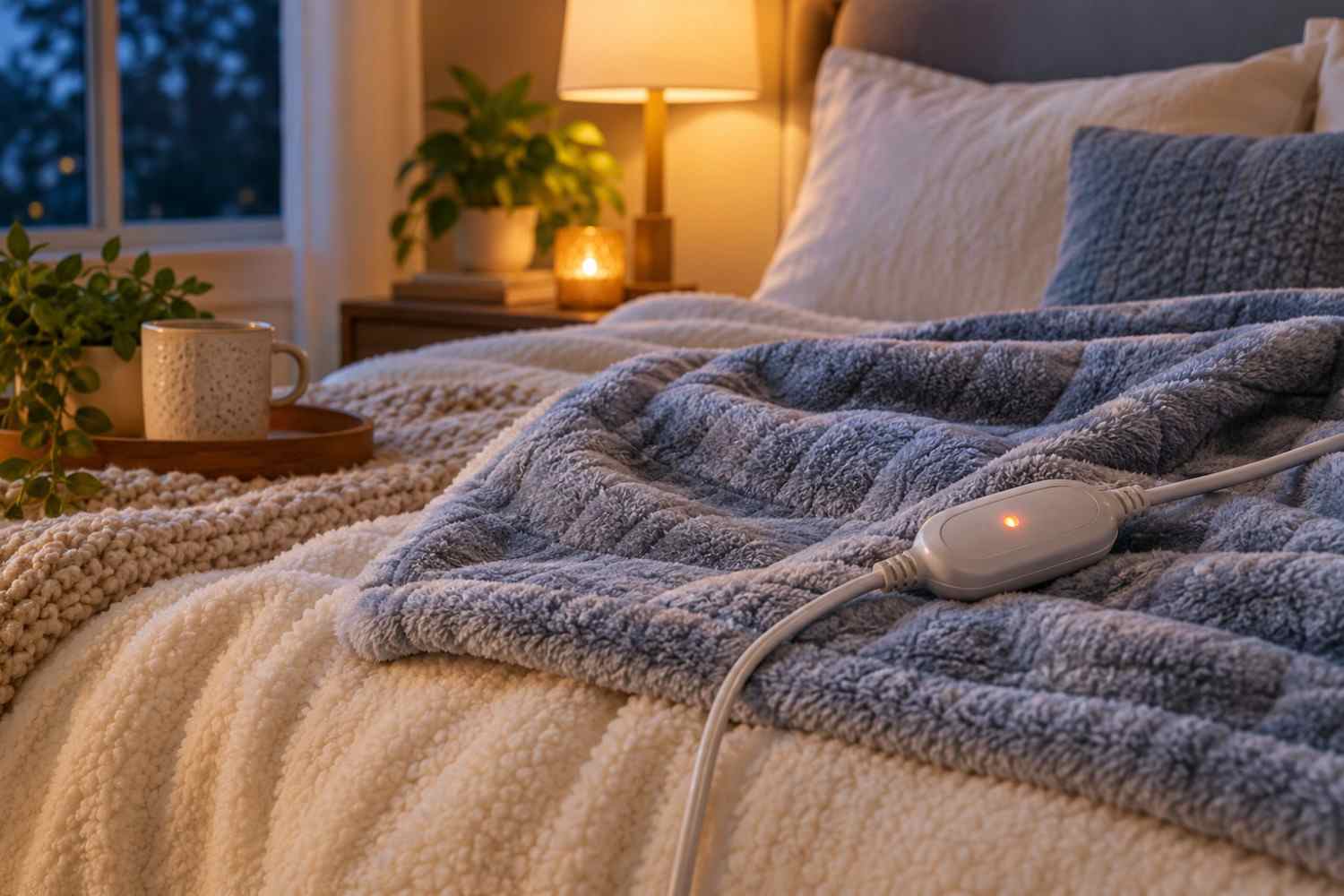
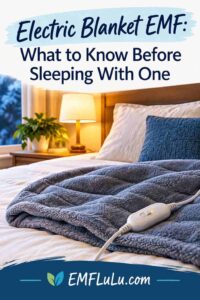
There is something especially comforting about climbing into a warm bed on a cold night. Electric blankets make that easy by using heating wires inside the fabric to create steady warmth without requiring you to turn up the heat throughout your home. But because those wires carry electricity while the blanket is directly on or near your body, you may wonder about electric blanket EMF and whether sleeping beside an electrical heating element for hours at a time is something you should be concerned about.
Electric blankets do produce electromagnetic fields. More specifically, traditional electric blankets are a source of extremely low frequency electromagnetic fields, commonly called ELF-EMFs. That does not mean an electric blanket is producing the same type of radiation as an X-ray machine, nor does it establish that using an electric blanket will harm your health. Understanding what the blanket produces, how exposure changes with use, and what you can do if you prefer to minimize unnecessary EMF exposure can help you make a more informed decision.
The good news is that reducing exposure doesn’t necessarily require getting rid of your electric blanket. A few simple changes in how you use it can allow you to enjoy a warm bed while significantly reducing the amount of time the blanket remains powered next to your body.
What Is Electric Blanket EMF?
An electric blanket works by passing electrical current through insulated heating elements woven or embedded throughout the blanket. When electricity flows through these elements, electrical resistance generates heat, which spreads through the fabric and warms the bed.
Any device using electricity can create electric and magnetic fields. Electric blankets are no exception.
The National Cancer Institute lists electric blankets among common sources of extremely low frequency electromagnetic fields, or ELF-EMFs. These fields are part of the non-ionizing portion of the electromagnetic spectrum.
That distinction matters.
Ionizing radiation includes forms of radiation such as X-rays and gamma rays. These contain enough energy to damage DNA or cells directly. ELF-EMFs do not have enough energy to ionize atoms and are classified as non-ionizing radiation.
An electric blanket therefore isn’t exposing you to the same type of radiation you would encounter during a medical X-ray.
It is also useful to distinguish electric blankets from wireless devices. Cell phones, Wi-Fi routers and Bluetooth devices primarily raise questions about radiofrequency electromagnetic fields. An electric blanket plugged into a household electrical outlet primarily creates lower-frequency electric and magnetic fields associated with the electricity flowing through its heating elements.
Understanding that distinction makes it easier to determine what you are actually trying to measure or reduce.
Why Electric Blankets Are an Interesting EMF Source
Electrical appliances are everywhere in a modern home. Your refrigerator, television, lamps, hair dryer and numerous other devices create electromagnetic fields when operating.
So why pay particular attention to an electric blanket?
The answer comes down largely to three factors: source, distance and time.
An electric blanket places the electrical source extremely close to your body. Depending on how you use the blanket, the heating wires could be just inches from you or directly against you.
Compare that with a refrigerator across the kitchen or a television several feet from your couch. Even though those devices also use electricity, you aren’t normally lying directly against them.
Distance matters because magnetic fields from electrical appliances generally become substantially weaker as you move farther away from the source. The National Institute of Environmental Health Sciences notes that magnetic fields close to appliances can be relatively strong but tend to decrease quickly with distance.
Time is another consideration.
You might use a hair dryer for five or ten minutes. An electric blanket could potentially remain beside your body for six, seven or eight hours while you sleep.
None of this means electric blanket EMF has been proven dangerous. Instead, it explains why someone following a precautionary approach to EMF exposure might pay more attention to a device located against the body for an extended period than to an appliance used briefly from farther away.
How Much EMF Does an Electric Blanket Produce?
There isn’t one measurement that applies to every electric blanket.
EMF levels can vary based on the blanket’s design, wiring configuration, operating setting, age and where you take the measurement. Even different areas of the same blanket can produce different readings because of the location of the heating wires.
Historical measurements published by the National Institute of Environmental Health Sciences help demonstrate this variability. In measurements taken approximately 5 centimeters, or about 2 inches, from electric blankets, conventional blankets had considerably higher magnetic-field readings than specially designed low-magnetic-field blankets.
It is important not to treat older measurements as a prediction of what a modern blanket will produce. Electric blanket designs have changed, and the NIEHS material itself cautions that appliances may have been redesigned since those measurements were collected.
The more useful lesson is that blanket design matters and measurements can vary.
If you are concerned about a particular electric blanket, measuring that blanket is much more informative than assuming that every electric blanket produces an identical field.
Is Electric Blanket EMF Dangerous?
This is where it is particularly important to separate what is known from what is suspected.
Extremely low frequency electromagnetic fields are non-ionizing. According to the National Cancer Institute, low- to mid-frequency EMFs are not known to damage DNA or cells directly in the way ionizing radiation can.
Research into possible health effects from long-term ELF magnetic-field exposure has continued for decades, but that does not translate into evidence that normal electric blanket use causes disease.
The National Cancer Institute’s definition of ELF-EMF states that although health concerns have been raised, ELF-EMF is not known to cause harmful health effects, including cancer.
This is an important point for anyone researching EMF online. The fact that a product produces a measurable electromagnetic field does not by itself demonstrate that the field is causing harm.
At the same time, some people prefer to reduce unnecessary EMF exposure when doing so is easy and does not significantly interfere with everyday life.
Electric blankets are a good example because exposure can be reduced without necessarily giving up the comfort they provide.
Instead of asking, “How do I block all EMF from my electric blanket?” a more practical question may be, “Do I need to keep the blanket powered beside my body all night?”
For many people, the answer will be no.
Does an Electric Blanket Give Off EMF When Turned Off?
This question is more complicated than it initially sounds because “off” can mean two different things.
A blanket can be switched off at its controller while remaining connected to the electrical outlet, or it can be switched off and completely unplugged.
When the blanket is actively heating, electrical current travels through the heating elements, creating magnetic fields around those conductors.
Turning the blanket off stops its normal heating current. However, depending on the design of the blanket, controller and wiring, portions of the electrical system may remain connected to line voltage while the blanket is plugged into the wall. This is relevant when considering electric fields even if the blanket is no longer actively heating.
Rather than trying to determine the internal wiring arrangement of a particular blanket, there is an extremely simple solution for someone who wants to minimize exposure:
Turn the blanket off and unplug it from the outlet before sleeping.
Once it is physically disconnected from household electricity, there is no ambiguity about whether its wiring remains energized from the outlet.
A Simple Way to Reduce EMF Exposure From an Electric Blanket
If you enjoy having a warm bed but would prefer not to sleep with powered heating wires directly beside your body, you don’t necessarily have to stop using an electric blanket.
In fact, one of the simplest approaches allows the blanket to perform the job you purchased it for while substantially reducing the amount of time it remains powered next to you.
Here is a practical routine you can consider:
- Place the electric blanket on the bed according to the manufacturer’s instructions. Always follow the directions for your particular blanket because some heated bedding is designed to be used differently from others.
- Turn the blanket on before bedtime. Giving it approximately 15 to 30 minutes to warm the bed may be enough, although heating time will depend on the blanket, room temperature and heat setting.
- Turn the blanket off before getting into bed. Instead of using it continuously throughout the night, use the electric blanket primarily as a bed warmer.
- Unplug the blanket if you want to further minimize exposure. Physically disconnecting it eliminates uncertainty about energized wiring while you’re sleeping.
- Use conventional bedding to retain the heat. A good comforter, wool blanket or other insulating bedding can help keep the warmth that the electric blanket created.
This isn’t merely an EMF-blog suggestion. The Wisconsin Department of Health Services specifically identifies warming the bed beforehand and turning the electric blanket off before sleeping as one way someone can reduce EMF exposure.
It is an excellent example of practical precaution because it costs nothing, requires very little effort and doesn’t require you to give up the comfort of climbing into a warm bed.
Distance Can Make a Difference
Distance is one of the most useful concepts to understand when evaluating household EMF sources.
The strength of magnetic fields from appliances typically decreases as distance increases. That means moving an electrical source farther from your body can sometimes make a substantial difference in exposure.
An electric blanket creates an unusual situation because there may be almost no distance between you and the source. If you sleep directly underneath the blanket, the heating elements may remain very close to your body throughout the night.
Simply adding another thin blanket between you and an electric blanket should not be assumed to “block” the magnetic field. Ordinary fabrics are not magnetic-field shielding materials.
Creating physical distance can reduce exposure, but with an electric blanket, maintaining significant distance while still receiving useful heat isn’t particularly practical.
That is another reason the preheating approach makes sense. Rather than trying to shield yourself from an operating electric blanket, you can use the blanket to warm your bed and then disconnect the electrical source.
EMF Isn’t the Only Electric Blanket Safety Consideration
It is easy to focus entirely on electromagnetic fields when researching electric blankets, but EMF is not the only factor worth considering.
Electric blankets contain electrical wiring and heating elements that are intentionally designed to generate heat. That makes proper use and maintenance important regardless of your opinion about EMF exposure.
Before using an electric blanket, inspect it carefully. A blanket that has been used for years deserves particular attention.
Some warning signs that may indicate a blanket should no longer be used include:
- Frayed or damaged power cords
- Cracked or damaged controllers
- Exposed wiring
- Scorch marks or discoloration
- Areas that become noticeably hotter than the rest of the blanket
- Damaged electrical connectors
- Heating wires that appear bunched, bent or displaced
- A blanket that operates unpredictably
These warning signs aren’t primarily about EMF. They are indications that an electrical heating product may no longer be operating as intended.
Modern heated blankets may also include timers, automatic shutoff systems and other safety features. Those features are useful, but they shouldn’t replace following the manufacturer’s instructions.
Avoid folding, bunching or using an electric blanket in a way the manufacturer specifically warns against. You should also check whether your particular blanket is intended for overnight use rather than assuming that every heated bedding product can safely be operated in the same manner.
Can You Measure EMF From Your Electric Blanket?
Yes, and measuring your own blanket can be useful if you want to understand what is happening in your actual sleeping environment.
The important part is using the correct type of meter.
Because an electric blanket is primarily a low-frequency electrical appliance, you want a meter capable of measuring low-frequency magnetic fields and, if desired, electric fields. An RF-only meter designed primarily for Wi-Fi, cellular and Bluetooth signals would not tell you everything you want to know about an electric blanket.
One option from one of EMFLuLu’s affiliate partners is the Safe and Sound EM3 Gauss Meter. According to Safe Living Technologies, the EM3 measures low-frequency AC magnetic fields and AC electric fields in addition to offering body-voltage measurement.
A meter certainly isn’t necessary just because you own an electric blanket. If your only goal is reducing exposure, preheating the bed and unplugging the blanket before sleeping is considerably simpler and costs nothing.
However, a meter can be worthwhile for someone conducting a broader home EMF assessment because the same instrument can be used to investigate other low-frequency sources around the home.
If you do measure your electric blanket, take readings where your body would actually be located rather than placing the meter directly against a heating wire solely to find the highest possible number. You can also compare readings with the blanket operating, switched off and unplugged.
The goal should be understanding realistic exposure rather than searching for the most alarming reading you can produce.
Affiliate Advertisement
What About “Low-EMF” Electric Blankets?
You may encounter heated bedding advertised as “low EMF,” “zero EMF” or with similar terminology.
Treat those descriptions as claims that should be investigated rather than guarantees.
Ask what type of EMF the manufacturer is referring to. Is the company talking about magnetic fields, electric fields or radiofrequency radiation? At what distance was the product measured? What measurement equipment was used? Were measurements taken across the entire blanket or only in a particular location?
These details matter.
A manufacturer may have designed the heating wires in a way that reduces magnetic fields compared with a conventional design. Historical NIEHS measurements demonstrate that low-magnetic-field blanket designs can produce different readings from conventional designs.
However, “low EMF” is not the same thing as “no electromagnetic field whatsoever.”
If minimizing exposure is important to you, look for actual measurement specifications rather than relying entirely on marketing language.
Do You Need an EMF-Shielding Blanket?
Probably not for this particular problem.
EMF shielding is complicated because different shielding materials are intended for different types of electromagnetic fields. A product designed primarily to reduce radiofrequency signals from cell towers, Wi-Fi routers or cellular devices should not automatically be assumed to block the low-frequency magnetic fields associated with an electric blanket.
This is one reason I don’t recommend buying a shielding blanket simply because you use an electric blanket.
There is a much simpler approach available.
Warm the bed. Turn the electric blanket off. Unplug it.
Sometimes reducing the source is more practical than trying to shield yourself from it.
Alternatives for Staying Warm Without an Electric Blanket
If you decide you would rather not sleep with electrically heated bedding, there are plenty of ways to make your bed warmer without continuously powering a heating element next to your body.
Before purchasing anything new, consider whether changing your bedding or bedtime routine could solve the problem. Depending on how cold your bedroom becomes, a combination of insulation and preheating may provide all the warmth you need.
Some options include:
- Flannel sheets: Flannel often feels warmer immediately because its brushed surface doesn’t have the cold initial feel of some smoother fabrics.
- A heavier comforter: Increasing the insulation above your body can help retain the heat your body naturally produces.
- A wool blanket: Wool provides excellent insulation and can be layered with other bedding.
- A down or down-alternative comforter: Lofted insulation traps air and helps retain body heat throughout the night.
- A hot-water bottle: When used according to appropriate safety instructions, a hot-water bottle can provide localized warmth without remaining connected to electricity.
- Preheating the bedroom: Increasing the room temperature before bedtime and then lowering the thermostat afterward may make getting into bed more comfortable.
- Preheating with the electric blanket: You don’t have to choose between owning an electric blanket and avoiding overnight use. Preheating may give you much of the benefit without continuous exposure.
There is no universal best solution. Someone sleeping in a mildly cool bedroom may only need flannel sheets, while another person in a much colder environment may prefer several layers of insulating bedding.
Frequently Asked Questions About Electric Blanket EMF
Electric blankets raise several recurring questions because they combine electricity, heat and prolonged close contact with the body. The following answers summarize the most important points covered in this article.
Do electric blankets emit EMF?
Yes. Electric blankets use electrical current flowing through heating elements and therefore produce electric and magnetic fields. The National Cancer Institute specifically lists electric blankets as a source of extremely low frequency electromagnetic fields.
What type of EMF does an electric blanket produce?
The primary concern is extremely low frequency, or ELF, electric and magnetic fields associated with household electricity. This differs from the radiofrequency EMF typically discussed with Wi-Fi routers, cell phones and Bluetooth devices.
Is electric blanket EMF the same as X-ray radiation?
No. X-rays are ionizing radiation. ELF-EMFs from household electrical appliances are non-ionizing and do not contain enough energy to damage DNA directly in the manner that ionizing radiation can.
Does unplugging an electric blanket stop its EMF?
Disconnecting the blanket from electrical power prevents household electrical current from flowing through its heating circuit and removes line voltage from the blanket. If minimizing exposure while sleeping is your goal, unplugging it is the most straightforward approach.
Is sleeping with an electric blanket every night dangerous?
Current evidence does not establish that ordinary electric blanket EMF exposure causes harmful health effects. There are also non-EMF considerations when using heated bedding, including overheating and electrical safety. Always follow the manufacturer’s instructions for your specific product.
If you would rather minimize unnecessary EMF exposure, you can preheat your bed and disconnect the blanket before sleeping.
Does putting another blanket between me and the electric blanket block EMF?
Don’t assume it does. Normal bedding materials are not designed to shield low-frequency magnetic fields. Although additional separation creates some distance, simply adding a thin fabric layer shouldn’t be viewed as EMF shielding.
Should I buy an EMF meter just to test my electric blanket?
Probably not unless you are particularly interested in measurements. If your goal is simply reducing exposure, turning the blanket off and unplugging it before sleeping accomplishes that without purchasing anything.
An appropriate meter makes more sense if you want to perform a broader EMF assessment of your bedroom or home.
Conclusion
Electric blankets unquestionably produce electromagnetic fields while using electricity, but the presence of an electromagnetic field should not automatically be interpreted as proof of danger. The fields associated with traditional electric blankets are primarily extremely low frequency, non-ionizing electric and magnetic fields rather than the ionizing radiation associated with X-rays.
For someone concerned about electric blanket EMF, one of the easiest approaches doesn’t involve shielding products, expensive equipment or throwing away a perfectly functional blanket.
Use the electric blanket to warm your bed before bedtime. Turn it off when you’re ready to sleep. If you want to minimize exposure further, unplug it completely and allow your regular bedding to retain the warmth.
That approach follows a simple principle that can be useful throughout the home: when reducing an exposure is inexpensive, convenient and doesn’t interfere with your quality of life, reducing the source or the amount of time spent near it can often be easier than trying to shield yourself from it.
You can still enjoy the comfort of a warm bed while making an informed choice about how long you want an electrical heating device operating directly beside your body.
Before You Go…
Get Weekly EMF Protection Tips
Enjoy this article? Join the EMFLuLu newsletter for simple weekly tips to reduce everyday EMF exposure from phones, WiFi routers, laptops, and smart home devices.
Try Our Free EMF Calculators
Curious how much EMF exposure you may experience each day?
These simple tools can help you estimate your exposure and identify possible problem areas in your home.
Try these free calculators:
Like this article? Pin it on Pinterest!
More to Explore