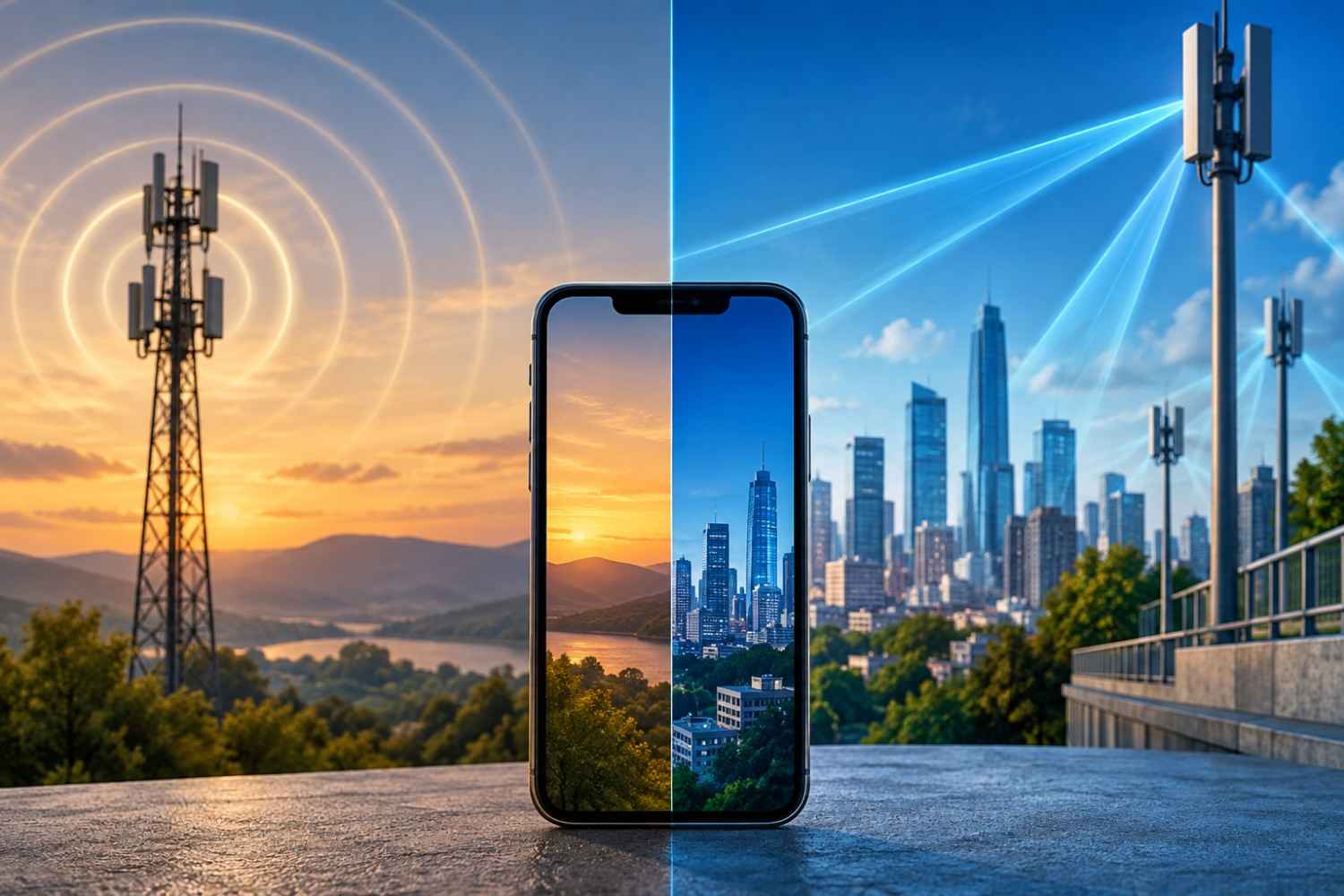
5G has become a normal part of cellular service, but 4G hasn’t disappeared. Today’s phones routinely operate across both 4G LTE and 5G networks depending on location, coverage, device capabilities, and network conditions. That makes the comparison between 5G vs 4G radiation more relevant than it might seem. Does 5G expose us to a fundamentally different type of radiation? Does it mean greater radiofrequency exposure? And what actually changes when your phone switches from 4G to 5G?
First, What Kind of Radiation Do 4G and 5G Use?
The word “radiation” can sound alarming because it is often associated with X-rays, nuclear materials, or other forms of ionizing radiation. However, radiation describes energy traveling through space, and there are many different types across the electromagnetic spectrum.
Both 4G and 5G cellular networks use radiofrequency electromagnetic fields, usually shortened to RF-EMF or simply RF.
Radiofrequency radiation is non-ionizing. It does not carry enough energy per photon to ionize atoms in the way that X-rays and gamma rays can. That distinction is fundamental when discussing wireless technology.
According to the World Health Organization (WHO), tissue heating is the primary established mechanism by which radiofrequency fields interact with the human body at sufficiently high exposure levels. At the exposure levels associated with current wireless technologies, WHO says the resulting temperature rise in the body is negligible.
The CDC similarly identifies cell-phone RF as different from ionizing radiation such as X-rays. Current U.S. guidance requires wireless devices sold in the country to comply with Federal Communications Commission exposure limits.
This means that 5G did not transform cellular phones into sources of ionizing radiation. The interesting differences between 4G and 5G involve how radiofrequency signals are generated and transmitted.
5G vs 4G Radiation: What Actually Changes?
One of the biggest misconceptions about 5G vs 4G radiation is that 5G represents one particular new frequency. In reality, 5G is a telecommunications standard capable of operating across different portions of the radiofrequency spectrum.
Some 5G networks operate at relatively low frequencies, including bands that are similar to frequencies previously used by 4G and older cellular technologies. Other 5G networks use mid-band frequencies, which provide a useful combination of speed, capacity, and coverage.
5G can also use considerably higher frequencies, including what are commonly called millimeter-wave or mmWave frequencies. These higher-frequency signals can carry large amounts of data but generally do not travel as far or penetrate obstacles as effectively as lower-frequency signals.
WHO explains that 5G extends mobile communications into higher frequencies, including around 3.5 GHz and potentially into the tens of GHz. It also notes that some of these higher frequencies were already being used for other applications before 5G cellular networks appeared.
Here is a simplified comparison:
| Feature | 4G | 5G |
| Type of radiation | Non-ionizing RF | Non-ionizing RF |
| Frequencies | Primarily established cellular bands | Low, mid, and higher-frequency bands |
| Beamforming | Possible in some systems | More extensively used |
| Small cells | Used | Potentially more common |
| Network capacity | High | Significantly higher |
| Exposure pattern | Varies with location and use | Can be more variable because of beamforming and network design |
| Data speed | Fast | Potentially much faster |
| Ionizing radiation | No | No |
The important takeaway is that 5G changes the way cellular networks operate, but it does not create an entirely new category of electromagnetic radiation.
Does 5G Automatically Mean More RF Exposure?
It might seem logical that faster wireless service, more antennas, and additional frequency bands would automatically result in greater RF exposure. Real-world exposure is more complicated.
A person’s RF exposure can depend on the distance from a transmitter, frequency, signal strength, transmission power, network traffic, surroundings, how the device is being used, and even how well the phone can communicate with the network.
A phone being used against the head, for example, represents a very different exposure situation from a cellular antenna located some distance away.
WHO has reported that exposure from 5G infrastructure operating around 3.5 GHz has been similar to exposure from existing mobile-phone base stations. WHO also notes that beamforming can make 5G exposure more variable depending on users’ locations and how the network is being used.
This makes it difficult to say that switching from 4G to 5G automatically increases or decreases a particular person’s RF exposure.
There is another factor that is easy to overlook: your phone adjusts its transmission behavior according to network conditions. A device struggling to maintain a connection may need to communicate differently than one with a strong connection to nearby network infrastructure.
As a result, simply looking at the “4G,” “LTE,” or “5G” symbol on your phone isn’t enough to determine your actual RF exposure at that moment.
What Are 5G Small Cells?
Another major change associated with 5G is the potential for denser networks of antennas, particularly in areas using higher-frequency signals.
Traditional cellular networks rely heavily on larger towers or antennas that cover substantial geographic areas. Those are still an important part of 5G.
However, higher-frequency signals generally have shorter effective ranges and can be more easily obstructed by buildings and other physical objects. Networks can compensate by installing smaller cellular antennas closer to the areas where service is needed.
These installations are often called small cells.
You may see them mounted on utility poles, streetlights, buildings, or other structures.
It is tempting to assume that more antennas automatically mean greater exposure. That conclusion doesn’t necessarily follow.
Smaller cells can operate at lower power and provide service across smaller areas. At the same time, an individual may be physically closer to one of these antennas than to a conventional macro cell tower.
The result is a different RF environment rather than a simple “more radiation” or “less radiation” equation.
WHO has noted that higher-frequency 5G deployment may involve a greater number of base stations and connected devices.
Actual exposure still depends heavily on distance, transmitted power, antenna characteristics, location, and network usage.
Beamforming Is Another Important 5G Difference
Beamforming is one of the more significant technological changes to understand when comparing modern 5G networks with earlier cellular systems.
Imagine a traditional antenna sending RF energy across a relatively broad coverage area. That works, but much of the transmitted signal may be traveling toward places where no connected device currently needs it.
Beamforming allows compatible antenna systems to direct signals more efficiently toward devices that are actively communicating with the network.
This can improve network performance while making RF exposure patterns more dynamic.
Instead of imagining a 5G antenna constantly producing exactly the same field in every direction, it is more accurate to think of some modern antenna systems as adapting their transmissions according to network demand and user locations.
WHO specifically notes that 5G uses beamforming antennas to focus signals more efficiently toward devices and that the resulting exposure can vary according to the location of users and their activity.
That variability is important.
It means a single RF measurement taken at one location and one moment may not necessarily describe every possible exposure condition around a 5G antenna.
Does Higher Frequency Mean More Dangerous Radiation?
This is another area where terminology can cause confusion.
A higher frequency does not automatically mean greater biological danger.
The electromagnetic spectrum includes frequencies ranging from extremely low-frequency fields through radio waves, microwaves, infrared, visible light, ultraviolet radiation, X-rays, and gamma rays.
Eventually, electromagnetic radiation reaches frequencies capable of ionization. Cellular 5G frequencies remain within the non-ionizing portion of the spectrum.
Frequency still matters because it affects how electromagnetic energy interacts with materials and the human body.
WHO explains that as radiofrequency increases, penetration into body tissue becomes shallower, with energy absorption increasingly concentrated near the surface of the body, including the skin and eyes.
This is particularly relevant when discussing millimeter-wave 5G.
Higher frequency should therefore not be interpreted as a simple scale where “higher equals more dangerous.” Exposure level, frequency, duration, distance, absorption, and other physical characteristics all need to be considered.
What Is Millimeter-Wave 5G?
Millimeter-wave 5G, often abbreviated as mmWave, has received considerable attention because it can operate at frequencies much higher than those traditionally associated with mobile phones.
It is important, however, not to use “5G” and “millimeter wave” interchangeably.
A 5G phone may spend much of its time communicating through low-band or mid-band 5G rather than mmWave. Availability varies greatly by carrier, location, network design, and device.
Millimeter-wave signals can provide extremely high data capacity. Their drawback is limited propagation compared with lower-frequency signals.
Buildings, walls, foliage, and other obstacles can interfere with these signals. This is one reason mmWave deployments can require antennas positioned relatively close to users.
From an exposure perspective, higher-frequency RF also behaves differently when it reaches the body.
As frequency increases, penetration becomes more superficial. WHO notes that at higher frequencies, less energy penetrates deeply into body tissues and absorption becomes increasingly confined to the body’s surface.
That doesn’t settle every question about long-term exposure. It does explain why the idea that higher-frequency 5G necessarily sends radiation “deeper” into the body is incorrect.
What Does Current Research Say About 5G and Health?
Claims about 5G health effects range from assertions that there is absolutely nothing left to study to claims that 5G has already been proven to cause widespread illness. Neither framing accurately communicates the state of the evidence.
WHO states that no adverse health effect has been causally linked with exposure to wireless technologies and says that health conclusions are based on research conducted across the radio spectrum. It also acknowledges that fewer studies have specifically examined some frequencies used by 5G. WHO continues to evaluate the broader evidence concerning radiofrequency fields and health.
The CDC’s July 2026 guidance is also appropriately cautious. It states that there is no definite scientific answer as to whether cell-phone use causes cancer and that additional research is needed concerning possible long-term health effects. The CDC notes that researchers continue studying outcomes including certain tumors, sleep, memory, headaches, and eye effects.
That distinction matters.
An unanswered research question is not proof of harm. At the same time, the absence of established harm does not mean researchers should stop studying rapidly evolving wireless technologies.
Long-term research remains useful because wireless devices are extraordinarily common, technology continues changing, and exposure patterns evolve as people spend more time using connected devices.
For readers trying to make practical decisions today, the evidence does not support treating 5G as if it were a new form of ionizing radiation. People who nevertheless prefer to limit unnecessary RF exposure can do so through relatively simple behavioral changes without giving up wireless technology entirely.
Your Phone May Be More Relevant Than the 5G Tower
When discussing 5G vs 4G radiation, people often focus primarily on cellular towers. Yet distance from the RF source is an important part of exposure.
A cellular tower might be hundreds or thousands of feet away. Your smartphone might be touching your head or sitting in your pocket.
WHO has long noted that RF field strength is greatest near its source and decreases rapidly with distance. It also notes that the RF exposure of a mobile-phone user can be considerably higher than typical exposure from distant base stations because the phone is operated very close to the body.
This doesn’t mean that normal phone use has been established as dangerous. It simply illustrates why distance is useful when thinking about personal RF exposure.
It also leads to one of the easiest precautionary strategies available: create a little space between transmitting wireless devices and your body when doing so is practical.
Affiliate Advertisement
Simple Ways to Reduce Everyday Cell Phone RF Exposure
Some people are comfortable using wireless technology without changing their habits. Others prefer to take simple precautions while research continues. If you fall into the second group, reducing exposure doesn’t have to involve abandoning your smartphone or worrying every time you see a 5G indicator.
The following practices focus primarily on distance and reducing unnecessary transmission. They are optional exposure-reduction measures rather than treatments or responses to a proven health hazard.
Use Speakerphone When Practical
Holding a phone several inches away instead of directly against your head increases the distance between your body and the transmitting device.
The CDC specifically suggests using speakerphone more often as an option for people concerned about reducing RF radiation near their bodies.
Consider a Wired Headset
A wired headset lets you keep the phone away from your head while still having a private conversation.
The CDC also recommends a hands-free headset that connects directly to the phone as an exposure-reduction option.
Don’t Keep Your Phone Against Your Body When You Don’t Need To
Your phone doesn’t always need to be in your hand, shirt pocket, or pants pocket.
When practical, placing it on a desk, table, console, or other nearby surface creates additional distance without affecting your ability to use it.
Use Airplane Mode When Connectivity Isn’t Necessary
Airplane mode can disable cellular transmissions and, depending on your phone and settings, other wireless connections.
It can be useful when you don’t need the phone to communicate wirelessly, particularly when you’re using the device for downloaded music, saved videos, reading, or other offline activities.
Remember that Wi-Fi and Bluetooth can sometimes be turned back on independently while airplane mode remains enabled, so check your settings if your goal is to temporarily disable wireless transmissions.
Avoid Sleeping With an Active Phone Directly Beside Your Head
If your phone serves as your alarm clock, it doesn’t necessarily have to be underneath your pillow or inches from your head.
Placing it farther away is a simple way to increase distance during the hours you’re sleeping. Airplane mode is another option if you don’t need calls, messages, or other wireless connectivity overnight.
These approaches work regardless of whether your phone happens to be connected to 4G, low-band 5G, mid-band 5G, or another wireless network.
4G vs. 5G: Should You Be More Concerned About One?
There isn’t a scientifically sound way to declare that every 5G connection creates more RF exposure than every 4G connection.
The technologies overlap considerably.
Both use non-ionizing RF energy. Some 5G signals use frequencies similar to frequencies previously used for cellular communications, while other 5G deployments extend into higher-frequency bands.
Network architecture is also changing. Beamforming, small cells, additional connected devices, and new frequency bands can create different RF exposure patterns.
That is more informative than simply labeling one generation “safer” than another.
If your personal approach is to minimize unnecessary RF exposure, you don’t need completely different habits for every generation of cellular technology.
Distance remains a useful and straightforward principle. Use speakerphone when convenient. Keep actively transmitting devices away from your body when you don’t need them directly against you. Use wired connections when they make sense. Turn wireless transmitters off when you genuinely don’t need them.
These practices don’t require assuming that 5G is dangerous. They simply allow someone who prefers a precautionary approach to reduce unnecessary exposure without giving up modern technology.
The Bottom Line
When comparing 5G vs 4G radiation, the most important point is that 5G does not introduce an entirely new type of radiation. Both technologies communicate using non-ionizing radiofrequency electromagnetic fields. The major changes involve the range of frequencies available, network architecture, antenna density, beamforming, capacity, and the way signals may be distributed around users.
Some 5G networks operate at frequencies relatively similar to previous cellular systems. Others use higher frequencies, including millimeter-wave bands. Higher-frequency RF penetrates less deeply into body tissue, while beamforming and denser antenna networks can make real-world exposure patterns more complex.
Current public-health guidance does not establish that 5G exposure within applicable limits causes adverse health effects, while research into RF exposure and possible long-term effects continues.
For people who prefer a precautionary approach, there is no need to panic about the “5G” symbol on a phone. Simple measures such as increasing distance, using speakerphone or a wired headset, and disabling wireless connections when they aren’t needed can reduce unnecessary RF exposure regardless of which generation of cellular network is being used.
Understanding what actually changed with 5G is more useful than treating every new wireless technology as either completely harmless or automatically dangerous. The evidence can continue to evolve, and practical choices can evolve with it.
Before You Go…
Get Weekly EMF Protection Tips
Enjoy this article? Join the EMFLuLu newsletter for simple weekly tips to reduce everyday EMF exposure from phones, WiFi routers, laptops, and smart home devices.
Try Our Free EMF Calculators
Curious how much EMF exposure you may experience each day?
These simple tools can help you estimate your exposure and identify possible problem areas in your home.
Try these free calculators:
Like this article? Pin it on Pinterest!
More to Explore