Solar power has become a common sight on homes across the country, but adding a large electrical system to your roof can raise questions about electromagnetic fields. Does electricity flowing through solar panels create EMF? What about the inverter, wiring, battery system, and other equipment? If you are concerned about EMF from solar panels, it helps to understand where electromagnetic fields may actually originate in a home solar system, what type of radiation is involved, and how distance and equipment placement can affect your exposure.
The short answer is that solar photovoltaic systems can produce electromagnetic fields because they generate and transport electricity. However, this should not be confused with ionizing radiation such as X-rays or gamma rays. In fact, the solar panels themselves may not be the part of the system that deserves the most attention. The inverter, electrical wiring, smart monitoring equipment, and other components can all contribute to the electromagnetic environment around a solar installation.
Let’s look at how a residential solar system works and what homeowners should know before becoming concerned about solar panel radiation.
What Type of Radiation Are We Talking About?
The word “radiation” can sound alarming because it is often associated with X-rays, radioactive materials, and nuclear energy. However, radiation is a much broader term.
The U.S. Environmental Protection Agency separates radiation into two general categories: ionizing and non-ionizing radiation.
Ionizing radiation has enough energy to remove electrons from atoms. X-rays and gamma rays are examples. Because ionizing radiation can alter atoms and damage biological tissue, exposure to sufficiently high levels can present established health risks.
Non-ionizing radiation does not have enough energy to ionize atoms. This category includes radio waves, microwaves, visible light, and the low-frequency electromagnetic fields associated with electrical power.
The electric and magnetic fields found around electrical wiring and equipment are forms of non-ionizing radiation. This is the category that is relevant when discussing a residential solar power system.
Solar panels do not make your roof radioactive, nor do they generate X-rays or gamma rays simply because they are producing electricity.
How Does a Home Solar System Work?
Understanding where EMF can originate is easier when you understand the path electricity takes through a solar system.
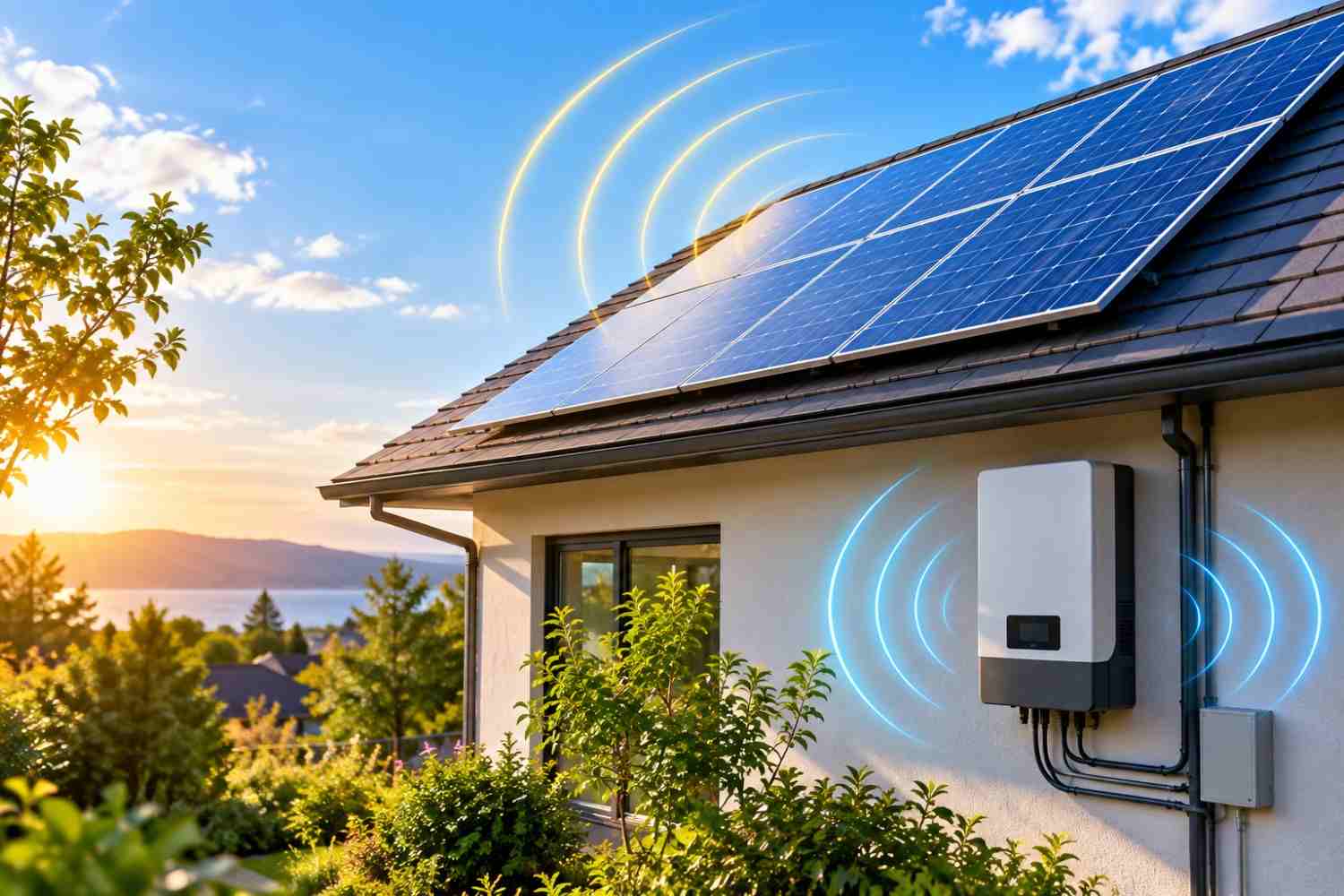
Photovoltaic panels convert sunlight into direct-current electricity, commonly called DC electricity. That electricity travels through the solar system’s wiring to equipment that allows the energy to be used by your home.
One of the most important pieces of equipment is the inverter.
The U.S. Department of Energy explains that an inverter converts the DC electricity generated by photovoltaic panels into alternating-current electricity, or AC, which is the form used by most household appliances and the electrical grid.
Depending on the design of the system, a home may have a central inverter or microinverters associated with individual solar panels. Some modern systems also include batteries, monitoring systems, communications equipment, and other electronics.
That distinction matters because when someone asks about “solar panel EMF,” they may actually be measuring an electromagnetic field produced by another component of the solar installation.
Do Solar Panels Produce EMF?
Yes, electromagnetic fields can be associated with solar power systems because electricity is being generated and transported. However, it is useful to distinguish the photovoltaic panels themselves from the rest of the equipment.
Electric fields are associated with voltage, while magnetic fields are associated with moving electrical current. According to the EPA, the strength of magnetic fields associated with electrical current generally decreases as you move farther away from the source.
Solar panels generate DC electricity. That electricity then travels through wiring toward an inverter or other power electronics.
For homeowners concerned about EMF from solar panels, this means looking only at the panels may provide an incomplete picture. The inverter, wiring, electrical panel, battery equipment, and wireless communications equipment may also be relevant.
This is why measuring an actual solar installation can be more useful than making assumptions based solely on the presence of panels on the roof.
Where Can EMF Come From in a Solar Power System?
A residential photovoltaic system contains multiple electrical components. Each has a different purpose, and the electromagnetic fields around each component can differ.
Before looking at individual sources, remember that an EMF reading taken a few inches from electrical equipment does not necessarily represent the exposure someone receives several feet away. Location, electrical load, equipment design, wiring configuration, and distance can all influence measurements.
Solar Panels
Photovoltaic cells convert sunlight into DC electricity. The panels and associated conductors can therefore be associated with electric and magnetic fields while the system is producing electricity.
However, simply having panels installed several feet above a living area does not tell you what EMF levels will be inside that room. Distance and the configuration of the system matter.
Solar Wiring
Electricity produced on the roof has to travel somewhere.
DC wiring carries electricity from the panels toward the inverter or other components. After the electricity has been converted to AC, additional wiring carries it into the home’s electrical system.
The routing of these cables is therefore worth considering, particularly if you are planning a new installation and have flexibility regarding where equipment and wiring will be located.
Solar Inverter
The inverter is one of the more interesting components from an EMF perspective.
Its job is to convert DC electricity generated by the panels into AC electricity that can be used by the home or sent to the grid. Modern inverters accomplish this through electronic switching and other power electronics.
Some systems use a single inverter, while others use microinverters at individual panels.
If you are planning a solar installation and are concerned about EMF, asking where the inverter will be located is reasonable. When practical, placing major electrical equipment away from areas where people spend long periods may provide additional distance from the source.
Electrical Panel
Solar-generated electricity eventually becomes part of the home’s electrical system. Your main electrical panel and the circuits connected to it are already sources of electric and magnetic fields whenever electricity is being used.
This isn’t unique to solar power. It is part of living in an electrified home.
Smart Meters and Wireless Monitoring
Modern solar systems can also include communication technology.
The Department of Energy notes that advanced or “smart” inverters may allow two-way communication. Solar monitoring systems may also communicate with an app, network, utility, or cloud-based service.
This introduces an important distinction. Wireless communication can involve radiofrequency, or RF, signals, whereas the electrical components of the solar installation can also produce lower-frequency electric and magnetic fields.
A homeowner trying to evaluate a solar installation should therefore know exactly what type of field he or she is measuring.
Is the Solar Inverter More Important Than the Panels?
The inverter deserves particular attention because it performs active power conversion.
A solar panel’s basic job is relatively straightforward: convert incoming sunlight into DC electricity. The inverter then takes that electricity and electronically converts it into AC electricity.
That does not mean a solar inverter is inherently dangerous. It means that if your goal is to understand the electromagnetic environment associated with a solar system, the inverter is a logical location to measure.
Location also matters.
Imagine two otherwise identical homes. In one, the inverter is installed on an exterior garage wall. In another, the inverter is mounted on a wall directly opposite the head of a bed.
Even if the equipment produces identical fields, the occupants’ exposure situations are not identical because their distance from the equipment is different.
This is one reason equipment placement is worth discussing with a solar installer before the installation begins.
Can Solar Panels Create EMF in a Bedroom Below the Roof?
This is a reasonable concern for someone considering rooftop solar, especially when panels will be positioned above bedrooms.
The answer depends on the specific installation.
The presence of a solar panel on the roof does not automatically mean there will be a significant EMF level at the bed underneath it. The distance between the equipment and the occupant matters, as do the location of conductors, electrical current, panel configuration, inverter design, and other variables.
The EPA notes that magnetic field strength from electrical current decreases with distance. This makes distance one of the simplest considerations when evaluating electrical equipment.
Instead of assuming that a bedroom underneath solar panels has a particular level of exposure, someone who is concerned can take actual measurements.
That produces information specific to the home rather than relying on a generic number found online.
Do Solar Panels Produce EMF at Night?
Solar photovoltaic panels require sunlight to generate electricity. At night, the panels are not actively generating solar electricity in the same way they do during daylight hours.
That means the electromagnetic environment associated specifically with solar generation can change between daytime production and nighttime.
A home with battery storage adds another consideration. Stored energy may be used after sunset, and the battery system and inverter can continue operating depending on the system design.
Other household electrical sources also continue operating whether or not the sun is shining.
If you own an EMF meter, this creates an interesting experiment. Take measurements at several locations during strong daytime solar production and then repeat the measurements at night. Keeping the meter position consistent can help you determine whether readings change with solar production.
How Does Solar EMF Compare With Other Household EMF Sources?
Solar equipment is only one part of a home’s overall electromagnetic environment.
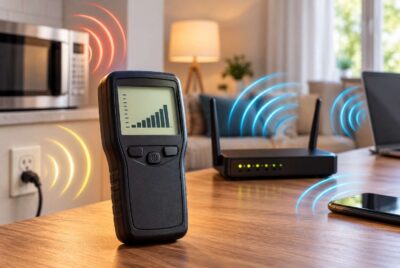
Everyday electrical and wireless equipment can also produce electric, magnetic, or radiofrequency fields. Refrigerators, microwave ovens, electrical panels, Wi-Fi routers, Bluetooth devices, computers, televisions, appliances, chargers, and household wiring are examples.
Comparing these sources requires caution because there is no single meaningful “EMF number” for every device.
Measurements can vary based on several factors. Before comparing one source with another, consider the following:
- Distance from the source: A measurement taken directly against a device can be very different from one taken several feet away.
- Electrical load: Magnetic fields can vary according to the amount of current flowing through a conductor.
- Frequency: RF radiation from wireless communication isn’t measured or interpreted in exactly the same way as low-frequency magnetic fields.
- Operating condition: Equipment may produce different readings when active, idle, transmitting, charging, or turned off.
- Meter capability: Not every EMF meter measures every frequency or type of electromagnetic field.
For these reasons, it is more useful to evaluate your actual environment than to assume that every solar system produces the same readings.
Should You Be Concerned About EMF From a Home Solar System?
It is important to keep the issue in perspective.
A solar photovoltaic system is electrical equipment, and electrical equipment can produce electromagnetic fields. These are non-ionizing fields, not the ionizing radiation associated with X-rays and radioactive materials.
That distinction does not prevent someone from choosing to reduce unnecessary exposure as a precaution. It simply means that decisions should be based on an accurate understanding of the source.
Someone who wants to take a precautionary approach does not necessarily need to remove solar panels or purchase shielding products.
There are simpler steps worth considering first.
7 Practical Ways to Reduce Solar-System EMF Exposure
If you are planning a solar installation or already have one, there are several practical ways to evaluate and potentially reduce exposure without assuming that the system presents a serious problem. Most of these strategies involve thoughtful equipment placement, distance, and measurement rather than expensive modifications.
1 – Think About Inverter Placement Before Installation
Ask your installer where the inverter will be located.
If several suitable locations are available, consider one that provides reasonable separation from bedrooms, home offices, favorite chairs, children’s play areas, and other places where family members spend hours at a time.
A garage or exterior utility area may provide more separation than a wall adjoining a bedroom, although the best location will depend on electrical, safety, code, weather, and installation requirements.
2 – Ask Where the Wiring Will Run
You don’t need to redesign an entire solar installation around EMF concerns, but understanding the proposed cable routes is useful.
Ask the installer to show you where the solar wiring will travel from the roof to the inverter and from the inverter to the electrical panel.
3 – Use Distance Where Practical
Distance is one of the easiest strategies because electromagnetic field strength generally decreases as you move away from a localized source.
If you discover an elevated reading immediately beside a particular component, take additional readings one foot, three feet, six feet, and farther away.
The pattern may be more informative than the initial measurement.
4 – Don’t Assume the Solar Panels Are the Source
If you measure an elevated field somewhere in your house, investigate before blaming the solar panels.
The source could be nearby wiring, an electrical panel, appliance, inverter, wireless device, utility equipment, or something unrelated to the solar installation.
5 – Compare Daytime and Nighttime Measurements
If you are trying to determine whether a reading is associated with solar generation, repeat measurements under different operating conditions.
Measure at the same locations during substantial solar production and again after dark. Keep other variables as consistent as reasonably possible.
6 – Measure Before Purchasing Shielding
This is one of the most important recommendations in this article.
It is easy to assume that a solar installation requires shielding because panels are located above your home. Before spending money, determine whether you actually have an exposure issue and identify the source.
Randomly applying shielding without understanding the type and source of the field may accomplish little and could complicate troubleshooting.
7 – Consult a Qualified Professional When Necessary
Solar systems involve potentially dangerous electrical voltages and currents. Do not open an inverter, electrical panel, junction box, battery enclosure, or other electrical equipment to investigate EMF.
If you believe something is wrong with the installation, contact a qualified solar installer or electrician.
Affiliate Advertisement

How to Measure EMF Around Your Solar System
If you want to investigate EMF from solar panels and related equipment yourself, an EMF meter can provide much more useful information than guessing based on where the panels are installed.
One option that fits this purpose is the TriField EMF Meter Model TF2 from Safe Living Technologies. It measures AC magnetic fields, AC electric fields, and RF/microwave radiation. According to its specifications, its AC magnetic and electric modes cover 40 Hz to 100 kHz, while its RF mode covers 20 MHz to 6 GHz.
If you use a meter, don’t take one reading and stop. Start by establishing a baseline in an area away from the solar equipment. Then take readings near—but without touching or opening – the inverter, near relevant walls, around the electrical panel, and in occupied rooms.
For example, if an inverter is installed on the exterior side of a bedroom wall, you might measure at the interior wall, three feet away, six feet away, and at the bed.
Record the measurements and repeat them under similar conditions.
The goal isn’t to walk around the house searching for the highest number possible. The goal is to identify sources, see how readings change with distance, and understand the environment in areas where you actually spend time.
Questions to Ask a Solar Installer Before Installation
If you haven’t installed solar yet, you have an advantage: you can ask questions before the equipment locations are finalized.
You don’t need to turn the consultation into an EMF investigation. A few practical questions can help you understand exactly what will be installed and where it will be located.
Consider asking:
- Where will the inverter or inverters be installed?
- Can the main inverter be located away from bedrooms?
- Where will the DC and AC wiring run?
- Will the system include a battery?
- Where will the battery and associated power electronics be installed?
- Does the monitoring system use Wi-Fi or another wireless connection?
- Will the system require additional utility communication equipment?
- Are alternative equipment locations available?
Electrical codes, manufacturer requirements, weather protection, ventilation, accessibility, cable lengths, and other practical considerations will influence what the installer can do.
The purpose of these questions isn’t to override proper installation practices. It is simply to make equipment location part of the planning process.
Common Myths About Solar Panel Radiation
Solar panels combine several subjects that can easily create confusion: radiation, electricity, wireless communication, power conversion, and sunlight. Clearing up a few misconceptions can make it easier to evaluate a solar installation realistically.
Myth 1: Solar Panels Produce Dangerous Ionizing Radiation
A photovoltaic solar system does not produce X-rays or gamma rays simply because it generates electricity.
The electromagnetic fields associated with electrical equipment fall into the non-ionizing portion of the electromagnetic spectrum.
Myth 2: Solar Panels Are Always the Biggest EMF Source
Not necessarily.
The inverter, electrical wiring, electrical panel, wireless monitoring equipment, and unrelated household electronics can all contribute to your home’s electromagnetic environment.
This is why source identification is important.
Myth 3: Solar Panels Constantly Produce the Same EMF
Solar production changes throughout the day.
Sunlight, weather, shading, season, system size, household electricity consumption, battery operation, and other factors can affect how the system operates.
Myth 4: Everyone With Solar Panels Needs EMF Shielding
There is no reason to assume that every solar installation requires shielding.
If you are concerned, measure first. Determine what type of field you’re detecting and where it originates. Simple distance or equipment-placement changes may be more appropriate than purchasing shielding materials.
Myth 5: One EMF Reading Tells You Everything
A single measurement doesn’t provide much context.
Take measurements at different distances, locations, and operating conditions. If possible, compare daytime solar production with nighttime readings.
Patterns tell you much more than one isolated number.
Frequently Asked Questions About Solar Panels and EMF
Do solar panels emit radiation?
Solar photovoltaic systems are associated with non-ionizing electromagnetic fields because they generate and transport electricity. This is different from ionizing radiation such as X-rays and gamma rays.
Do solar panels produce EMF at night?
Photovoltaic panels are not generating solar electricity at night because sunlight is absent. However, homes with batteries and other solar equipment may have components operating after sunset.
Can solar panels create EMF inside my house?
Electrical fields associated with a solar installation can potentially be measurable in or around a home, but the actual reading depends on the system design, equipment location, wiring, electrical load, distance, and other factors. Measurement is preferable to assuming a particular exposure level.
Do solar inverters produce EMF?
Inverters are electrical power-conversion devices. They convert the DC electricity generated by solar panels into AC electricity and can be a source of electromagnetic fields. If you are assessing a solar system, the inverter is a sensible component to include in your measurements.
Is it bad to have solar panels over a bedroom?
The presence of panels over a bedroom does not by itself establish that occupants are receiving high EMF exposure. Distance, wiring routes, equipment configuration, electrical current, inverter location, and other factors need to be considered. If you are concerned about a particular bedroom, actual measurements can provide more useful information.
Should I buy EMF shielding for solar panels?
Not automatically. First identify whether you have an elevated field, what type of field it is, and where it originates. Measuring first can prevent you from purchasing a solution for a problem that may not exist.
Conclusion
Solar panels offer homeowners a way to generate electricity from sunlight, but it is reasonable to wonder how adding an electrical generation system to your home affects its electromagnetic environment. EMF from solar panels and related equipment involves non-ionizing electromagnetic fields, not the ionizing radiation associated with X-rays or radioactive materials.
For someone who prefers a precautionary approach, the most practical strategy is not to fear the entire solar system. Understand its components. Pay attention to inverter and wiring placement. Use distance where practical. If you want to know what is happening in your particular home, measure the environment rather than relying on assumptions.
Solar panels, inverters, wiring, batteries, electrical panels, and wireless monitoring equipment each play different roles. Understanding those differences makes it possible to make informed decisions about solar energy while taking reasonable steps to manage your home’s overall EMF environment.
Before You Go…
Get Weekly EMF Protection Tips
Enjoy this article? Join the EMFLuLu newsletter for simple weekly tips to reduce everyday EMF exposure from phones, WiFi routers, laptops, and smart home devices.
Try Our Free EMF Calculators
Curious how much EMF exposure you may experience each day?
These simple tools can help you estimate your exposure and identify possible problem areas in your home.
Try these free calculators:
Like this article? Pin it on Pinterest!
More to Explore