Aluminum foil is one of the cheapest and most readily available conductive materials in the average home, so it is understandable that people have experimented with using it for EMF shielding. Search online and you may find everything from foil-covered routers to homemade Faraday cages and entire walls lined with reflective material. But does aluminum foil block EMF in a meaningful way? The answer is more interesting than a simple yes or no. Aluminum can interfere with and reduce certain electromagnetic signals, particularly radiofrequency (RF) signals, but that does not mean a sheet of kitchen foil blocks every type of electromagnetic field. The type of EMF, the frequency, the size and position of the foil, gaps in the shielding, and even the location of the source can all affect what happens.
Understanding these differences is important before turning your kitchen into an aluminum-foil construction project. Household foil can be a surprisingly useful material for experimenting with RF shielding, but it also demonstrates why effective EMF reduction requires more thought than simply placing metal between yourself and an electronic device.
Why Can Aluminum Foil Affect EMF?
Aluminum is an electrically conductive metal. When electromagnetic waves encounter a conductive material, the material can reflect, absorb, and otherwise alter some of that electromagnetic energy rather than allowing all of it to pass through unchanged.
This principle is one reason conductive materials are used in electromagnetic shielding.
A familiar example is a Faraday cage. A Faraday cage uses conductive material to reduce electromagnetic fields within an enclosed area. It does not necessarily need to be a solid metal box. Depending on the frequencies involved, conductive mesh can also provide shielding.
That helps explain why an aluminum-foil experiment with a cell phone can produce noticeable results. Completely enclosing a phone in foil may weaken or eliminate its connection to a cellular network, Wi-Fi network, or Bluetooth device. The foil is interfering with the radiofrequency signals the phone needs to communicate.
However, there is an important distinction between demonstrating that aluminum can interfere with RF communication and concluding that aluminum foil is a universal EMF shield.
It isn’t.
EMF Is Not Just One Thing
One of the biggest sources of confusion surrounding EMF shielding is the term “EMF” itself. Electromagnetic fields cover an enormous range of frequencies and sources.
Wi-Fi signals, Bluetooth transmissions, electrical wiring, household appliances, power lines, cell phones, and magnets can all be discussed in relation to electromagnetic fields, but the fields involved do not behave identically.
This matters because a shielding material that performs well against one type of electromagnetic energy may perform poorly against another.
For a typical home EMF discussion, it is useful to think about three broad categories: radiofrequency radiation, electric fields, and low-frequency magnetic fields.
Radiofrequency Radiation
RF radiation is associated with wireless communications such as Wi-Fi, cellular networks, Bluetooth, and many smart-home devices.
This is the category where aluminum can be particularly relevant.
A sufficiently continuous conductive barrier can attenuate RF signals. In everyday language, this means the barrier can reduce the strength of the signal passing through it.
This does not necessarily mean that every bit of RF energy disappears. Some can be reflected, some can be absorbed, and some may pass around or through gaps in the barrier.
That is why shielding effectiveness depends on much more than the material alone.
Electric Fields
Electric fields can be produced by voltage in electrical wiring, cords, appliances, and other electrical equipment.
Conductive materials can be used as part of electric-field shielding strategies, but proper installation becomes important. Grounding can also be an important consideration with certain shielding systems.
For a homeowner, this is one reason it is wise to distinguish a kitchen experiment using aluminum foil from an electrical shielding project involving walls, wiring, grounding, or permanent installations.
Low-Frequency Magnetic Fields
Low-frequency magnetic fields are another matter.
They can occur around electrical wiring, motors, transformers, electrical panels, appliances, and other sources carrying electrical current.
Ordinary aluminum foil should not be considered an effective general-purpose solution for shielding the low-frequency magnetic fields commonly encountered around household electrical sources.
Specialized magnetic shielding can require materials with very different properties from ordinary aluminum.
This is perhaps the most important limitation to understand when asking whether aluminum foil block EMF. Seeing aluminum foil interfere with your phone’s Wi-Fi connection does not demonstrate that it will shield every electromagnetic field in your home.
A Simple Aluminum Foil Experiment
If you want to see the effect for yourself, you can perform a simple experiment without turning it into a home improvement project.
The easiest demonstration involves a cell phone because the phone depends on RF signals for cellular, Wi-Fi, and Bluetooth communication.
Before performing the experiment, keep in mind that this isn’t laboratory testing and won’t tell you an exact percentage of EMF reduction. Your phone’s signal indicator isn’t a scientific EMF measurement instrument. The experiment simply demonstrates that sufficiently enclosing a wireless device with conductive material can interfere with RF communication.
You can try the following:
- Check that your phone has a strong cellular or Wi-Fi connection.
- Wrap the phone completely in several overlapping sections of aluminum foil, making sure there aren’t obvious openings.
- Try calling the phone from another device or check whether it maintains its Wi-Fi connection.
- Remove the foil and repeat the test.
Depending on the phone, network, foil coverage, signal strength, and other factors, you may see the connection weaken or disappear.
Now repeat the experiment while leaving a substantial opening in the foil.
You may get a different result.
That difference demonstrates one of the most important concepts in RF shielding: coverage matters.
A sheet of aluminum foil isn’t a magical object that sucks electromagnetic radiation out of the surrounding area. Its effect depends on how it is positioned relative to the source and receiver.
Why an EMF Meter Makes a Better Experiment
A cell phone makes the aluminum-foil experiment easy, but it has a major limitation. Signal bars tell you about the phone’s connection to a network, not the complete RF environment around you.
If you’re seriously interested in experimenting with shielding, an EMF meter capable of measuring RF can provide much more useful information.
Instead of asking whether your phone still has Wi-Fi, you can take a measurement at a particular location, introduce the shielding material, and measure again.
The basic procedure is simple. Establish a baseline reading, change one variable, take another measurement, and compare the results.
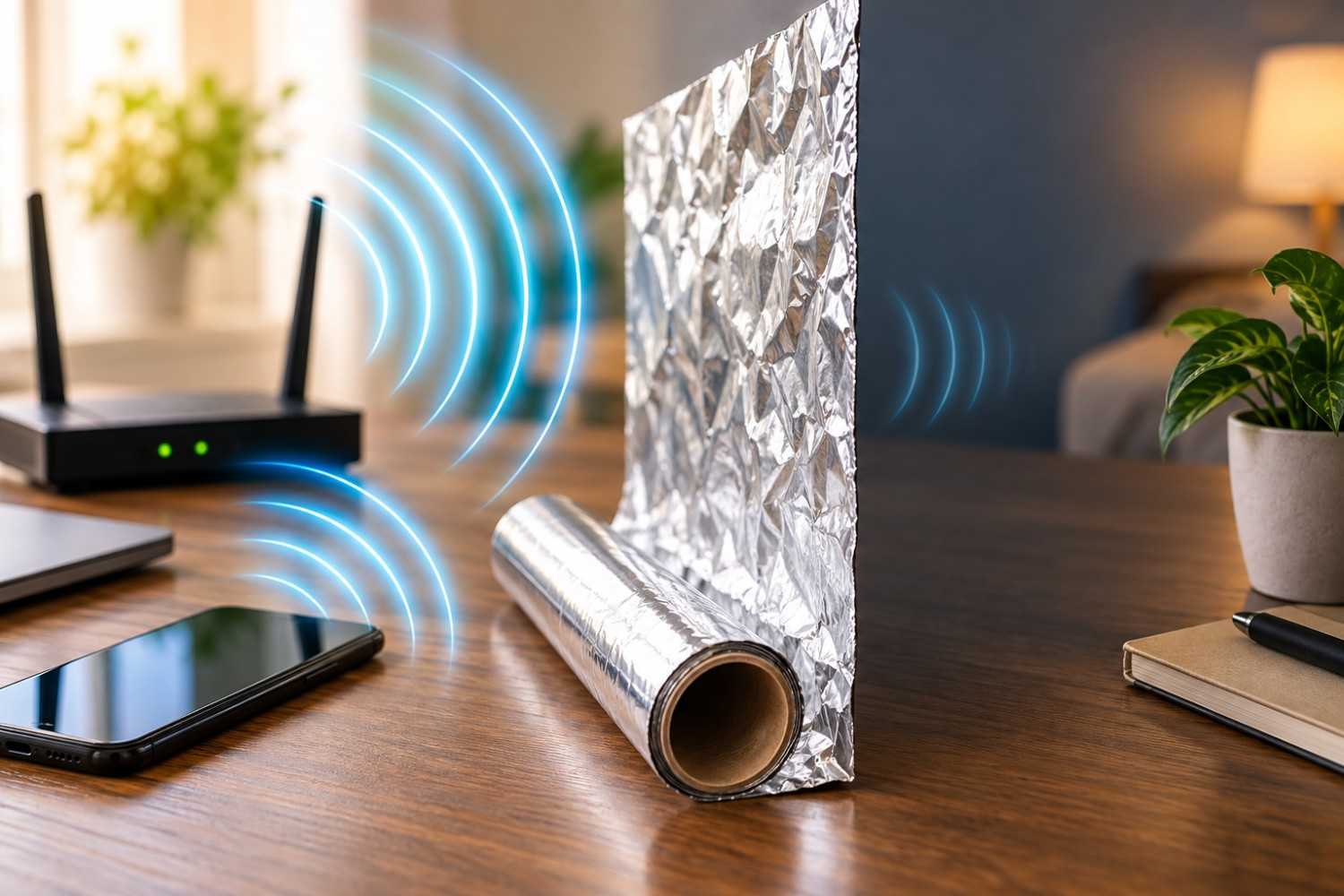
For example, you could measure RF levels at a particular spot with a Wi-Fi router operating normally. You could then position foil between the router and the measurement location and test again.
Move the foil.
Increase the distance.
Change its orientation.
Measure again.
This begins to demonstrate something that is difficult to appreciate when reading about EMF shielding: the electromagnetic environment can vary significantly depending on location and the source.
If you decide to purchase a meter, look for one that specifically measures the fields you want to investigate rather than assuming that every meter measures everything equally well.
Why Gaps Matter With Aluminum Foil Shielding
Suppose you place a large sheet of aluminum foil between a Wi-Fi router and your bed.
You measure from the bed and discover that the RF reading decreases.
Does that mean you’ve successfully shielded the bed?
Possibly from some of the RF arriving directly from that direction, but it doesn’t necessarily mean you’ve dramatically reduced your total RF exposure.
Radiofrequency energy doesn’t behave like a narrow beam of light traveling exclusively in a perfectly straight line from the router to you. Signals can propagate in different directions and interact with walls, floors, ceilings, furniture, and other objects.
This is why professional shielding installations pay attention to continuity.
A shielding system may need to account for seams, edges, doors, windows, outlets, ventilation openings, cables, and other penetrations.
A tiny tear in your kitchen foil probably won’t ruin a casual experiment, but a large uncovered area can substantially change the result.
Think about building a fence around a yard. Putting up one section of fence may block one path into the yard, but it doesn’t create an enclosure.
RF shielding can face a similar problem.
Can Aluminum Foil Make an EMF Situation Worse?
This is one of the more interesting questions surrounding DIY shielding.
Conductive shielding doesn’t simply make RF energy cease to exist. RF can be reflected and redirected, which means poorly planned shielding can change the distribution of RF energy within an area.
There is another consideration when the wireless device itself is being shielded.
Cell phones are designed to communicate with cellular networks. Their transmit power can vary depending on network conditions and the connection they are trying to maintain.
That makes partially wrapping a phone in foil while continuing to use it a poor exposure-reduction strategy.
You don’t want to create a situation where you’re making it harder for a wireless device to communicate while simultaneously expecting it to continue functioning normally.
If your goal is reducing unnecessary RF exposure from a device, turning off an unneeded wireless transmitter, using airplane mode when appropriate, increasing distance, or using a wired alternative may be simpler than trying to shield an actively transmitting device.
Should You Put Aluminum Foil Behind a Wi-Fi Router?
This idea is frequently discussed because it seems straightforward: if aluminum attenuates or reflects RF, why not put a sheet behind your router and direct the signal away from a bedroom or sitting area?
There is some logic behind directional shielding, but the real-world result depends on the environment.
A conductive barrier placed between a router and a measurement location may reduce RF arriving directly through that path. However, Wi-Fi signals travel throughout the home and can reflect from surrounding surfaces.
There is also an obvious tradeoff.
Your router exists because you want Wi-Fi coverage.
Completely enclosing the router in conductive material would work against its primary purpose.
Instead of automatically building a foil shield, consider whether you can relocate the router. Increasing distance between a strong RF source and an area where you spend long periods may be a simpler solution.
You can also consider wired Ethernet for devices that don’t need to be wireless.
Neither solution requires covering your walls or router in aluminum foil.
What About Aluminum Foil on Bedroom Walls?
This is where DIY EMF shielding becomes considerably more complicated.
A large conductive sheet can attenuate RF passing through it, so it isn’t unreasonable to wonder whether aluminum foil could be placed behind drywall, wallpaper, furniture, or another surface.
The problem is that a room isn’t a single flat surface.
If you’re considering shielding an entire room, there are several factors that need to be considered before deciding that foil is an inexpensive substitute for a professionally designed shielding material:
- Where is the RF source located?
- Which direction is the signal coming from?
- Are there wireless devices operating inside the room?
- Are windows allowing RF into the room?
- What about the ceiling and floor?
- Are there large gaps between shielding materials?
- Are there electrical outlets or cables passing through the shield?
- Does the shielding system require grounding?
- What happens to cellular and Wi-Fi reception inside the room?
Those questions illustrate why randomly attaching aluminum foil to a wall isn’t necessarily a good permanent EMF-reduction strategy.
If you are considering a large shielding project, measuring the environment before making changes is particularly valuable. Otherwise, you may spend considerable time and money solving the wrong problem.
Affiliate Advertisement
Household Aluminum Foil vs. Purpose-Built RF Shielding
Kitchen foil has some obvious advantages.
It is inexpensive, conductive, readily available, and easy to experiment with. If your goal is demonstrating that conductive material can interfere with RF communication, it is difficult to find a cheaper material.
As a permanent building material, however, kitchen foil has substantial limitations.
It tears easily. Maintaining continuous coverage can be difficult. Seams and edges must be considered. It isn’t particularly attractive. And most importantly, the roll of foil in your kitchen wasn’t manufactured as a tested RF shielding product with published shielding-performance specifications.
Purpose-built shielding materials are available for applications where permanent RF reduction is the actual goal.
These can include conductive fabrics, meshes, shielding paint, window films, foil products, and conductive tapes.
Safe Living Technologies, for example, offers specialized RF shielding materials intended for applications very different from wrapping leftovers in your kitchen.
The purpose of mentioning these products isn’t to suggest that everyone concerned about EMF needs to purchase shielding.
Quite the opposite.
Before purchasing shielding material, identify what you’re trying to reduce, determine where it is coming from, and measure it if possible.
You may discover that shielding isn’t necessary at all.
When Does DIY Aluminum Foil Shielding Make Sense?
Despite all these limitations, aluminum foil isn’t useless for EMF experiments.
In fact, its low cost makes it an excellent educational tool.
There are several situations where experimenting with aluminum foil can help you understand RF shielding without spending much money:
- Demonstrating how conductive material affects wireless signals.
- Experimenting with a simple Faraday-style enclosure.
- Comparing RF meter readings before and after adding a barrier.
- Testing different barrier locations.
- Seeing how gaps affect shielding performance.
- Experimenting before purchasing more expensive shielding materials.
The important distinction is between experimenting and assuming.
An aluminum foil experiment can show you that something changed. Measurements can help determine how much it changed.
Neither automatically proves that you’ve created a low-EMF environment.
What Aluminum Foil Cannot Do
There is a tendency for EMF discussions online to turn complicated subjects into absolute claims: a particular material either “blocks EMF” or it doesn’t.
The reality is more nuanced.
Understanding the limitations of aluminum foil is just as important as understanding its useful properties. In particular, household foil shouldn’t automatically be expected to:
- Eliminate every electromagnetic field in a room.
- Effectively shield common low-frequency magnetic fields.
- Provide complete RF shielding when large areas remain uncovered.
- Guarantee a particular percentage reduction in every environment.
- Replace measurements from an appropriate instrument.
- Solve exposure from wireless transmitters operating inside a shielded area.
- Perform identically at every electromagnetic frequency.
This doesn’t mean aluminum foil “doesn’t work.”
It means that aluminum foil block EMF claims need context. The important questions are: What type of EMF? At what frequency? From what source? At what distance? With what shielding configuration?
Without those details, statements about something “blocking EMF” don’t tell you very much.
A Better DIY Approach to Reducing EMF
If your goal isn’t simply experimenting but actually reducing unnecessary exposure in your home, aluminum foil probably shouldn’t be your first step.
Start by identifying sources.
An RF meter can help identify wireless sources. An appropriate electric- or magnetic-field meter can help investigate other types of fields. Once you know where higher readings are occurring, you can decide whether action makes sense.
In many cases, the simplest changes don’t involve shielding at all.
For example, you might increase the distance between a Wi-Fi router and a bed or desk. You might turn off wireless features that aren’t being used. A stationary computer or television might be connected through Ethernet rather than Wi-Fi. A phone can be moved away from the body when it isn’t needed.
The key is prioritizing changes that make sense for your actual environment.
A useful DIY hierarchy is:
Measure → Identify → Increase Distance → Reduce Unnecessary Wireless Use → Consider Wired Alternatives → Evaluate Shielding
Shielding comes near the end rather than the beginning.
That’s intentional.
If a source can simply be moved farther away or turned off when it isn’t needed, building a shield around it may add complexity without providing much additional benefit.
Don’t Confuse Signal Reduction With Health Risk
There is one more important distinction worth making.
Demonstrating that aluminum foil reduces an RF signal doesn’t, by itself, demonstrate that the original signal was dangerous.
Those are two separate questions.
A meter can tell you something about electromagnetic field levels. An aluminum foil experiment can demonstrate how conductive shielding changes those levels. Neither experiment alone establishes a health effect.
Health guidance regarding RF exposure is based on a much broader body of scientific evidence, exposure levels, frequency, duration, and other factors.
That distinction is especially important for DIY experiments because dramatic results can be misleading.
If your phone loses Wi-Fi after being wrapped in aluminum foil, you’ve successfully demonstrated that the foil interfered with communication between the phone and router.
You haven’t demonstrated that Wi-Fi was harming you before the experiment.
Keeping those questions separate makes EMF testing much more useful.
The Biggest Lesson From the Aluminum Foil Experiment
Perhaps the most valuable thing about experimenting with aluminum foil isn’t discovering an inexpensive EMF shield.
It’s discovering how complicated shielding can be.
Move the foil and your results may change.
Leave a large opening and they may change again.
Move farther from the source and you may get another result.
Switch from RF measurements to low-frequency magnetic-field measurements and the foil may suddenly appear much less impressive.
That’s exactly why EMF shouldn’t be treated as one single substance that can be universally “blocked.”
Frequency matters.
Source matters.
Distance matters.
Material matters.
Shielding design matters.
And measurement matters.
Once you understand those principles, you can make much more informed decisions about whether shielding is worthwhile in the first place.
Conclusion: Does Aluminum Foil Block EMF?
So, does aluminum foil block EMF? Aluminum foil can attenuate certain electromagnetic signals, particularly radiofrequency signals used by technologies such as Wi-Fi, Bluetooth, and cellular devices. A simple foil experiment can make this effect surprisingly easy to observe.
But aluminum foil is not a universal EMF shield. It should not be expected to effectively shield all low-frequency magnetic fields, and simply placing a sheet of foil near an electronic device does not guarantee meaningful overall exposure reduction.
For DIY experimentation, aluminum foil is inexpensive, accessible, and genuinely interesting. For permanent shielding, however, purpose-built materials, careful installation, and actual measurements are far more important.
The best approach is usually to determine what type of field you’re dealing with, identify its source, measure when practical, and try simple measures such as increasing distance or reducing unnecessary wireless transmissions before considering extensive shielding.
Aluminum foil can teach you quite a bit about electromagnetic shielding. Just don’t mistake a roll from the kitchen drawer for a complete EMF solution.
Before You Go…
Get Weekly EMF Protection Tips
Enjoy this article? Join the EMFLuLu newsletter for simple weekly tips to reduce everyday EMF exposure from phones, WiFi routers, laptops, and smart home devices.
Try Our Free EMF Calculators
Curious how much EMF exposure you may experience each day?
These simple tools can help you estimate your exposure and identify possible problem areas in your home.
Try these free calculators:
Like this article? Pin it on Pinterest!

More to Explore