
Every day, our bodies are surrounded by invisible electromagnetic fields (EMFs) emitted by WiFi routers, 5G cell towers, smartphones, tablets, and countless wireless devices. While these technologies have become integral to modern life, many people are growing increasingly concerned about long-term exposure – especially those who spend long hours near multiple devices. One of the most practical solutions gaining popularity is EMF protection clothing. But what exactly makes these garments work?
This article explores how EMF shielding clothing works scientifically, revealing the real mechanisms that allow these fabrics to block or reduce radiation. We’ll look at the materials used, how laboratory testing measures effectiveness, and what features you should look for before purchasing. You’ll also see examples of real, lab-tested clothing from DefenderShield.com – including their EMF protection beanie, baseball cap, hooded jacket, and gloves – and learn how to use them effectively as part of your EMF-reduction strategy.
What Is EMF and Why Do People Wear Shielding Clothing?
To understand the value of EMF protective clothing, it helps to first understand what EMFs actually are.
Electromagnetic fields are invisible zones of energy produced by electricity and wireless communication. They exist everywhere – from the low-frequency fields emitted by power lines to the high-frequency radio waves used by 5G towers and cellphones.
Common household sources include:
- WiFi routers
- Bluetooth devices
- Smart meters and smart appliances
- Cellphones and tablets
- Laptops and wearable technology (smartwatches, wireless earbuds)
Many people wear EMF shielding clothing as a precautionary step. Although the scientific community continues to debate potential health impacts, a growing number of studies have suggested that prolonged exposure to certain EMF frequencies could cause biological stress, headaches, or sleep disturbances in sensitive individuals.
For those seeking peace of mind, protective garments offer an extra layer of defense – a physical barrier that reflects and absorbs electromagnetic energy before it reaches the body.
How EMF Shielding Clothing Works Scientifically
Let’s explore the heart of this topic: how EMF shielding clothing works scientifically.
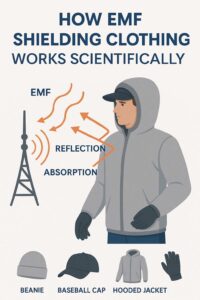
At its core, shielding clothing functions as a wearable Faraday cage – a conductive enclosure that blocks external electromagnetic radiation by redistributing it along the surface of the material. Instead of allowing EM waves to penetrate your body, the energy is either reflected away or dissipated within the conductive fibers of the garment.
Here’s how it happens:
- Reflection: When EM waves hit the conductive surface of the garment (often made with silver, copper, or stainless steel threads), much of the energy is reflected outward, similar to how a mirror reflects light.
- Absorption: Some of the energy that passes through is absorbed and converted into small amounts of heat, which are then safely dispersed through the fabric.
- Attenuation: The combination of reflection and absorption drastically reduces the field intensity reaching your skin. The reduction is measured as “shielding effectiveness” (SE), typically expressed in decibels (dB). For example, a 40 dB rating means the material blocks 99% of EMF radiation; 50 dB means 99.9%.
The effectiveness depends on several factors:
- Conductivity: Higher metal content means better reflection of EM waves.
- Frequency Range: Different fabrics are tested for various frequencies – from low-frequency magnetic fields (like power lines) to high-frequency RF radiation (like 5G and WiFi).
- Coverage Area: A full-coverage jacket provides more protection than a small cap or scarf.
- Fabric Layering: Double-layered materials often provide stronger shielding than single-layer ones.
In essence, EMF protective clothing works by forming a barrier between your body and the EMF source, using physics rather than chemistry. That’s the scientific foundation of these garments – a principle validated by decades of research into electromagnetic interference (EMI) shielding.
Materials Used in EMF Shielding Fabrics
Before you buy any EMF-blocking apparel, it’s important to understand what it’s made of and why certain materials perform better than others.
Here’s an overview of the most common materials found in scientifically designed shielding fabrics – with an explanation of what makes each effective:
- Silver-coated fibers: Silver is one of the most conductive elements. When woven into fabric, it creates a fine metallic mesh that reflects EM radiation while remaining soft and breathable. It’s also antimicrobial, preventing odor buildup.
- Copper fibers: Copper is another highly conductive metal used to create strong reflection of radiofrequency signals. It’s sometimes blended with polyester or nylon to increase flexibility.
- Stainless steel fibers: Stainless steel provides durability and maintains conductivity even after multiple washes. Often used in industrial or military-grade EMF garments.
- Nickel-copper coatings: Some textiles are sprayed or plated with nickel-copper compounds for additional shielding power across a broader frequency range.
- Hybrid conductive textiles: These fabrics combine metallic and non-metallic fibers, balancing comfort with protection.
How to choose materials:
When buying EMF protection clothing, check the product details or technical datasheet for the percentage of metal fiber and its frequency range. Look for garments tested to block 99%+ of radiation from 300 MHz–10 GHz, which includes WiFi, Bluetooth, and 5G frequencies.
How EMF Clothing Is Tested
Because EMF exposure varies by frequency, testing is the only way to verify performance. Manufacturers that take science seriously will have their fabrics tested using standardized laboratory methods.
Below is an overview of how this testing works and what those numbers mean.
Common EMF Shielding Tests
Before diving into the methods, it’s helpful to understand what the results show: they measure how many decibels (dB) of signal reduction occur when EMF waves attempt to pass through the fabric.
- ASTM D4935 Coaxial Transmission Line Test:
This is the most recognized laboratory test. It places the fabric between two conductive plates and measures how much electromagnetic energy passes through.- Result: Shielding effectiveness in dB over a wide frequency range (30 MHz to 1.5 GHz).
- Interpretation: A result above 40 dB means excellent protection (≈ 99%).
- Open-Field Test (Real-World Simulation):
The garment is exposed to EMF waves in a controlled room or anechoic chamber. Sensors behind the clothing measure the residual field strength. This test mimics real-life conditions such as WiFi or cellphone radiation. - Reverberation Chamber Testing:
Used for high-frequency signals (like 5G), this method evaluates how clothing performs when EM waves bounce around in an enclosed area – similar to the complex environment of an office or home.
Affiliate Advertisement
Understanding the Data
When you see claims like “blocks 99% of EMF radiation up to 90 GHz,” that statement is derived from lab reports. Higher dB = stronger shielding. Every 10 dB increase represents a 10× reduction in signal strength.
For example:
- 20 dB = 90% blocked
- 30 dB = 97% blocked
- 40 dB = 99% blocked
- 50 dB = 99.9% blocked
If the brand provides testing certificates or third-party validation, that’s a strong indicator that the product’s claims are trustworthy.
Key Features to Evaluate When Choosing EMF Clothing
When shopping for protective apparel, it’s easy to get overwhelmed by marketing claims. The best way to choose is to focus on scientifically verifiable criteria.
Here’s what to evaluate — and why each factor matters:
- Shielding Range and Effectiveness
- What to do: Look for detailed test reports showing attenuation (in dB) across multiple frequencies. Ensure coverage includes 300 MHz–10 GHz or higher.
- Why it matters: Some garments perform well for WiFi but poorly for 5G; full-range protection ensures consistency.
- Coverage and Fit
- What to do: Choose clothing that covers the area closest to frequent EMF exposure – for instance, a beanie for head protection while using Bluetooth devices.
- Why it matters: Gaps or loose fits reduce protection since EMF can enter through uncovered areas.
- Material Durability and Washing Instructions
- What to do: Follow the care guide carefully. Hand-wash in cold water with mild detergent; avoid bleach and tumble drying.
- Why it matters: Over-washing or heat can degrade metallic fibers, reducing conductivity and shielding power.
- Comfort and Breathability
- What to do: Pick blended fabrics (like cotton + silver fiber) if you plan to wear the garment daily.
- Why it matters: You’re more likely to use clothing consistently if it’s comfortable.
- Independent Testing and Transparency
- What to do: Request or review lab certificates from third-party facilities.
- Why it matters: Honest companies publish their testing results instead of making vague claims.
By checking these elements, you ensure your purchase aligns with both science and practicality – the essence of how EMF shielding clothing works scientifically.
Affiliate Advertisement
DefenderShield Product Spotlights
Now that you understand how EMF-shielding fabrics function, let’s look at real-world examples from DefenderShield, one of the most respected brands in the EMF-protection industry. All four of these products are independently tested to block up to 99% of EMF and 5G radiation (up to 90 GHz).
Each example below connects the science to an actual product.
DefenderShield EMF Protection Baseball Cap
Product link: DefenderShield Baseball Cap
This stylish cap is lined with silver-fiber fabric that reflects and absorbs high-frequency radiation. It’s perfect for daily use – especially when using cellphones, Bluetooth earbuds, or while driving near strong signal zones.
How it works: The metallic mesh inside the lining redistributes electromagnetic energy across its surface, blocking it from entering the head area.
Usage tip: Wear it snugly to ensure full coverage of your scalp; combine it with reducing direct phone-to-ear use for best results.
DefenderShield EMF Protection Gloves
Product link: DefenderShield EMF Protection Gloves
These gloves shield your hands and wrists from EMF exposure while using phones, tablets, or laptops.
How it works: Conductive silver fibers reflect most of the radiofrequency radiation from devices, minimizing skin-level absorption.
Usage tip: Ideal for those who type on laptops for long hours. Use them along with a DefenderShield Laptop Shield to protect both hands and torso simultaneously.
DefenderShield EMF Protection Winter Beanie
Product link: DefenderShield Winter Beanie
Lined with high-conductivity silver thread, this beanie offers 360-degree coverage for the brain and upper neck area.
Scientific connection: Because the head is a highly sensitive region with strong nerve and blood-brain barrier activity, EMF attenuation here is especially beneficial. The beanie functions as a soft Faraday shield.
Usage tip: Great for sleeping or traveling – particularly on airplanes or in crowded wireless environments.
DefenderShield EMF Protection Hooded Jacket
Product link: DefenderShield Hooded Jacket
A premium full-body garment that blocks up to 99% of EMF radiation. Made with silver-thread technology and designed for comfort, it’s perfect for those who want maximum protection outdoors or while commuting.
How it works scientifically: The jacket’s internal silver-fiber layer reflects both electric and magnetic components of EM waves, functioning as an extensive barrier system.
Usage tip: Zip up fully to maintain coverage and combine it with the beanie for comprehensive protection.
Practical Tips for Using EMF Protective Clothing
Wearing EMF-blocking clothing is most effective when combined with smart habits that minimize exposure overall. Here’s how to integrate these garments into your lifestyle.
- Identify High-Exposure Environments – Start by noticing where EMF levels are highest – offices with many WiFi routers, airports, trains, and dense urban areas. You can use an EMF meter to measure hot spots.
- Combine Clothing with Distance Strategies – Even the best EMF clothing works best as part of a multi-layered defense. Keep phones off your body when not in use, avoid sleeping near routers, and turn off Bluetooth when possible.
- Layer Smartly – For extra coverage, pair a DefenderShield jacket with gloves or a beanie. The more surface area covered, the lower your exposure.
- Maintain Your Garments – Because metallic fibers are sensitive, hand-wash your EMF clothes with gentle soap, no bleach, and air-dry. This preserves conductivity and prevents fiber corrosion.
- Track Your Results – If you own an EMF meter, test before and after wearing your clothing to see real attenuation. It’s a powerful way to confirm how your garments perform under your environment’s frequencies.
Balanced Perspective (Understanding Limitations)
While EMF shielding clothing offers real, measurable attenuation, it’s important to maintain realistic expectations. The fabrics can dramatically reduce exposure but not eliminate it entirely.
Variables that affect performance include:
- Fit and coverage (loose areas allow EMF leakage).
- Fabric wear and tear after washing.
- Layer interaction with your own body (some radiation can couple capacitively through skin contact).
- Gaps between clothing pieces (for example, uncovered neck or ankles).
Balanced guidance:
- Use clothing in conjunction with other methods: distance, time reduction, shielding walls or curtains, and keeping devices in airplane mode when possible.
- Don’t rely solely on garments if exposure is extremely high (like near industrial transmitters).
The good news is that lab tests confirm high-quality shielding materials – like those used in DefenderShield apparel – can block up to 99% of common RF signals, making them a valuable part of a holistic EMF-management strategy.
Conclusion
By understanding how EMF shielding clothing works scientifically, you can separate marketing hype from real, physics-based protection. These garments function through measurable principles – reflection, absorption, and attenuation – made possible by conductive fibers such as silver and copper. Laboratory testing confirms that well-designed fabrics can reduce EMF exposure by 99% or more under typical wireless frequencies.
DefenderShield’s beanies, jackets, gloves, and caps take these concepts from theory to practice, combining advanced materials with independent testing. While EMF clothing is not a cure-all, it is an effective and tangible way to minimize exposure in your daily routine.
Before You Go…
Get Weekly EMF Protection Tips
Enjoy this article? Join the EMFLuLu newsletter for simple weekly tips to reduce everyday EMF exposure from phones, WiFi routers, laptops, and smart home devices.
Try Our Free EMF Calculators
Curious how much EMF exposure you may experience each day?
These simple tools can help you estimate your exposure and identify possible problem areas in your home.
Try these free calculators:
Like this article? Pin it on Pinterest!

More to Explore