
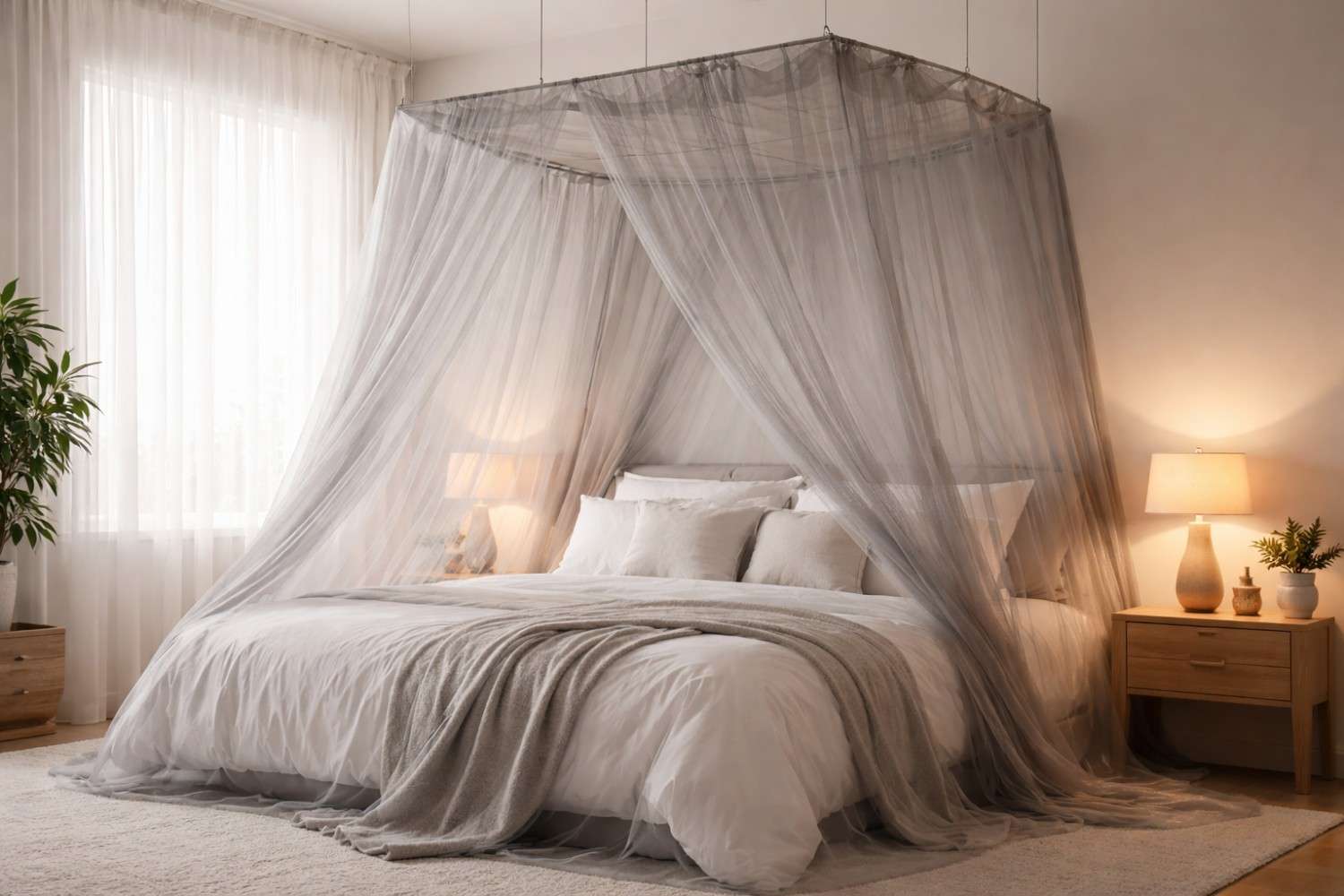
Bedrooms used to be the safest room in the house. For most of human history, sleep happened in near‑complete electrical silence. Today, however, the modern bedroom is filled with invisible signals. WiFi routers operate through walls, cell towers transmit continuously outside our homes, smart meters pulse from neighboring buildings, and phones often sit charging just inches from the bed. For people who care about long‑term health, recovery, and deep sleep, this new environment has raised an important question: can an emf bed canopy for sleep meaningfully reduce nighttime radiation exposure?
Interest in shielding sleep environments has grown rapidly in recent years. Many people report poor sleep, nighttime restlessness, headaches, or heightened sensitivity when surrounded by wireless signals. At the same time, awareness of electromagnetic fields and their biological interactions has expanded. This has led to the rise of EMF bed canopies – fabric enclosures designed to surround the sleeping area and block radiofrequency radiation during the most vulnerable hours of the day.
This guide takes a detailed, practical, and science‑based look at EMF bed canopies. You will learn how they work, what types of radiation they block, when they make sense, how effective they really are, and which models provide reliable shielding. The goal is not to promote fear, but to provide clear information so you can decide whether an emf bed canopy for sleep is an appropriate solution for your home and your health.
Why EMF Exposure at Night Matters More Than You Think
Sleep is the most sensitive window of the day for neurological recovery and hormonal regulation. During deep sleep, the brain performs critical maintenance processes that depend heavily on stable electrical signaling within the nervous system. Melatonin production increases, cellular repair accelerates, and stress hormones decline. When external electromagnetic fields remain present throughout the night, they can interfere with these delicate processes in subtle ways.
Nighttime exposure is different from daytime exposure for several reasons. First, the body is stationary for long periods. A phone or router that might be several feet away during the day can remain within a fixed distance for eight continuous hours at night. Second, the nervous system becomes more electrically sensitive during sleep cycles, especially during REM and deep slow‑wave sleep. Third, many people unknowingly sleep very close to sources such as smart meters mounted on bedroom walls, neighboring routers in apartments, or outdoor cell infrastructure.
Research on low‑level radiofrequency exposure continues to evolve, but several consistent observations appear in the literature. RF exposure can suppress melatonin secretion, alter sleep architecture, and affect autonomic nervous system balance in sensitive individuals. While the intensity of household EMF is far below acute injury thresholds, long‑duration nighttime exposure is precisely the pattern that raises long‑term biological questions.
What Is an EMF Bed Canopy and How Does It Work?
An EMF bed canopy is a fabric enclosure designed to surround the sleeping area and reduce incoming radiofrequency radiation. The fabric itself is woven with conductive materials such as silver, copper, or stainless steel fibers. These conductive threads create a continuous electrical surface that reflects and absorbs incoming electromagnetic waves before they reach the body.
The principle behind this design is simple. When an electromagnetic wave encounters a conductive surface, most of its energy is reflected or dissipated rather than transmitted. When the conductive material fully encloses the sleeping space, it functions similarly to a partial Faraday enclosure. This does not block all electromagnetic fields, but it can dramatically reduce radiofrequency exposure from WiFi routers, cell phones, Bluetooth devices, and nearby base stations.
Most modern canopies are designed primarily to attenuate radiofrequency radiation, which includes frequencies used by WiFi, cellular networks, cordless phones, and smart home devices. Some fabrics also reduce electric fields from household wiring, although magnetic fields from nearby transformers or motors are more difficult to block with fabric alone.
The effectiveness of a canopy depends on several factors: the conductivity of the fabric, the completeness of the enclosure, the presence of gaps or openings, grounding configuration, and the direction and strength of the incoming radiation. High‑quality canopies are laboratory tested and provide measurable attenuation across a wide range of frequencies.
Does an EMF Bed Canopy Actually Work?
This is the most important question to answer honestly. An EMF bed canopy does not eliminate all electromagnetic exposure, but when properly designed and installed, it can significantly reduce radiofrequency radiation inside the sleeping area.
Laboratory testing typically reports attenuation values in decibels. A reduction of 20 dB corresponds to roughly a 99 percent reduction in power density. Higher quality fabrics often achieve 40 to 60 dB attenuation, which represents reductions of 99.99 percent or more at targeted frequencies. In real bedrooms, reductions vary depending on signal sources and geometry, but properly installed full enclosures often achieve meaningful reductions across common wireless bands.
Real‑world effectiveness depends heavily on enclosure completeness. Partial curtains, headboard shields, or single‑panel barriers provide limited benefit because radiation can still enter from uncovered sides. Full 360‑degree enclosures that extend beneath the mattress perform much better by limiting leakage paths.
Grounding is another important factor. Some canopies are designed to be grounded to reduce electric field accumulation and static charge. Grounding can improve electric field reduction but is not strictly necessary for RF attenuation. Many users choose ungrounded installations to avoid introducing wiring currents into the sleeping area.
When used appropriately, an emf bed canopy for sleep can reduce nighttime RF exposure by an order of magnitude or more. This level of reduction is often sufficient to improve subjective sleep quality in sensitive individuals and significantly lower long‑term cumulative exposure.
When an EMF Bed Canopy Makes Sense – and When It Does Not
Not every bedroom requires shielding, and not every person benefits equally. EMF canopies make the most sense in specific environments and situations.
They are particularly useful in apartments and condominiums where multiple routers, access points, and smart meters operate nearby. Bedrooms located close to exterior walls facing cell towers or rooftop antennas often experience elevated RF levels that are difficult to mitigate through distance alone. People who use smart home systems, mesh WiFi networks, or keep phones near the bed may also benefit from targeted nighttime shielding.
Canopies are also helpful for individuals who identify as electrically sensitive or who notice clear sleep disruption associated with wireless exposure. Even modest reductions can provide relief in these cases.
On the other hand, in detached homes with routers located far from bedrooms, minimal nighttime device use, and low measured RF levels, simpler strategies such as increasing distance, relocating routers, and disabling wireless functions at night may achieve sufficient reduction without a canopy.
Shielding should always complement, not replace, basic exposure reduction habits.
Affiliate Advertisement

Best EMF Bed Canopies for Sleep
Selecting an effective canopy requires attention to fabric quality, enclosure design, testing data, and durability. Among manufacturers, Safe Living Technologies stands out for laboratory‑verified performance and long‑term reliability.
It is important important to understand what separates high‑quality shielding products from decorative alternatives. True shielding canopies use densely woven conductive fabric, provide full enclosure geometry, publish attenuation curves across frequency ranges, and maintain conductivity after repeated washing. Without these features, shielding performance may degrade rapidly or never reach meaningful levels.
Safe Living Technologies EMF bed canopies are typically handmade full-bed enclosures built using Swiss Shield RF shielding fabrics. They offer multiple fabric options – including natural cotton (Naturell), ultra-high attenuation cotton blends (Ventus), and lightweight breathable mesh (Daylite) – allowing users to balance comfort, airflow, and shielding strength. These canopies are usually ceiling-mounted and designed to reduce RF and microwave exposure around the sleeping area, often paired with floor shielding sheets and RF meters for full sleep-space protection.
Click here for all to view all Safe Living Technologies EMF bed canopies.
Affiliate Advertisement
How to Install an EMF Bed Canopy Correctly
Installation quality determines much of a canopy’s performance. Even the best fabric cannot provide full protection if gaps remain or coverage is inconsistent.
Begin by selecting a mounting method that allows the canopy to drape evenly around the bed. Ceiling hooks provide the most stable support and allow precise centering. Adjustable frames offer flexibility for renters or temporary setups. The fabric should extend beyond all sides of the mattress and tuck underneath to minimize openings at floor level.
Pay close attention to overlaps where fabric panels meet. Overlapping seams maintain electrical continuity and prevent leakage paths. Avoid leaving corners open or folded in ways that create exposed channels for incoming radiation.
Grounding is optional and should be approached carefully. If grounding is used, connect only to verified building earth points using supplied cables. Improper grounding can introduce unwanted electrical noise. Many installations perform effectively without grounding by relying solely on conductive reflection.
Regular inspection ensures long‑term performance. Washing should follow manufacturer instructions to preserve fiber conductivity.
How Much EMF Reduction Can You Expect?
Reduction levels vary widely depending on source strength, geometry, and fabric quality. In well‑designed installations, reductions of 90 to 99.99 percent are common for radiofrequency exposure. Measured power densities inside the canopy often fall close to background environmental levels even in high‑signal areas.
Magnetic fields from nearby transformers or motors are more difficult to attenuate, and no fabric canopy fully blocks them. However, these sources are less common in typical bedrooms. For WiFi, cellular, and smart device exposure, canopies remain one of the most effective passive protection tools available.
Are EMF Bed Canopies Safe to Sleep In?
High‑quality canopies are breathable and designed to allow adequate airflow. Temperature retention is minimal with modern fabrics, and most users adapt quickly to the enclosed environment. There is no evidence that properly manufactured shielding fabrics create harmful field concentrations or reflections inside the enclosure.
Psychological comfort matters as well. Some users prefer partially open designs for visual space, while others appreciate full enclosure for light reduction and sensory isolation. Individual preference plays an important role in long‑term satisfaction.
Conclusion
Modern bedrooms are no longer electrically quiet spaces, and long‑duration nighttime exposure is increasingly recognized as a meaningful component of total EMF load. For people who live in high‑signal environments, use wireless technology extensively, or notice sleep disruption associated with radiation exposure, an emf bed canopy for sleep offers a practical and scientifically grounded solution.
When properly selected and installed, these canopies can reduce radiofrequency exposure by orders of magnitude, providing a calmer electromagnetic environment during the body’s most critical recovery period. They are not necessary for every home, and they should always complement simple reduction strategies such as distancing devices and disabling wireless functions at night. But for the right situation, they represent one of the most effective passive shielding tools available.
Before You Go…
Get Weekly EMF Protection Tips
Enjoy this article? Join the EMFLuLu newsletter for simple weekly tips to reduce everyday EMF exposure from phones, WiFi routers, laptops, and smart home devices.
Try Our Free EMF Calculators
Curious how much EMF exposure you may experience each day?
These simple tools can help you estimate your exposure and identify possible problem areas in your home.
Try these free calculators:
Like this article? Pin it on Pinterest!
More to Explore


