
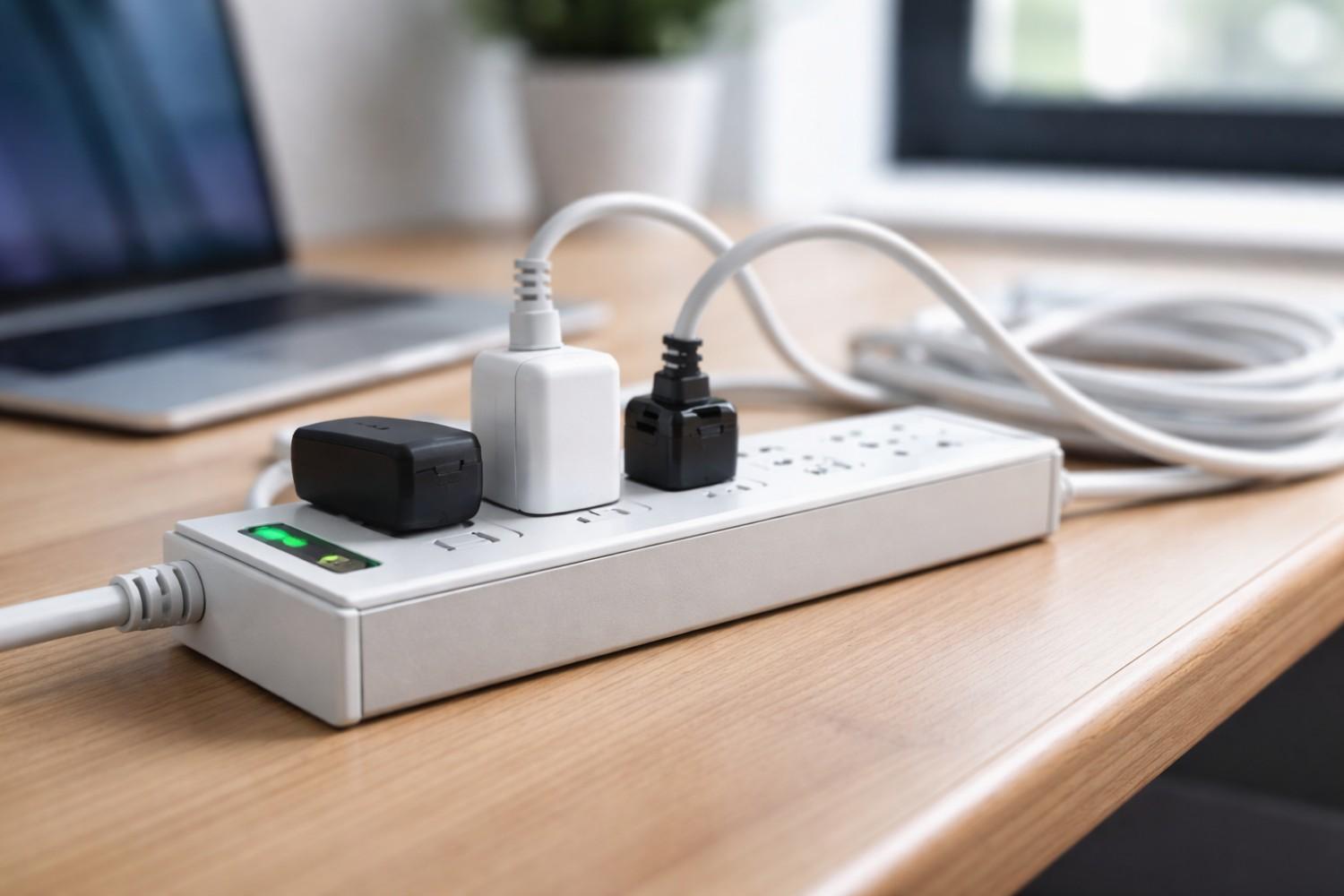
Power strips are in almost every home. They sit under desks, behind entertainment centers, beside beds, and in home offices powering computers, monitors, routers, and chargers. As awareness of electromagnetic fields (EMF) grows, many people begin to wonder: do power strips emit EMF radiation, and if they do, should we be concerned?
It’s a fair question. Power strips concentrate multiple electrical connections into one compact device, often positioned close to where we sit or sleep. That combination can understandably raise questions about exposure levels. The good news is that the answer is more nuanced than many online discussions suggest. Power strips do produce electromagnetic fields, but understanding what type, how strong, and under what conditions makes all the difference.
This article will walk you through what actually happens electrically inside a power strip, when EMF levels may increase, whether specialty “low EMF” power strips make sense, and what practical steps matter most. The goal here is clarity, not hype.
Understanding the Type of EMF Power Strips Produce
Before evaluating risk, it’s important to understand what kind of EMF a power strip can generate. Not all electromagnetic fields are the same.
Power strips operate using standard household alternating current (AC), typically 60 Hz in North America. That means they produce extremely low frequency (ELF) electromagnetic fields, not radiofrequency (RF) radiation like WiFi routers or cell phones.
There are two primary components involved:
First, electric fields. These are produced whenever voltage is present in a wire, even if no device is drawing power. If a power strip is plugged into the wall, there is voltage present along the internal wiring, which means a measurable electric field exists.
Second, magnetic fields. These are produced when current flows. If devices are plugged in and actively drawing power, the moving current generates a magnetic field around the conductors.
So when people ask, do power strips emit EMF radiation, the technically correct answer is yes – but primarily in the form of low-frequency electric and magnetic fields, not high-frequency wireless radiation.
This distinction is critical because many online articles blur the difference and imply that power strips emit WiFi-type radiation. They do not.
When Can EMF Levels Around Power Strips Increase?
In most homes, EMF levels around power strips are relatively low. However, certain conditions can increase exposure.
To understand when that might happen, it helps to consider how power strips are commonly used. They are often placed directly beneath a desk where legs rest, tucked against a nightstand near a bed, or positioned behind a couch where someone sits for hours. Proximity plays a significant role in measured field strength because EMF intensity decreases rapidly with distance.
Magnetic fields increase when higher current flows through the strip. Devices such as space heaters, large printers, gaming computers, or multiple monitors can increase the current load and therefore raise magnetic field strength around the strip’s wiring.
Another factor involves coiled cords. When extension cords or excess cable length are tightly coiled, the configuration can influence localized magnetic field measurements. Keeping cords neatly arranged is fine, but tightly wrapping active cords into tight coils is not ideal.
Older homes with poor grounding may also exhibit stray voltage or higher electric field readings. In these cases, the issue is less about the strip itself and more about the electrical infrastructure.
So while the question do power strips emit EMF radiation has a straightforward answer, the real-world exposure level depends heavily on placement, load, and wiring quality.
Does a “Low EMF” Power Strip Actually Reduce EMF?
The market now includes products advertised as shielded or grounded power strips designed to reduce EMF exposure. To evaluate whether they work, it’s important to understand what they are designed to address.
Electric fields can be reduced through shielding. A grounded metal housing surrounding internal wiring can help reduce the electric field emitted outward. Proper grounding allows stray electric fields to dissipate safely.
Magnetic fields are more difficult to shield. They are produced by current flow and are not easily blocked by simple casing. Reducing magnetic fields typically requires design considerations such as tightly paired or twisted conductors, which help cancel opposing magnetic fields.
One example often referenced is the Safe Living Technologies Shielded Grounded Power Strip.
This model uses a metal housing and grounded shielding intended to reduce electric field exposure from the strip’s internal wiring. It is designed particularly for desk environments where the strip may sit close to legs or torso.
It is important to understand what such a product can realistically do. It may reduce electric field measurements near the strip. It does not eliminate magnetic fields generated by high current loads. If someone plugs in a space heater drawing significant amperage, the magnetic field will still be present.
So, do power strips emit EMF radiation in a way that requires specialty products? For most households, increasing distance is often more impactful than upgrading the strip itself. However, for individuals who sit very close to a strip for extended periods, shielded designs may offer measurable electric field reduction.
Affiliate Advertisement

When Might It Make Sense to Upgrade Your Power Strip?
Not everyone needs a specialty strip. In fact, most homes function safely with standard grounded power strips.
However, there are certain scenarios where upgrading may be reasonable. Individuals who work long hours at a desk with the strip directly beneath their legs may want to measure their environment. People who are particularly sensitive to electric fields, or who simply prefer precautionary approaches, might consider improvements if measurements show elevated readings.
Before purchasing anything, measurement provides clarity. Guessing often leads to unnecessary expense or worry. A reliable meter allows you to determine whether electric or magnetic fields are elevated in your specific environment.
Safe Living Technologies offers professional-grade meters here.
Using a meter first allows you to see whether a change in placement alone resolves the issue. Many times, moving the strip just a foot or two farther away dramatically reduces measured field strength.
Practical Ways to Reduce EMF From Power Strips Without Buying Anything
Before assuming that a special product is required, it’s helpful to look at practical adjustments that often produce greater results than hardware changes.
Distance is one of the most powerful tools available. Electromagnetic field strength decreases rapidly as you move away from the source. Simply relocating a power strip from directly under your legs to the side of your desk can significantly lower exposure.
Avoid tightly coiling active cords. Keeping cords organized is fine, but tightly wound loops around a power strip carrying current are not ideal.
Separate high-current devices from low-current workstations. Plugging a space heater or large appliance into a dedicated wall outlet rather than your desk strip can reduce localized magnetic fields.
Turn off the strip when not in use. While electric fields exist when voltage is present, turning off a switched strip reduces active current flow and eliminates magnetic fields.
Ensure proper grounding. A grounded outlet and properly wired home make a substantial difference in electric field behavior.
These simple steps often address concerns more effectively than purchasing specialty equipment.
Affiliate Advertisement

What About EMF Blocking or Harmonizing Devices?
Some companies approach EMF mitigation differently. Instead of shielding or grounding, they focus on harmonizing or altering the biological interaction of EMF exposure.
For example, EMF-Harmony offers products designed around bioenergetic harmonization principles. These operate on a different theoretical model than physical shielding and grounding.
Similarly, some companies produce protective laptop pads or device shields such as those from DefenderShield.
These are primarily intended for reducing radiofrequency exposure from wireless devices rather than low-frequency fields from power strips.
It’s important to distinguish between product categories. A power strip primarily produces low-frequency electric and magnetic fields. Laptop shields or phone shields address radiofrequency radiation. Understanding the difference prevents mismatched expectations.
Are Low EMF Power Strips Worth It?
After reviewing the science and practical considerations, the answer depends on context.
If a power strip is located several feet away from where you sit or sleep, exposure levels are typically minimal. In those cases, layout adjustments are often sufficient.
If a strip sits inches from your body for eight hours per day, and measurements show elevated electric fields, a shielded grounded strip may offer some benefit.
If you are concerned about magnetic fields from high-current loads, the more effective solution is separating heavy appliances rather than replacing the strip.
The key takeaway is that while the question do power strips emit EMF radiation can sound alarming, the magnitude and type of field matter far more than the existence of a field alone.
Final Thoughts
So, do power strips emit EMF radiation? Yes, they emit low-frequency electric and magnetic fields associated with standard household electricity. They do not emit WiFi-type radiation unless a wireless device is built into them.
For most households, simple adjustments such as increasing distance, separating high-current devices, and ensuring proper grounding provide meaningful reductions. Specialty shielded strips may reduce electric field exposure in close-proximity setups, but they are not universally necessary.
As with most EMF topics, understanding the source, measuring intelligently, and making calm, practical decisions lead to the best outcomes. In many cases, thoughtful placement is more powerful than product replacement.
Like this article? Pin it on Pinterest!

More to Explore


