Take a moment to think about how many devices are active around you right now. Your phone may be within arm’s reach, your WiFi router is quietly transmitting signals, and multiple electronics are likely running in the background. Modern homes are filled with technology, and with that convenience comes exposure to electromagnetic fields, often referred to as EMF. This naturally leads to an important question many people are starting to ask: where is EMF highest in your home?
Understanding where EMF is strongest is not about fear – it’s about awareness. Some areas of your home expose you to more EMF than others, and often it’s not the places you would expect. The goal of this guide is to walk you through your home room by room, identify where exposure tends to be highest, and show you simple ways to reduce it without disrupting your daily life.
By the end of this article, you’ll have a much clearer picture of how EMF moves through your home and what small adjustments can make a meaningful difference.
What Is EMF? A Simple Explanation
Before breaking down each room, it helps to understand what EMF actually is. EMF stands for electromagnetic fields, which are invisible areas of energy produced by electrical devices and wireless signals. These fields fall into two broad categories.
Low-frequency EMFs are generated by things like wiring inside your walls, power lines, and household appliances. These are present anytime electricity is flowing. Radiofrequency EMFs come from wireless technologies such as WiFi routers, smartphones, Bluetooth devices, and smart home systems.
Both types exist in your home at all times, but the intensity varies depending on proximity, usage, and the number of devices in one location. That variation is what makes a room-by-room breakdown so useful.
Where Is EMF Highest in Your Home? A Quick Overview
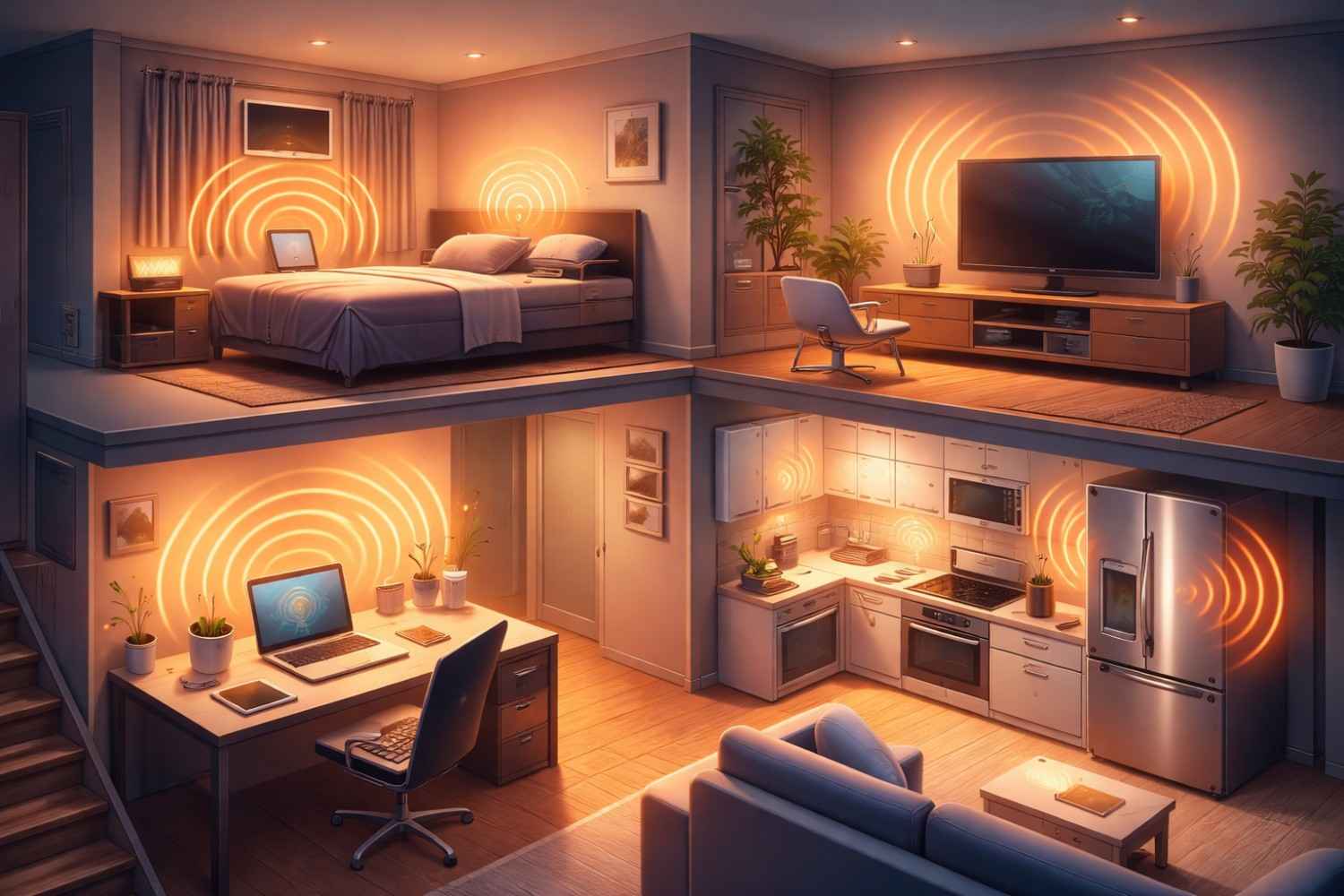
Not every room in your home carries the same level of EMF exposure. Some areas act as hotspots simply because of how often devices are used there or how many signals are concentrated in one place. If you’re wondering where EMF is highest in your home, the answer usually comes down to three factors: how many devices are present, how close you are to them, and how long you spend in that environment.
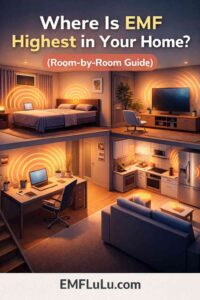
Rooms like home offices and living rooms often produce the highest EMF levels during the day because of heavy device usage. Bedrooms can quietly become high-exposure areas as well, especially overnight when devices remain close to your body for long periods. Kitchens tend to have bursts of EMF when appliances are in use, while other areas like bathrooms typically remain lower due to shorter exposure times.
Now let’s walk through each room in detail.
Bedroom: The Most Important Room to Evaluate
The bedroom may not always have the highest peak EMF levels, but it is often the most important room to focus on. This is where you spend several uninterrupted hours every night, which makes long-term exposure more relevant here than anywhere else in your home.
Most people keep their phone on a nightstand, often charging just inches from their head. In addition, WiFi routers are sometimes placed in nearby rooms or even inside the bedroom itself. Smart alarms, Bluetooth headphones, and other small devices can quietly add to the overall exposure.
This matters because your body is in a resting state during sleep, and even small environmental factors can influence sleep quality. While research is still evolving, many people choose to reduce EMF exposure in the bedroom simply because it is one of the easiest areas to control.
There are several simple adjustments that can make a noticeable difference. Moving your phone a few feet away from your bed or switching it to airplane mode at night immediately reduces direct exposure. Keeping the WiFi router outside the bedroom is another effective step. If you prefer to keep your phone nearby, using a protective case can help limit the amount of radiation reaching you.
One option some people consider is a DefenderShield EMF Blocking Phone Case. This type of case is designed to reduce exposure from one side of the phone, which can be helpful when the device is close to your body for extended periods.
Living Room: A Central EMF Hub
The living room is often one of the most active areas in the home, and because of that, it can quickly become an EMF hotspot. This is where WiFi routers are frequently placed to provide strong coverage throughout the house. Smart TVs, streaming devices, gaming consoles, and wireless speakers all contribute to a steady flow of signals.
Unlike the bedroom, exposure here is usually more intermittent, but it can still be significant due to the number of devices operating at the same time. The closer you are to these devices, the higher your exposure tends to be.
One of the most effective ways to reduce EMF in the living room is to create a little distance between yourself and the main signal sources. For example, placing the router farther away from seating areas can lower your exposure without affecting performance. Turning off WiFi overnight or during long periods when it’s not needed can also make a difference.
Using wired connections for streaming or gaming devices is another practical step that reduces wireless signals without sacrificing functionality.
Home Office: Often the Highest EMF Area
If there is one room that consistently ranks at the top when asking where EMF is highest in your home, it is the home office. This is especially true for anyone who works remotely or spends several hours a day on a computer.
In a typical home office setup, you may have a laptop or desktop computer, a monitor, a smartphone, Bluetooth accessories, and a WiFi connection all operating at once. Because these devices are used at close range and for long periods, the exposure here can be both intense and continuous.
Reducing EMF in this space doesn’t require major changes. Simply keeping your laptop on a desk rather than on your lap creates distance between you and the device. Turning off Bluetooth when it’s not needed cuts down on unnecessary signals. Using wired accessories, such as a keyboard or mouse, can further reduce wireless exposure.
Some people also choose to use shielding accessories for added protection. For example, the DefenderShield Laptop Radiation Shield. This type of product is designed to sit between your body and your device, helping to limit exposure during extended work sessions.
Affiliate Advertisement

Kitchen: Short Bursts of Higher EMF
The kitchen is a unique space because EMF exposure tends to come in short bursts rather than constant levels. Appliances like microwaves, refrigerators, and induction cooktops generate EMF when in use, sometimes at higher levels than other household devices.
However, because most people are not standing directly next to these appliances for long periods, overall exposure is usually moderate. The key here is awareness rather than concern.
A simple habit like stepping a few feet away while the microwave is running can reduce exposure without requiring any effort. Avoiding direct contact with large appliances while they are active is another easy adjustment. Smart kitchen devices, if present, can also contribute to background signals, so limiting unnecessary wireless features can help keep levels lower.
Kids’ Room: An Overlooked Area
Children’s rooms are often overlooked when discussing EMF, but they can contain several hidden sources. Tablets, gaming devices, and wireless toys are common, along with baby monitors that continuously transmit signals.
Because children’s bodies are still developing, many parents prefer to take a cautious approach when it comes to exposure. The goal is not to eliminate technology, but to manage how and where it is used.
Keeping devices away from the bed is one of the simplest and most effective changes. Reducing nighttime exposure by turning off unnecessary electronics can also help. In the case of baby monitors, some families explore lower-emission options or wired alternatives.
Bathroom: Lower Overall Exposure
The bathroom typically has lower EMF levels compared to other areas of the home. Most devices here, such as hair dryers or electric toothbrushes, are used for short periods, which limits overall exposure.
While these devices do produce EMF when in use, the brief duration makes this room less of a priority when trying to reduce exposure throughout the home.
Which Room Has the Highest EMF Overall?
After looking at each area, a clear pattern starts to emerge. The rooms with the highest EMF levels are usually the ones where devices are both concentrated and used for long periods.
During the day, the home office often produces the highest exposure due to constant, close-range device use. The living room can also rank high because of multiple wireless systems running simultaneously. At night, the bedroom becomes especially important because of the length of exposure, even if the intensity is lower.
So when people ask where EMF is highest in your home, the answer is not always a single room. It is more accurate to say that the highest exposure occurs wherever devices are closest to you and used the longest.
A Simple Whole-Home Approach to Reducing EMF
Reducing EMF exposure across your home does not require drastic changes. Small adjustments, when combined, can create a noticeable difference over time.
One of the most effective habits is turning off WiFi at night, especially if your router is close to sleeping areas. Keeping devices away from your body whenever possible reduces direct exposure. Using airplane mode on your phone when you don’t need connectivity is another simple step that many people overlook.
Limiting unnecessary wireless signals, such as leaving Bluetooth on all day, can also help reduce overall exposure. These changes are easy to implement and do not interfere with how you use your devices.
Conclusion
Modern homes are filled with technology, and EMF exposure is a natural part of that environment. The key is understanding how it varies from room to room and making small adjustments where it matters most. By identifying where EMF is highest in your home, you can focus your efforts on the areas that have the greatest impact, such as your bedroom, home office, and living room.
The goal is not to eliminate EMF entirely, but to create a more balanced environment. Even simple changes like moving your phone away from your bed or reducing unnecessary wireless signals can make a difference over time. Once you understand where EMF is highest in your home, you are in a much better position to take control of your exposure in a practical and manageable way.
Before You Go…
Get Weekly EMF Protection Tips
Enjoy this article? Join the EMFLuLu newsletter for simple weekly tips to reduce everyday EMF exposure from phones, WiFi routers, laptops, and smart home devices.
Try Our Free EMF Calculators
Curious how much EMF exposure you may experience each day?
These simple tools can help you estimate your exposure and identify possible problem areas in your home.
Try these free calculators:
Like this article? Pin it on Pinterest!

More to Explore