Wireless technology is now woven into nearly every part of daily life. Smartphones stay within arm’s reach, laptops rest on laps for hours at a time, and WiFi routers transmit signals around the clock. As awareness grows around environmental exposures, more people are asking a practical and important question: do EMF protection blankets really work for radiation protection?
EMF shielding blankets are marketed as tools that can reduce exposure to radiofrequency (RF) radiation emitted from devices like phones, tablets, and laptops. Some individuals use them while working, others while relaxing at home, and some even incorporate them into nighttime routines. Yet skepticism remains. Are these blankets legitimate protective tools grounded in physics, or are they simply comfort products with clever marketing?
To answer that properly, we need to understand how EMF radiation works, how shielding materials function, what the scientific literature suggests, and what realistic expectations should look like. The goal of this article is not to exaggerate claims, but to provide a clear, evidence-based explanation so readers can make informed decisions.
Understanding What EMF Radiation Actually Is
Before evaluating shielding blankets, it helps to clarify what type of radiation we are discussing. The electromagnetic spectrum includes many forms of energy, ranging from extremely low frequency fields produced by electrical wiring to higher frequency radiofrequency radiation emitted by wireless devices.
Cell phones, WiFi routers, Bluetooth devices, and laptops primarily emit non-ionizing radiofrequency radiation. Non-ionizing means it does not have enough energy to break chemical bonds or directly damage DNA the way X-rays or gamma rays can. That distinction is important because it frames the level of biological concern.
However, non-ionizing radiation can still interact with biological tissue in other ways, primarily through heating effects and possible influences on cellular signaling. The scientific community continues to study long-term exposure patterns, particularly as wireless usage increases.
When people ask whether shielding blankets are effective, they are typically referring to RF radiation from close-contact device use.
How EMF Protection Blankets Are Designed to Work
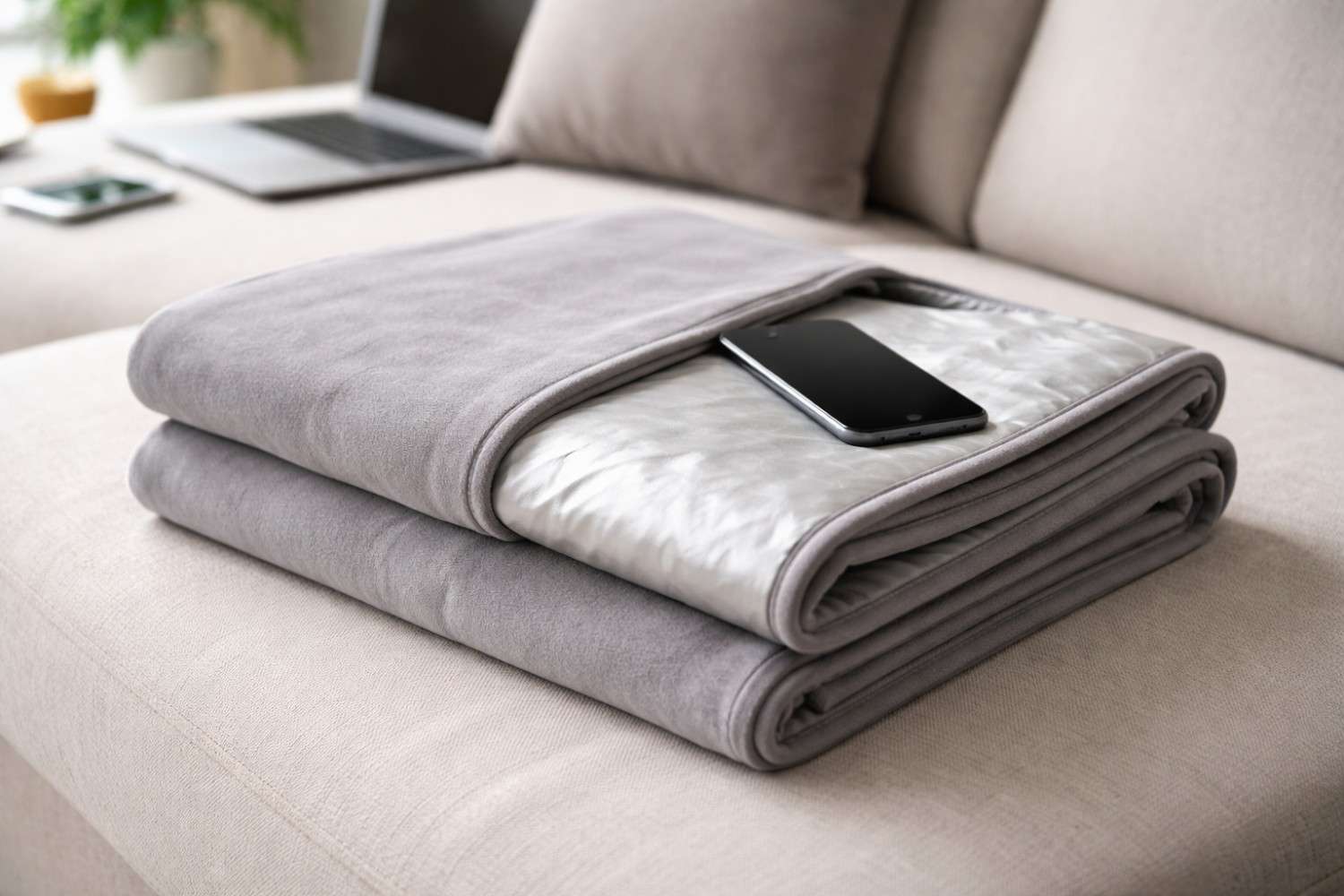
EMF protection blankets are typically constructed using conductive materials such as silver, copper, stainless steel fibers, or specialized metallic fabrics woven into the textile. These materials are chosen because conductive surfaces can reflect or redirect electromagnetic waves.
The principle behind these blankets is based on shielding physics similar to a Faraday cage. When electromagnetic waves encounter conductive material, a portion of that energy can be reflected, absorbed, or redirected away from the body.
For example, if a laptop is placed directly on the lap, the RF radiation emitted from its internal antennas may travel toward the torso. Placing a shielding blanket between the device and the body can reduce the amount of radiation that passes through to the user.
One example is the DefenderShield EMF Protection Blanket. This product incorporates multiple shielding layers designed to block RF radiation when positioned properly between the body and a device.
Safe Living Technologies also offers shielding clothing and fabrics, which use similar conductive textile technology. Understanding this shielding mechanism helps frame the larger question: do EMF protection blankets really work for radiation protection in real-world conditions?
What Types of Radiation Can EMF Blankets Reduce?
To answer that question accurately, it is important to clarify what these blankets can and cannot do. EMF blankets are designed primarily to reduce exposure to radiofrequency radiation from nearby wireless devices.
They may help reduce exposure from:
- Cell phones placed against the body.
- Laptops used directly on the lap.
- Tablets used while resting on the abdomen.
- Portable WiFi hotspots placed nearby.
They are not designed to block:
- Radiation already absorbed into the body.
- Extremely low frequency magnetic fields from power lines.
- Whole-room ambient exposure coming from multiple directions.
Shielding is directional. The blanket must be positioned between the radiation source and the body for it to provide meaningful reduction. If radiation is coming from behind or from multiple surrounding sources, the blanket will not create total isolation.
This directional limitation is important because it sets realistic expectations. EMF blankets reduce exposure in specific situations; they do not eliminate environmental radiation entirely.
What Does Testing Say About Shielding Effectiveness?
Most reputable EMF shielding products are tested for attenuation levels. Attenuation refers to how much a material reduces signal strength, typically measured in decibels (dB). A reduction of 20 dB corresponds to about a 99 percent reduction in signal strength under laboratory conditions.
Manufacturers such as DefenderShield state that their products are independently tested to block a high percentage of RF radiation when used properly. The DefenderShield EMF Protection Blanket is marketed as blocking up to 99 percent of RF radiation from 0 to 10 GHz when positioned correctly.
Safe Living Technologies, which specializes in professional-grade shielding materials, also provides attenuation data for their fabrics and clothing products.
Laboratory testing conditions are controlled. Real-world effectiveness depends on positioning, device output power, frequency range, and surrounding environmental signals. That nuance matters when evaluating whether EMF blankets perform as expected in daily life.
Affiliate Advertisement
Situations Where EMF Protection Blankets May Be Most Useful
To understand practical value, it helps to examine specific use scenarios rather than broad claims. There are certain situations where shielding blankets may provide the greatest benefit.
First, laptop use directly on the lap is one of the most common applications. Laptops contain internal WiFi antennas that transmit continuously when connected. Placing a shielding layer between the device and the body can reduce direct exposure to the lower abdomen and reproductive organs.
Second, extended tablet or phone use while resting devices against the torso may warrant shielding for individuals who prefer additional protection.
Third, people working remotely for long hours with wireless devices may use shielding fabrics to reduce cumulative close-contact exposure.
Fourth, individuals who consider themselves electromagnetically sensitive sometimes report symptom improvement when reducing direct exposure. While EMF sensitivity remains debated in scientific literature, exposure reduction may provide subjective comfort for some users.
In these targeted scenarios, the question “do EMF protection blankets really work for radiation protection” becomes more context-specific. When used properly as a barrier between the device and the body, they can reduce measured RF levels on the shielded side.
When EMF Blankets May Not Be Necessary
It is equally important to discuss situations where shielding blankets may offer limited benefit. If devices are already used at a distance, such as placing a laptop on a desk or using speaker mode on a phone, exposure drops significantly due to the inverse square law. Distance reduces radiation intensity quickly.
If a WiFi router is located across the room, placing a shielding blanket over the body may not significantly change overall exposure from multiple directions.
Simple behavioral adjustments can often reduce exposure without specialized products. These include increasing device distance, turning off wireless functions when not in use, and avoiding carrying active phones directly against the body.
Affiliate Advertisement

Addressing Common Concerns About Shielding Products
Some critics argue that shielding products create a false sense of security. That concern usually stems from misunderstanding how shielding works. Blankets do not “absorb radiation into the body,” nor do they increase emission from devices under typical use. They function as passive conductive barriers.
Another concern is overheating. Most reputable shielding blankets are designed with breathable outer fabrics so they can be used comfortably while working or relaxing.
Some users also worry whether shielding interferes with device function. If the shielding layer completely surrounds a device, signal strength may decrease. When used between the body and the device while leaving the outer side exposed, devices typically maintain connection.
So, Do EMF Protection Blankets Really Work for Radiation Protection?
When the question is examined through physics rather than marketing, the answer becomes clearer. Conductive materials can reduce RF radiation passing through them. Laboratory testing supports measurable attenuation.
Therefore, when positioned correctly between a radiation source and the body, EMF shielding blankets can reduce exposure on the protected side. That does not mean they eliminate all environmental EMFs, nor does it imply medical benefits. It simply means they perform as directional barriers.
The more appropriate question may be whether the reduction is meaningful for an individual’s personal comfort or precautionary goals.
A Reasonable Perspective on Risk and Reduction
Scientific consensus has not established definitive harm from everyday consumer-level RF exposure. Major health organizations continue to monitor research, and guidelines remain in place to limit thermal effects.
At the same time, some individuals prefer to take precautionary steps, particularly with close-contact device use. Using shielding blankets is one option within a broader strategy that may include limiting nighttime device use, increasing distance, and reducing unnecessary wireless exposure.
Products such as the DefenderShield EMF Protection Blanket and shielding fabrics from Safe Living Technologies offer tools for those who prefer added barriers during device use.
The decision to use them should be personal, informed, and free from fear-based messaging.
Conclusion
As wireless technology continues to expand, curiosity about exposure reduction tools is understandable. When asking do EMF protection blankets really work for radiation protection, the evidence shows that properly designed conductive blankets can reduce radiofrequency radiation passing through them when positioned between the body and a device.
They are not magic shields, nor are they medical devices. They are directional barriers grounded in well-established electromagnetic principles. For individuals who want to reduce close-contact exposure, they can serve a practical purpose when used appropriately.
Ultimately, thoughtful device habits, increased distance, and balanced perspective remain foundational. Shielding blankets are simply one option within that larger approach.
Before You Go…
Get Weekly EMF Protection Tips
Enjoy this article? Join the EMFLuLu newsletter for simple weekly tips to reduce everyday EMF exposure from phones, WiFi routers, laptops, and smart home devices.
Try Our Free EMF Calculators
Curious how much EMF exposure you may experience each day?
These simple tools can help you estimate your exposure and identify possible problem areas in your home.
Try these free calculators:
Like this article? Pin it on Pinterest!

More to Explore