Induction cooking has become one of the fastest-growing kitchen trends thanks to its speed, efficiency, and sleek design. But along with its popularity, a new question has taken center stage: how much EMF exposure comes from induction cooktops? This question is especially important for people who are EMF-sensitive, those who are expecting, families with young children, and anyone trying to make conscious choices about the technologies they bring into their home.
While induction cooktops are often marketed as “safer” than gas or traditional electric stoves, the science behind their electromagnetic fields (EMF) is not always well understood. In this comprehensive guide, we’ll break down how induction cooktops work, what types of EMF they emit, how much exposure occurs at different distances, and what peer-reviewed studies actually say about potential health impacts.
This article is written to give you a balanced, science-based, deeply detailed look at induction cooktop EMF exposure, and provide real-world solutions you can implement starting today.
How Induction Cooktops Generate EMF (and Why It Matters)
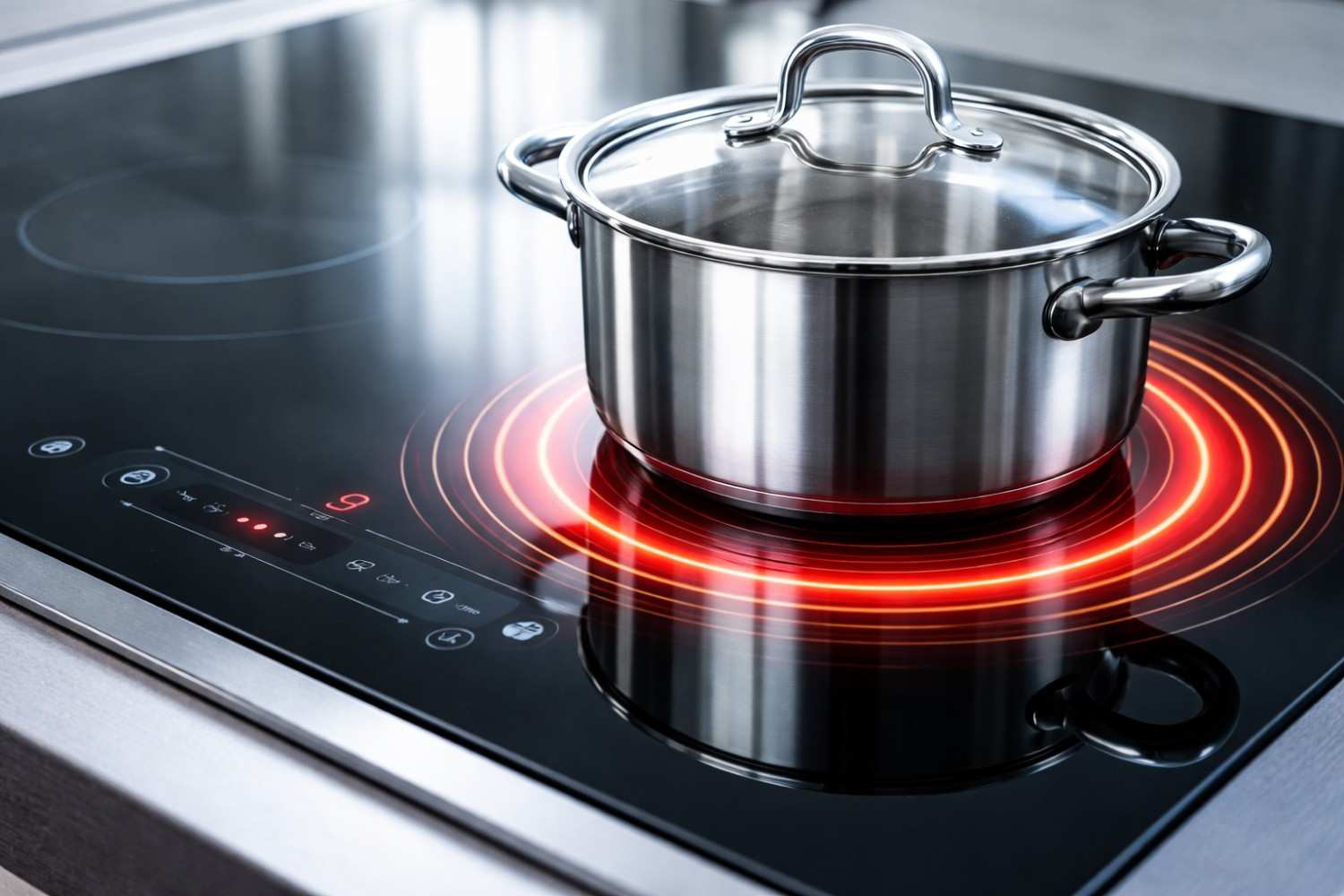
Induction cooking relies on electromagnetic principles – specifically, magnetic fields oscillating between 20 kHz and 60 kHz. Under the ceramic-glass cooktop is a copper coil. When electricity flows through this coil, it creates a rapidly changing magnetic field. That magnetic field then transfers energy directly into your cookware by vibrating the metal at high speed, generating heat inside the pan itself rather than on the cooktop surface.
This means induction is extremely efficient – but the efficiency comes from direct electromagnetic interaction.
Low-Frequency Magnetic Fields vs. Other EMFs
When studying how much EMF exposure comes from induction cooktops, it’s important to note that induction units do not emit the same type of EMF as WiFi routers, Bluetooth devices, or cell phones. Those emit radiofrequency (RF) radiation.
Induction cooktops emit low-frequency magnetic fields, which:
- Penetrate deeper into tissues
- Cannot be blocked easily
- Drop off significantly with distance
- Are influenced by cookware quality and placement
Low-frequency magnetic fields have been studied extensively in the context of household appliances, power lines, and workplace electrical equipment. The unique nature of induction cooking makes understanding their field strength even more important.
How Much EMF Exposure Comes From Induction Cooktops? Scientific Data Explained
To answer this question accurately, we need to look at peer-reviewed measurements and real-world testing. Research has consistently shown that magnetic field strength varies dramatically based on distance, cookware quality, power setting, and how the user positions themselves.
Most scientific tests use microtesla (µT) as the measurement. For context:
- Typical background home exposure: 0.1–0.2 µT
- ICNIRP guideline for general public (50/60 Hz): 200 µT
- Some biological studies observe effects between 0.3–1 µT, depending on context
Below is what research shows.
Distance Makes a Major Difference
Studies evaluating how much EMF exposure comes from induction cooktops consistently show that distance is the key factor:
At 30 cm (12 inches) from the cooktop:
- Many measurements fall between 0.3 µT and 3 µT
- This is above background levels but generally below most guidelines
At 5–10 cm (2–4 inches) from the cooktop:
- Measurements can spike to 10–30 µT or more, depending on the model
- Some units have been recorded above 100 µT at very close range
At 0–5 cm from cookware edges:
- The highest magnetic field leakage occurs
- This is the region people enter when stirring, leaning forward, or checking food
This makes posture and cooking habits extremely important.
What Affects EMF Levels?
Before listing the variables that influence induction cooktop EMF levels, it’s important to understand why these factors matter. Every induction system is essentially a coil interacting with metal. Anything that interferes with this interaction – such as off-center pans, thin cookware, or max power settings – can cause magnetic fields to leak more intensely and in multiple directions.
Below is a detailed list of factors that researchers consistently find influence EMF exposure.
Affiliate Advertisement

The Main Factors That Increase or Decrease EMF Exposure
Quality and Thickness of Cookware
Thin, cheap, or warped pans do not “capture” the magnetic field efficiently.
To optimize:
- Use heavy stainless steel cookware with a ferromagnetic base
- Cast iron works exceptionally well because of its density
- Avoid pans with warped bottoms
How to do it:
Hold a straightedge (ruler) across the bottom of your pan. If light passes under the ruler, the pan is warped and may leak more EMF.
Centering the Pan Correctly
When the pan is not positioned directly over the induction coil, the electromagnetic field leaks outward.
How to do it:
- Look for the circle or crosshair indicator on the cooktop
- Place the pan directly over the center
- Gently slide it left/right until perfectly aligned
- Test by turning the heat on low – if the pan clicks or toggles, it may be off-center.
Power Level (Wattage) Selection
Higher settings generate stronger magnetic fields.
How to do it:
- Use medium power to heat food
- Use lids more often (reduces need for max heat)
- Once boiling, immediately reduce to simmer
User Distance and Positioning
This is the single most important factor. Many people stand inches from the stove, which dramatically increases exposure.
How to do it:
- Stand at least 12–18 inches back whenever possible
- Use a long spoon or silicone spatula
- Avoid leaning forward to look into pans
- Rear burners reduce exposure by up to 70% compared to front burners
Pan Size Matching the Burner
If the pan is smaller than the coil underneath, EMF fields leak horizontally beyond the pan’s edge.
How to do it:
- Match the burner to your pan size (choose the smallest coil that fits fully under the cookware)
Affiliate Advertisement

Are Induction Cooktops Dangerous? Looking at Peer-Reviewed Studies
Science does not currently conclude that induction cooktops are universally harmful – but it also doesn’t conclude that low-frequency magnetic fields are completely harmless. Research is ongoing, particularly in areas related to neurological effects, oxidative stress, endocrine changes, and effects during pregnancy.
Here’s what studies generally agree on:
- Exposure is higher when you are close – Most users receive the greatest exposure while leaning over a simmering pot or while stirring.
- Pregnant individuals may want extra caution – The abdomen is one of the closest areas to the magnetic field during cooking.
- Induction cooking exceeds emissions from most other kitchen appliances – because it uses direct electromagnetic energy, fields are stronger than those from microwaves, blenders, toasters, or electric ovens.
- Rear burners drastically reduce exposure – Distance is the strongest protective factor.
- Cookware quality significantly impacts exposure – Bad cookware = more leakage.
Practical Ways to Reduce EMF Exposure While Using an Induction Cooktop
Before presenting a step-by-step list of reduction strategies, it’s helpful to know that most exposure reduction comes from small positional adjustments rather than complicated equipment. The lists below highlight simple, science-backed steps anyone can implement instantly.
Increase Distance From the Cooktop
This is the #1 protective strategy.
How to do it effectively:
- Stand upright instead of leaning
- Use long utensils to stir
- Teach children to stay back from the stove
- Cook using rear burners whenever possible
- Step away once food reaches temperature
Increasing distance from 4 inches to 12 inches can reduce magnetic field exposure by over 90% in many tests.
Choose Better Cookware
Better cookware captures more magnetic energy and reduces leaking.
How to select the right cookware:
- Choose thick stainless steel with multi-layer magnetic bases
- Consider cast iron for best results
- Avoid lightweight, non-magnetic, or warped cookware
- Invest in reputable brands that prioritize ferromagnetic quality
Use Lower Power Settings When Possible
Max settings create the strongest fields.
How to implement:
- Start cooking on a higher temperature, then reduce to medium
- Use lids to retain heat and cook efficiently
- Avoid “boost” or “turbo” modes unless absolutely necessary
Keep Children Away From the Cooktop
Children’s bodies absorb fields differently because of their smaller size and higher conductivity.
What to do:
- Create a 1–2 foot “no stand zone”
- Teach them to stay at the kitchen table or counter while cooking
- Use rear burners when cooking around kids
Should You Replace Your Induction Cooktop?
Replacing your induction cooktop isn’t necessary for most people. However:
You might consider switching if:
- You have severe EMF sensitivity
- You are pregnant and prefer to avoid magnetic fields
- You cook with front burners often and cannot maintain proper distance
- You want to eliminate EMF sources completely from your kitchen environment
Otherwise, simple adjustments – distance, cookware, power levels, and posture – are typically enough to reduce exposure dramatically.
Conclusion
Understanding how much EMF exposure comes from induction cooktops empowers you to make informed decisions about the appliances you use daily. While induction cooktops do create measurable low-frequency magnetic fields, exposure can be reduced significantly with better cookware, increased distance, mindful posture, and optional protection tools. The goal is not to create fear but to give you the scientific clarity and practical strategies you need to feel safer and more confident in your kitchen.
Before You Go…
Get Weekly EMF Protection Tips
Enjoy this article? Join the EMFLuLu newsletter for simple weekly tips to reduce everyday EMF exposure from phones, WiFi routers, laptops, and smart home devices.
Try Our Free EMF Calculators
Curious how much EMF exposure you may experience each day?
These simple tools can help you estimate your exposure and identify possible problem areas in your home.
Try these free calculators:
Like this article? Pin it on Pinterest!

More to Explore